
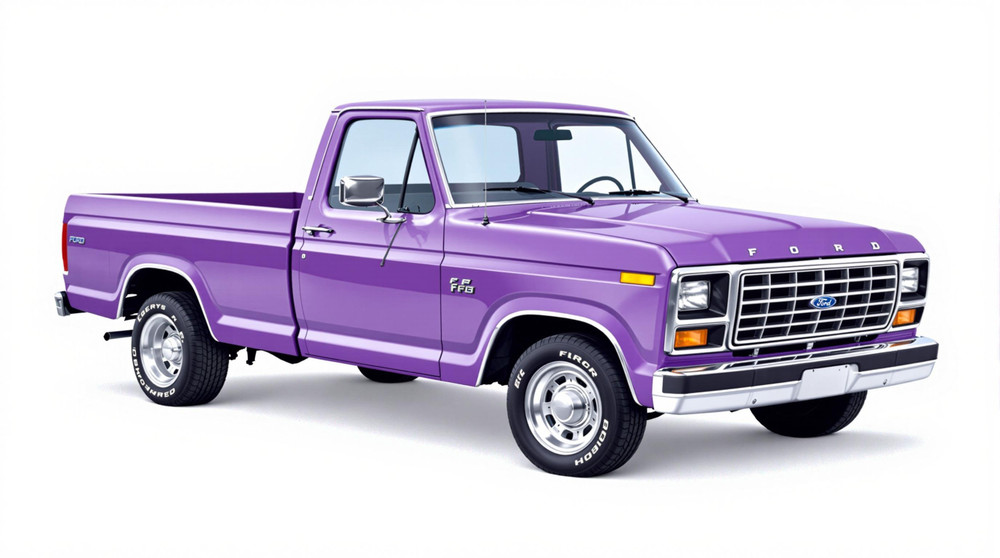
Image of 1982 Ford F-100, Note: These illustrations use artistic license and may differ from actual historical models.
Performance Metrics
Fundamental Metrics
Emotional Appeal
MMP Rating
| Engine Specifications | |
|---|---|
| Engine: | 4.9L 300 CID I6, 5.0L 302 CID V8, 5.8L 351 CID V8 |
| Displacement: | 300-351 CID |
| Horsepower: | 120-210 HP |
| Torque: | 223-315 lb-ft |
| Compression Ratio: | 8.0:1 - 8.4:1 |
| Ignition System: | Electronic Ignition |
| Cooling System: | Liquid cooled |
| Performance Specifications | |
| 0-60 Time: | 10-15 seconds |
| 1/4 Mile Time: | 17-20 seconds |
| Top Speed: | 85-100 mph |
| Transmission and Drive | |
| Drive Type: | Rear Wheel Drive |
| Transmission Type: | 3-speed automatic, 4-speed manual |
| Fuel and Efficiency | |
| Fuel System Type: | Carburetor |
| MPG: | 13-16 MPG |
| Dimensions and Brakes | |
| Brakes: | Front Disc / Rear Drum |
| Wheelbase: | 133 inches |
| Weight: | 3,600-4,000 lbs |
Note: Specifications for classic cars are given to the best of our ability, considering the limited and variant data available.
1982 Ford F-100: A Square-Jawed Classic Pickup
The 1982 Ford F-100 looks ready to get to work, and that was exactly the point. With its squared-off body, straightforward controls, and choice of hardworking engines, it represents the practical side of American pickup design at a time when trucks were becoming everyday transportation as well as job-site tools.
Ford introduced the F-Series in 1948, and the F-100 name arrived in 1953 as part of the company’s revised model-naming system. The 1982 truck belongs to the seventh-generation F-Series, launched for 1980 with a new, more angular body. It was built by Ford Motor Company, whose F-Series had become a major force in the American market. In 1982, the F-Series took the title of America’s best-selling vehicle, a milestone that helped establish the pickup as a mainstream choice beyond farms and construction sites.
One small but memorable detail is the blue Ford oval badge, which began appearing prominently on F-Series grilles around this period. It gave the blunt, upright front end a recognizable focal point, while the rest of the truck kept its attention on utility. The F-100 itself was nearing the end of its run: Ford phased out the name in the U.S. after the 1983 model year, with the F-150 taking over as the entry-level half-ton pickup.
Boxy Styling and Useful Choices
The 1982 F-100 wears the clean, geometric look that defined many pickups of the early 1980s. Its broad hood, nearly vertical grille, squared wheel openings, and flat-sided body make it look sturdy without excessive decoration. The design is less rounded than the trucks it replaced, but it is not a modern aerodynamic shape. It is a confident, easy-to-read design with plenty of visual space for work scars, dealer decals, or a two-tone paint scheme.
Ford offered the F-100 in regular-cab and extended SuperCab configurations, with different bed lengths depending on cab and drivetrain. Buyers could choose a Styleside bed, with smooth exterior sides, or a Flareside bed, where the rear fenders sit outside the bed box. Styleside pickups are the more familiar sight today, while a Flareside has a distinctive, old-school profile. Two-wheel drive and four-wheel drive were available, though equipment and combinations varied by configuration.
Trim and option packages ranged from plain work-truck appointments to better-equipped versions with more comfort and exterior brightwork. The cabin was designed for durability: vinyl upholstery and a simple bench seat were common on basic trucks, while cloth trim, upgraded seating, carpeting, and additional convenience features could make a higher-spec example more comfortable. Hard-wearing plastics, a broad dashboard, and large, uncomplicated controls suit the truck’s no-nonsense character. Even a well-equipped F-100 feels like a pickup first, not a luxury car in work boots.
Paint choices varied by year, trim, and factory order, but period F-100s could be found in whites, reds, blues, tans, browns, grays, and metallic shades. Two-tone combinations were especially at home on the angular body. White and red, blue and white, and earthy tan or brown combinations are among the looks many enthusiasts associate with early-1980s Ford trucks.
Engines, Equipment, and Period Technology
Engine availability depended on the truck’s configuration and market. Common gasoline choices included Ford’s 4.9-liter inline-six, often called the 300, and V8s such as the 5.0-liter and 5.8-liter. The 4.9-liter six earned a reputation for durability and low-speed pulling power. V8 options offered a more traditional truck sound and stronger performance, especially when paired with suitable gearing. Some F-Series configurations also offered a diesel engine, but availability varied and should be verified against an individual truck’s build information.
Transmissions included manual and automatic options, again depending on engine and specification. The technology was straightforward by modern standards: carburetion was common, emissions equipment was part of the package, and there were no electronic driver-assistance systems. Depending on the truck, buyers could get power steering, power brakes, air conditioning, cruise control, and a more fully equipped instrument panel. The independent Twin I-Beam front suspension on two-wheel-drive models was a notable Ford engineering feature. It gave the front wheels independent movement while retaining a rugged, truck-oriented layout.
For anyone shopping today, the equipment list matters. Two trucks with the same badge can feel quite different depending on engine, axle ratio, transmission, cab, and whether they are two-wheel or four-wheel drive. A factory data plate, VIN decoding, and a close inspection are more reliable than assuming every 1982 F-100 was equipped alike.
Why the 1982 F-100 Matters
The F-100’s importance is part of a larger story: the American pickup was moving from specialized work equipment toward a more versatile personal vehicle. The seventh-generation F-Series brought a modernized, squared-off shape and a broad range of configurations, allowing buyers to choose a basic hauler or a truck with enough comfort for regular road use.
Ford’s Twin I-Beam suspension became one of the company’s signature truck features on two-wheel-drive models. It was designed to combine a more composed ride than a solid front axle with the durability expected of a pickup. The arrangement was distinctive, though it could require careful attention to alignment and front-end wear as miles accumulated.
The F-100 also sits at an interesting point in the model’s history. It was a familiar half-ton name with decades of heritage behind it, but its final U.S. model years were approaching. When Ford discontinued the F-100 name after 1983, the F-150 became the entry-level half-ton model. That makes the 1982 truck one of the later examples of a long-running badge.
Performance and Driving Feel
There is no single performance figure for every 1982 F-100. Engine, transmission, axle ratio, cab, bed, tires, altitude, and mechanical condition all make a difference. As a broad period-truck estimate, a healthy gasoline-powered example might reach 0 to 60 mph in roughly 12 to 18 seconds. A typical top speed could fall somewhere around 85 to 100 mph, though that is not a recommended cruising target for a four-decade-old pickup. These are general estimates, not factory guarantees for every configuration.
On the road, the F-100 feels substantial and mechanical. The steering is slower than that of a modern pickup, and the truck’s size and solid, work-focused construction are immediately apparent. A six-cylinder model tends to deliver a steady, low-revving pull, while a V8 adds a deeper exhaust note and a more relaxed feel under acceleration. An automatic suits easy cruising; a manual makes the driver more involved and can feel especially satisfying in a basic truck.
Two-wheel-drive models with Twin I-Beam suspension can feel comfortable over ordinary road imperfections, but a worn example may wander, pull, or feel loose over bumps. Four-wheel-drive trucks sit higher and are better suited to rough tracks, but they generally feel heavier and less nimble on pavement. On windy roads, the high-sided body and truck tires reward smooth inputs rather than quick direction changes. It is not a sports pickup, and it does not pretend to be one. Its appeal is the clear view over the hood, the engine’s working rhythm, and the satisfying sense of operating a straightforward machine.
Living With an F-100
Today, a 1982 F-100 can serve as a weekend cruiser, a vintage work truck, a restoration project, or a show-and-shine classic. A sound, mostly original truck can also be used regularly, although many owners reserve the best examples for fair-weather driving. Four-wheel-drive versions are popular with buyers who want a period pickup for light off-road use, while two-wheel-drive trucks often make appealing, simpler street and show builds.
Routine maintenance is generally approachable for an owner with basic mechanical skills. The engine bay is relatively accessible, and many service jobs do not require modern diagnostic equipment. Parts support remains strong for common Ford truck components, though trim pieces, correct interior details, and model-specific body parts can take more searching. Carburetor tuning, ignition service, cooling-system care, brake work, and front-end inspection are all part of keeping an older F-100 dependable.
Age and neglect are the bigger concerns than the design itself. Inspect the cab corners, floor pans, bed, wheel arches, frame, and areas around the windshield for rust or old repairs. Check for worn steering and suspension parts, uneven tire wear, oil leaks, cooling problems, and electrical faults. On trucks with automatic transmissions, test for smooth engagement and shifting. A vehicle that starts easily and drives straight may still need significant work beneath the paint, so a pre-purchase inspection is worthwhile.
F-100 Facts and Common Criticisms
The 1982 F-100 is part of the F-Series family that became America’s best-selling vehicle in that year. That sales achievement belongs to the F-Series as a whole, not specifically to the F-100, and Ford did not publish a simple, widely used production figure for every individual F-100 configuration. As a result, claims about an exact 1982 F-100 production total should be treated cautiously.
A reasonable rough estimate is that U.S. F-100 production for the model year was in the broad neighborhood of 100,000 to 180,000 trucks, but this is an informed estimate rather than a verified factory total. Body style, engine, drivetrain, trim, and condition make some surviving versions much harder to find than the model badge alone suggests. There is no well-established record for a special 1982 F-100 speed or endurance achievement, and its significance is better understood through the success of the wider F-Series.
Common criticisms include modest acceleration, dated cabin ergonomics, fuel consumption that can be high by modern standards, and a ride that depends heavily on suspension condition. The Twin I-Beam setup can be durable, but worn components or poor alignment may cause uneven tire wear and vague steering. Rust is another frequent challenge, especially in regions where roads are salted. These are typical concerns for an older working pickup, not reasons to dismiss a well-maintained example.
Collector Value and Availability
Values vary significantly with condition, originality, rust, engine, drivetrain, and location. As a broad 2026 U.S. market estimate, a project truck may sell for about $3,000 to $8,000. A usable driver in fair-to-good condition might fall around $8,000 to $18,000, while a clean, well-restored, or unusually original example could bring roughly $20,000 to $35,000 or more. Exceptional four-wheel-drive trucks and especially appealing, documented examples may exceed those ranges, while heavily modified or rusty trucks can be worth much less.
The F-100 is not rare in the same way as a limited-production performance car, and parts trucks still appear on the market. However, clean, unmodified examples are increasingly harder to find, especially with desirable combinations of cab, bed, drivetrain, and factory equipment. Prices for vintage pickups rose as classic trucks gained popularity, and good examples continue to attract interest. The market is condition-sensitive, though: well-preserved trucks tend to hold value better than rough projects, and values can vary widely by region.
Before buying, compare completed sales rather than asking prices, confirm the truck’s identity and equipment, and budget for hidden rust and mechanical work. A modestly priced F-100 can become expensive quickly if it needs bodywork, a drivetrain rebuild, or hard-to-find trim.
A Classic Ford With a Working Reputation
The 1982 Ford F-100 combines the square-edged style of the early 1980s with the practical engineering that made the F-Series a fixture on American roads. Its engine choices, simple cabin, flexible body styles, and Twin I-Beam front suspension reflect an era when a pickup could be both a useful tool and a personal vehicle.
It may not be fast or refined by modern standards, but that is part of its character. A good F-100 delivers honest mechanical feel, familiar Ford truck toughness, and a direct connection to the model’s long history. As one of the final U.S. trucks to wear the F-100 name, the 1982 model is more than a handsome old pickup. It is a sturdy chapter in the story of how the American truck became an everyday classic.
1982 Ford F-100 Catalog of Parts
 1982 Ford F-100 Brake Pedal Pad. 4-3/4" wide X 2-1/4" long-CB 111-NBrake Pedal Pad. 4-3/4" wide X 2-1/4" long. Replaces OEM #'s BC3Z2457B, D3TZ2457A, D3TZ2457B. Each
 1982 Ford F-100 Door Seal (Imported). 154" Long-IS-LM 110Door Seal (Imported). 154" Long. Fits right or left, front and rear doors. Each
 1982 Ford F-100 Flocked Window Channel (Imported). Fits left and right side-IS-WC 6600-23Flocked Window Channel (Imported). Fits left and right side. Each
 1982 Ford F-100 Window sweeper kit. Fits 80-87 Ford Bronco and Truck 2 Door Extended/Standard-WC 6600-12This four piece set includes the inner and outer window felt beltline weatherstrips for each door side window. These strips wipe the side windows when the glass is lowered.
Why Choose Metro?
For over 100 years, Metro Moulded Parts has been the pinnacle of quality in classic car restoration parts. Our commitment to precision and authenticity in every component ensures a perfect fit and an OEM-level appearance.
- Expert Craftsmanship & Quality: Each part is a testament to our dedication to reliability and perfection, crafted from original designs and thoroughly tested.
- Advanced Technology: We use cutting-edge techniques to create flawless, long-lasting parts that surpass others in performance.
- SuperSoft Sponge – The Ultimate Door Seal: Not only are our door seals 30% softer than competitors', but they're also guaranteed to never leak. They effectively reduce wind and road noise, enhancing your classic car's comfort and driving experience.
- Proudly American: Our parts are a product of American craftsmanship, made in the USA with a spirit of excellence and heritage.
- Unrivaled Warranty: We back our products with a 30-year industry-leading warranty, a testament to our confidence in their quality.
Join us in preserving the legacy of classic cars with parts that are crafted for perfection, not just made.