
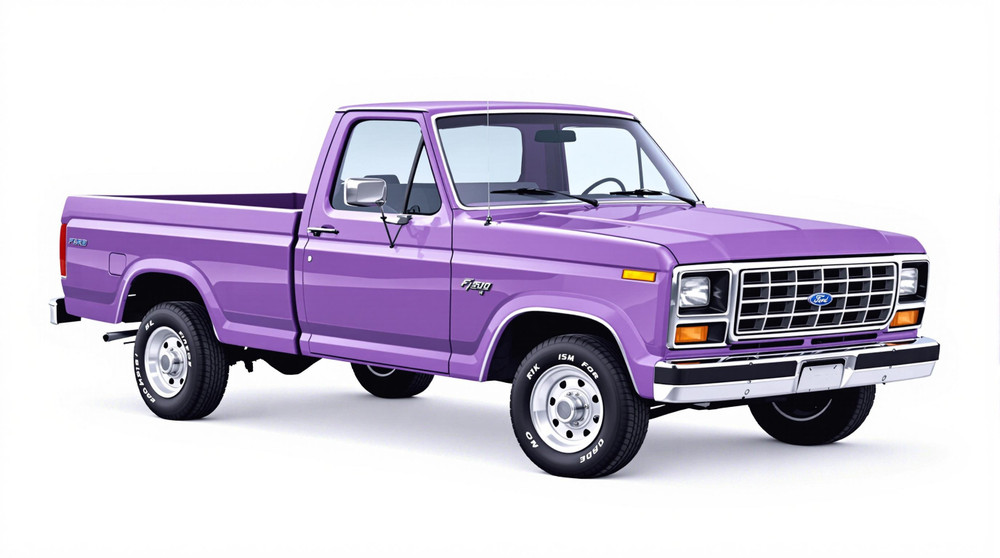
Image of 1982 Ford F-150, Note: These illustrations use artistic license and may differ from actual historical models.
Performance Metrics
Fundamental Metrics
Emotional Appeal
MMP Rating
| Engine Specifications | |
|---|---|
| Engine Options: | 4.9L 300 Cu In I6, 5.0L 302 Cu In V8, 5.8L 351 Cu In V8, 6.6L 400 Cu In V8, 7.5L 460 Cu In V8 |
| Displacement Range: | 300-460 Cu In |
| Horsepower Range: | 120-210 HP (estimated) |
| Torque: | 223-388 lb-ft (estimated) |
| Compression Ratio: | 8.0:1 - 8.4:1 (estimated) |
| Ignition System: | Electronic |
| Cooling System: | Liquid-cooled |
| Performance Specifications | |
| 0-60 Time: | 10-15 seconds (estimated) |
| 1/4 Mile Time: | 17-20 seconds (estimated) |
| Top Speed: | 85-100 mph (estimated) |
| Transmission and Drive | |
| Drive Type: | Rear-wheel drive (RWD), Four-wheel drive (4WD) |
| Transmission Type: | 3-speed automatic, 4-speed manual |
| Fuel and Efficiency | |
| Fuel System Type: | Carburetor |
| MPG: | 10-15 mpg (estimated) |
| Dimensions and Brakes | |
| Brakes: | Front disc, rear drum |
| Wheelbase: | 133.0 in (Regular cab), 155.0 in (SuperCab) |
| Weight: | 4,000-5,000 lbs (estimated) |
Note: Specifications for classic cars are given to the best of our ability, considering the limited and variant data available.
1982 Ford F-150: A Square-Jawed American Classic
The 1982 Ford F-150 made hard work look good. With its broad hood, upright grille, and unmistakable boxy shape, it was built for farm lanes, job sites, and family driveways alike. It belongs to Ford’s seventh-generation F-Series, redesigned for the 1980 model year, and comes from a period when pickup trucks were becoming more comfortable without giving up their work-truck roots.
Ford introduced the F-150 in 1975, placing it between the lighter-duty F-100 and the heavier F-250. The name described a useful middle ground, with more capability than the F-100 while remaining a popular personal-use pickup. The 1982 model arrived amid fuel-economy concerns and changing emissions rules, so efficient engines and practical design mattered more than ever. One notable twist in the F-150’s history is that it would eventually outlast the F-100 in Ford’s domestic lineup. Ford discontinued the F-100 after 1983, leaving the F-150 as its familiar entry-level full-size pickup.
Boxy Styling and Practical Cabin
The 1982 F-150 wears the seventh-generation truck’s clean, squared-off design. Its flat-sided body, tall windshield, straight shoulder line, and large rectangular headlamps give it the sturdy, no-nonsense look that has become a hallmark of classic American pickups. The front end is broad and simple, with a prominent grille and bumper designed to look purposeful rather than decorative. Compared with earlier, more rounded trucks, the shape also made the cab and cargo bed feel roomier and more usable.
Inside, the cabin is straightforward and durable. Depending on trim and equipment, buyers could find vinyl or cloth upholstery, a full-width bench seat, practical door panels, and a plain, easy-to-read instrument cluster. Higher trims added more comfort and finish, while options such as air conditioning, power steering, power brakes, an upgraded radio, and cruise control helped make long drives less tiring. The materials were workmanlike rather than luxurious, but that simplicity is part of the truck’s appeal today. Most controls are easy to understand and accessible without taking your eyes off the road for long.
Ford offered a broad range of paint colors, with choices varying by trim and production details. White, red, blue, silver, and earth-toned shades all suited the truck’s squared-off lines. Two-tone paint was another popular look, especially on better-equipped examples. Original paint and interior combinations can be a real draw for collectors, so it is worth checking a truck’s identification tags and documentation before assuming a color is factory-correct.
Buyers could choose a Regular Cab or a roomier SuperCab, along with Styleside beds with smooth outer sides or the more traditional Flareside bed with separate rear fenders. Bed length and equipment depended on configuration. The Styleside Regular Cab is the classic work-truck image, while the SuperCab offers a useful compromise for owners who want extra passenger or storage space behind the front seat.
Features That Fit the 1980s
The F-150 was not packed with electronics, but it offered useful technology for its era. Available automatic transmissions, four-wheel drive, power steering, power brakes, and comfort options made the truck more adaptable to everyday life. Depending on the configuration, buyers could choose a manual or automatic transmission. Four-wheel-drive versions added traction for snow, mud, and rough tracks, while rear-wheel-drive trucks were common choices for road use and hauling.
Engine availability varied with drivetrain and equipment, but the main gasoline choices included Ford’s 4.9-liter inline-six, 5.0-liter V8, and 5.8-liter V8. The six-cylinder was valued for straightforward service and useful low-speed pulling power. The V8s offered more relaxed acceleration and stronger performance under load. As with any vintage truck, exact specifications can differ by engine, transmission, axle ratio, emissions equipment, and market.
Why the 1982 F-150 Matters
The 1982 F-150 did not invent the pickup truck, but it helped define what a modern full-size pickup could be. The 1980 redesign brought a more squared-off body and a cabin shaped around improved practicality. At the same time, Ford kept the F-Series’ core strengths: a body-on-frame construction, a range of work-focused configurations, and a choice of engines and drivetrains suited to different buyers.
What set the F-150 apart from many contemporaries was its breadth of appeal. A basic model could serve as a dependable work tool, while a well-optioned truck could handle commuting, family use, and towing. Its combination of utility and everyday comfort helped cement the full-size pickup as a personal vehicle, not just a piece of commercial equipment. The F-Series went on to become a fixture of the American market, and the 1982 model represents an important chapter in that long-running success.
Performance, Ride, and Road Manners
There is no single performance figure for every 1982 F-150. Engine, transmission, axle gearing, tire size, body style, and load all make a difference. As a broad estimate, many examples reach 0 to 60 mph in roughly 12 to 18 seconds, with six-cylinder trucks generally slower and V8 versions generally quicker. Top speed is commonly in the neighborhood of 85 to 95 mph, though condition and gearing can shift that range. These are period-style estimates, not a guarantee for a specific truck, and an old pickup should never be pushed to its limits simply to test a number.
On the road, the F-150 feels substantial and mechanical. The steering is slower and less precise than that of a modern truck, and the suspension is tuned to carry weight rather than deliver sports-car cornering. A properly maintained truck can handle ordinary roads comfortably, but sharp bumps may send a firm jolt through the cabin, especially when the bed is empty. On winding roads, its size, body lean, and vintage tires call for measured inputs. Crosswinds and passing trucks can also be noticeable.
The driving experience is a big part of the charm. The engine’s low, steady rumble, the feel of a large steering wheel in your hands, and the deliberate shifts of a manual or older automatic make the truck feel connected and uncomplicated. A V8 adds a deeper note and stronger response, while the inline-six has a more modest sound and a reputation for being easy to live with. In either case, this is a truck to enjoy at a relaxed pace.
Living With a 1982 Ford Truck
Today, owners use 1982 F-150s as weekend drivers, farm and property trucks, restoration projects, show vehicles, and occasional daily transportation. A clean, dependable example can still handle light hauling, but age matters more than the original brochure promises. It is sensible to treat an unrestored truck as a classic first and a workhorse second, particularly if its frame, suspension, or drivetrain condition is unknown.
Routine maintenance is generally approachable for an owner with basic mechanical skills. The engines and systems are largely mechanical, and many repairs do not require specialized diagnostic equipment. Parts support remains good for common service items and popular restoration components, although trim pieces, original interior details, and model-specific items can take more searching. Before buying, inspect the frame, cab mounts, floor pans, rocker panels, bed, and wheel arches for rust. Also check steering and suspension wear, brake condition, cooling-system health, carburetor operation, and transmission behavior.
Reliability depends heavily on care and condition. A well-maintained inline-six or V8 can be durable, but decades of heat, corrosion, deferred service, and improvised repairs take their toll. Pay close attention to old wiring, fuel lines, vacuum hoses, and cooling components. A pre-purchase inspection by a mechanic familiar with older Ford trucks can help uncover problems that a polished exterior might hide.
F-150 Trivia and Common Criticisms
The F-150’s biggest claim to fame is part of a much larger story: Ford’s F-Series became one of America’s most successful and enduring truck lines. The 1982 model itself is not generally known for a unique land-speed record or a special endurance achievement. Its significance lies in its everyday reach and its place in the evolution of the full-size pickup.
There is no single celebrity-owned 1982 F-150 or rare edition that defines the model. Instead, rarity usually comes down to configuration and condition. A well-preserved four-wheel-drive truck, a desirable cab and bed combination, unusual factory equipment, or an authentic special trim can be harder to find than an ordinary two-wheel-drive work truck. Documentation and original parts can make a big difference to enthusiasts.
Common criticisms are familiar to anyone who has driven an older pickup: fuel economy is modest by modern standards, the ride can be firm, and steering and braking feel less refined than in a current truck. Rust and wear can also turn an inexpensive project into a costly restoration. Those drawbacks are balanced by mechanical simplicity, strong parts support, and a driving character that newer trucks often cannot replicate.
1982 F-150 Values and Collector Appeal
The 1982 F-150 is not rare in the same way as a limited-production sports car, and there is no readily available, universally accepted production total for every 1982 F-150 configuration. A reasonable broad estimate is that Ford sold roughly 150,000 to 200,000 F-150s in the United States for the model year, but that is an informed estimate rather than a confirmed factory production figure. The wider F-Series total was higher because it included other models and configurations.
In the current collector market, condition, originality, drivetrain, and location drive value. As a general U.S. private-sale guide, a rough project might bring about $2,000 to $6,000. A usable driver commonly falls around $6,000 to $15,000, while a clean, well-preserved example can reach roughly $15,000 to $30,000. Exceptional restorations or especially desirable four-wheel-drive configurations may sell for more, sometimes above $30,000. These are broad estimates, not appraisals, and asking prices can differ substantially from completed-sale prices.
Interest in classic pickups has supported values for clean examples, particularly original trucks and well-executed restorations. That does not mean every 1982 F-150 is steadily appreciating. Ordinary, worn trucks remain affordable, and restoration costs can exceed the finished vehicle’s market value. The strongest long-term prospects belong to trucks with sound structure, documented history, desirable equipment, and restrained restoration work.
The Lasting Appeal of the 1982 F-150
The 1982 Ford F-150 brings together durable construction, useful configurations, straightforward mechanicals, and unmistakable period styling. It helped carry Ford’s full-size truck into a new era, when pickups were increasingly expected to serve as both work equipment and everyday transportation. Today, it remains approachable to maintain, enjoyable to drive, and increasingly appreciated for its honest, square-jawed character.
It may not be fast, quiet, or polished by modern standards, but the 1982 F-150 has something those comparisons miss: a direct connection between driver, machine, and road. That is why this classic Ford still earns a place in driveways, workshops, and truck shows.
1982 Ford F-150 Catalog of Parts
 1982 Ford F-150 Brake Pedal Pad. 4-3/4" wide X 2-1/4" long-CB 111-NBrake Pedal Pad. 4-3/4" wide X 2-1/4" long. Replaces OEM #'s BC3Z2457B, D3TZ2457A, D3TZ2457B. Each
 1982 Ford F-150 Door Seal (Imported). 154" Long-IS-LM 110Door Seal (Imported). 154" Long. Fits right or left, front and rear doors. Each
 1982 Ford F-150 Flocked Window Channel (Imported). Fits left and right side-IS-WC 6600-23Flocked Window Channel (Imported). Fits left and right side. Each
 1982 Ford F-150 Window sweeper kit. Fits 80-87 Ford Bronco and Truck 2 Door Extended/Standard-WC 6600-12This four piece set includes the inner and outer window felt beltline weatherstrips for each door side window. These strips wipe the side windows when the glass is lowered.
Why Choose Metro?
For over 100 years, Metro Moulded Parts has been the pinnacle of quality in classic car restoration parts. Our commitment to precision and authenticity in every component ensures a perfect fit and an OEM-level appearance.
- Expert Craftsmanship & Quality: Each part is a testament to our dedication to reliability and perfection, crafted from original designs and thoroughly tested.
- Advanced Technology: We use cutting-edge techniques to create flawless, long-lasting parts that surpass others in performance.
- SuperSoft Sponge – The Ultimate Door Seal: Not only are our door seals 30% softer than competitors', but they're also guaranteed to never leak. They effectively reduce wind and road noise, enhancing your classic car's comfort and driving experience.
- Proudly American: Our parts are a product of American craftsmanship, made in the USA with a spirit of excellence and heritage.
- Unrivaled Warranty: We back our products with a 30-year industry-leading warranty, a testament to our confidence in their quality.
Join us in preserving the legacy of classic cars with parts that are crafted for perfection, not just made.