
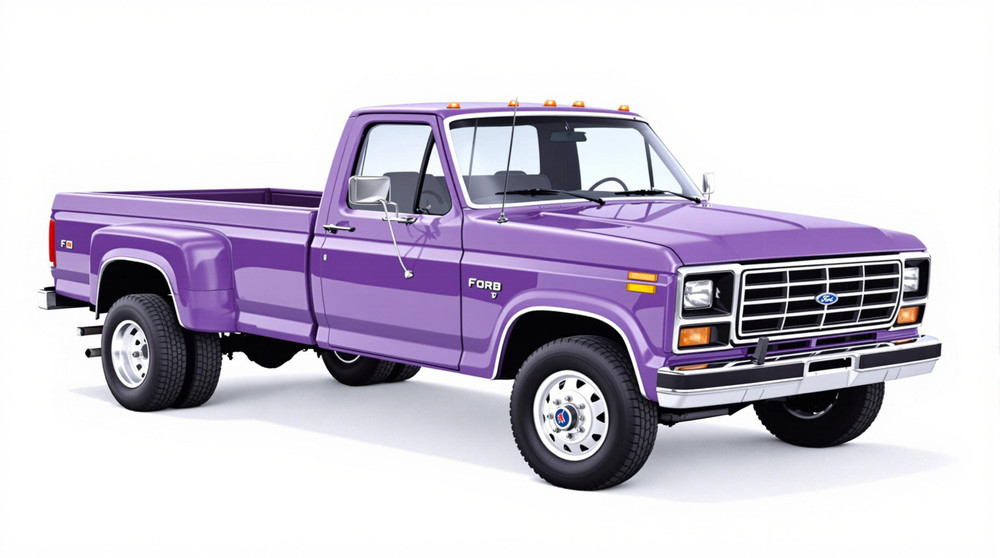
Image of 1982 Ford F-350, Note: These illustrations use artistic license and may differ from actual historical models.
Performance Metrics
Fundamental Metrics
Emotional Appeal
MMP Rating
| Engine Specifications | |
|---|---|
| Engine Options: | 4.9L I6, 5.8L V8, 6.6L V8, 7.5L V8 |
| Displacement Range: | 4.9L - 7.5L |
| Horsepower Range: | 120-210 HP |
| Torque: | 220-315 lb-ft |
| Compression Ratio: | 8.0:1 - 8.4:1 |
| Ignition System: | Distributor ignition |
| Cooling System: | Liquid cooled |
| Performance Specifications | |
| 0-60 Time: | 10-15 seconds |
| 1/4 Mile Time: | 17-22 seconds |
| Top Speed: | 85-95 mph |
| Transmission and Drive | |
| Drive Type: | Rear-wheel drive (RWD) |
| Transmission Type: | 3-speed automatic, 4-speed manual |
| Fuel and Efficiency | |
| Fuel System Type: | Carburetor |
| MPG: | 10-15 mpg |
| Dimensions and Brakes | |
| Brakes: | Front disc / Rear drum |
| Wheelbase: | 133-155 inches |
| Weight: | 4,500-5,500 lbs |
Note: Specifications for classic cars are given to the best of our ability, considering the limited and variant data available.
1982 Ford F-350: A Heavy-Duty Classic Built to Work
The 1982 Ford F-350 was less interested in making a grand entrance than in getting the job done. Tall, square-shouldered and built around a stout heavy-duty chassis, it belonged to Ford’s seventh-generation F-Series, the redesigned truck family introduced for 1980. Ford Motor Company offered the F-350 as a step up from lighter pickups, aimed at contractors, farmers, fleets and anyone who needed a truck capable of handling serious work.
Its historical moment was one of transition. The American pickup was becoming more comfortable and better equipped, but the F-350 remained a practical machine first. One small detail makes the 1982 model especially memorable to Ford enthusiasts: it was the first F-Series year to wear Ford’s familiar blue oval badge on the grille, replacing the large FORD lettering used on earlier trucks.
There is a useful distinction when discussing the F-350’s history. Ford published broad F-Series production and sales figures, but exact production totals for every F-350 body, engine and trim combination are difficult to pin down. That leaves plenty of room for surviving trucks to have their own stories, especially work-worn examples that spent decades earning their keep.
Square Styling, Practical Comfort
The 1982 F-350 wore the clean, angular look that defined Ford’s early-1980s trucks. Its broad grille, rectangular headlamps, upright windshield and flat-sided body gave it a purposeful stance. The front end looked substantial without being ornate, while the high beltline and long hood reinforced the impression that this was a truck designed for hard use. Depending on equipment and body configuration, details such as bright trim, wheel covers and two-tone paint could add a more polished appearance.
Ford offered the F-350 in several forms, including regular-cab pickups, extended SuperCab models and chassis-cab configurations intended for commercial bodies. Pickup beds could be ordered in different styles, while chassis-cab trucks could be fitted with utility, stake, service or other specialized bodies. Trim and availability varied, but the basic personality stayed the same: work-ready underpinnings with a range of comfort and appearance choices. For many buyers, a regular-cab truck with a long bed became the classic F-350 silhouette.
Inside, the cabin was straightforward and durable rather than luxurious. Hard-wearing vinyl was a natural choice for a truck expected to see muddy boots and tools, while cloth seating, carpeting and upgraded trim were available on better-equipped versions. The dashboard was upright and easy to read, with large controls that could be operated without much fuss. An XLT or Lariat-equipped truck could feel considerably more welcoming than a basic fleet model, but even the nicer versions remained recognizably work trucks.
Color choices depended on trim and ordering details. White, red, blue, silver and tan shades were common sights, with two-tone combinations adding extra visual interest. White was a particularly practical fleet and farm choice, while bright red and blue gave privately owned trucks a more personal look. Factory color availability could vary by region and production timing, so a truck’s original paint code is the best guide to its exact finish.
1982 F-350 Engineering and Equipment
The F-350’s appeal came from its substantial frame, heavy-duty suspension and components selected for carrying and towing. The precise payload and towing capacity depended on the engine, axle ratio, transmission, cab, wheelbase and other equipment. As with any vintage truck, it is better to check the original door certification label and factory documentation than rely on a single headline capacity figure.
Engine offerings varied with configuration and market. Common gasoline choices included Ford’s 4.9-liter inline-six and V8 engines, with the 7.5-liter 460-cubic-inch V8 available in appropriate heavy-duty configurations. Transmission choices also depended on the build, with manual and automatic options available. Four-wheel drive was offered on suitable configurations, while two-wheel-drive models were common in commercial and regional service.
Buyers could equip the truck with features that made a long workday easier, including power steering, power brakes, air conditioning, cruise control and upgraded radios. These were meaningful conveniences in a heavy truck, especially for owners who used it on the highway as well as around a jobsite. The available equipment was not modern by today’s standards, but the F-350 offered a useful balance of straightforward mechanical systems and then-current comfort options.
One engine detail is worth noting for diesel fans: Ford’s 6.9-liter International Harvester-built diesel arrived in the F-Series for the 1983 model year, not the 1982 model year. A genuine 1982 F-350 should therefore not be described as a factory 6.9 diesel truck.
Why the Seventh-Generation F-Series Matters
The 1980 redesign brought a more angular, modern look to the F-Series while preserving its traditional body-on-frame construction and work-truck character. Ford refined the truck’s packaging and equipment choices for a market in which buyers increasingly expected a pickup to serve as transportation as well as a tool. The F-350 sat at the heavy-duty end of that range, giving buyers a factory-built platform for demanding payloads and commercial upfits.
What set the F-350 apart from lighter pickups was not a single styling trick or high-tech gadget. It was the combination of a heavy-duty chassis, a broad range of configurations and the ability to be ordered for very different jobs. One might leave the factory as a pickup for a ranch, while another became a utility truck or a platform for a specialized commercial body. That flexibility helped establish the F-Series formula that still defines Ford’s truck lineup: one family of vehicles serving personal, commercial and fleet customers.
The 1982 F-350 is also part of the long-running story of Ford’s full-size trucks becoming a dominant presence in American work and everyday life. It did not introduce a revolutionary new technology, but it helped make the heavy-duty pickup a more versatile ownership proposition. Its influence is visible in the modern expectation that a truck can be configured for a precise task while still offering a reasonable level of comfort.
Performance and Road Manners
Exact performance figures for a 1982 F-350 are hard to define because the truck could be ordered with different engines, transmissions, axle ratios, tires and body styles. Period road tests were not always conducted on heavy-duty models, and surviving trucks may have been modified over the years. As a broad estimate, a gasoline-powered F-350 might reach 0 to 60 mph in roughly 14 to 20 seconds, with a top speed in the neighborhood of 85 to 95 mph. Those figures are approximate, not a guaranteed factory specification, and a loaded truck or one geared for towing could be slower.
Acceleration was never the point. A 460-powered truck could feel strong when pulling away with a load, while the inline-six favored steady, patient work over quick sprints. The engine note was part of the experience: a six-cylinder’s purposeful mechanical hum or the deeper, more pronounced rumble of a big V8 coming through the cab. Under hard acceleration, wind noise, tire noise and the sounds of the drivetrain reminded the driver that this was a working vehicle, not a modern luxury pickup.
On rough roads, the heavy-duty suspension could feel firm, especially when the truck was empty. Add cargo or a trailer and the ride became more settled, because the springs were designed to work under load. A tall body and substantial weight called for measured steering inputs on winding roads, and crosswinds could be noticeable. Two-wheel-drive and four-wheel-drive versions also had different front-end designs and road manners, so the exact feel varies from truck to truck.
From behind the wheel, the F-350 rewards anticipation. Its size, brakes and steering ask the driver to plan ahead, particularly in traffic or on tight roads. In return, it offers a clear view over the hood, a commanding seating position and the reassuring sense of sitting in a truck built with a job in mind.
Living With a 1982 Ford F-350
These trucks commonly served as farm pickups, contractor vehicles, tow rigs, service bodies and fleet transports. Today, many continue to work, while others have been restored as show trucks, used for vintage-truck gatherings or enjoyed as occasional drivers. A clean, original example can attract attention, but a well-kept work truck has its own appeal, particularly when its equipment tells a clear story about how it was used.
Mechanical simplicity is one of the F-350’s strongest ownership advantages. Many routine jobs are accessible to a capable home mechanic, and the truck’s long production lineage means that maintenance knowledge and replacement parts are generally easier to find than for a rare, low-volume classic. The large engine bay can make some repairs less cramped than they would be on a modern vehicle.
That does not mean every example is an easy restoration. Rust deserves close attention, particularly around the cab, floor, bed, wheel openings, frame and body mounts. Buyers should also inspect the suspension, steering, brakes, cooling system and transmission, then check for signs of hard towing or neglected maintenance. A truck that has spent decades working may have sound mechanical bones but tired bodywork, wiring or interior parts. On a four-wheel-drive model, the transfer case and front driveline deserve a thorough inspection.
As with any 40-plus-year-old vehicle, parts availability is not the same as parts condition. Some service items are straightforward to source, while trim pieces, correct interior components and model-specific body details may take patience. A truck with a complete interior and documented history is often a better buy than a cheaper project missing hard-to-find pieces.
F-350 Facts and Common Myths
The blue oval grille badge makes the 1982 model a small but recognizable milestone in the F-Series timeline. It is an easy detail to spot at a show, and it helps distinguish the truck from earlier seventh-generation examples with FORD lettering across the grille.
There is no widely recognized speed, endurance or production record associated specifically with the 1982 F-350. Its achievement was more practical: serving as a dependable platform across a huge range of jobs. Nor is there a well-documented celebrity connection that defines the model. Its fame comes from everyday use rather than a single movie appearance or famous owner.
Common criticisms are familiar to anyone who has driven a vintage heavy-duty pickup. The ride can be stiff when unloaded, fuel consumption from a large gasoline V8 can be substantial, and the tall, heavy truck feels less nimble than a modern pickup. Rust and age-related electrical or rubber-component problems can also complicate ownership. Those drawbacks are balanced by a straightforward layout, durable construction and a mechanical character that newer trucks often filter out.
Collector Value and Market Outlook
Values vary widely with condition, originality, drivetrain, cab style, trim and region. As a broad 2026 estimate in the United States, a running project or rough driver might sell for about $2,000 to $7,000. A solid, usable truck could fall around $8,000 to $20,000, while a very clean, restored or unusually well-equipped example may reach roughly $25,000 to $45,000 or more. Exceptional restorations and especially desirable configurations can exceed that range, but they are not the typical sale.
There is no dependable public production total for the 1982 F-350 alone. For a rough sense of scale, a reasonable estimate is that approximately 25,000 to 45,000 F-350s were built for the model year in North America. Treat that as an informed estimate rather than an official Ford figure. The number of surviving examples in original, well-preserved condition is much smaller, particularly for unusual combinations of cab, drivetrain, trim and factory equipment.
The market has generally favored clean, original trucks and carefully executed restorations. Interest in vintage pickups has lifted values for many desirable examples, but ordinary work trucks remain sensitive to condition and local demand. Appreciation is strongest for rust-free, documented trucks with original equipment. A heavily modified or incomplete example may be harder to sell, even if it has plenty of mechanical potential. In short, condition and authenticity matter more than simply being a one-year model.
The 1982 F-350’s Lasting Appeal
The 1982 Ford F-350 combines the no-nonsense character of a classic work truck with the flexibility that made the F-Series a fixture of American roads. Its square styling, heavy-duty construction and broad range of body and equipment choices tell the story of a vehicle designed to earn its place rather than pose for photographs.
For collectors, it offers a direct link to an era when trucks were increasingly comfortable but still proudly mechanical. For owners, it remains a repairable, adaptable machine with a distinctive presence. A 1982 F-350 may not hurry, pamper or hide its age, but give it a job and it makes a persuasive case for why the classic Ford work truck still matters.
1982 Ford F-350 Catalog of Parts
 1982 Ford F-350 Brake Pedal Pad. 4-3/4" wide X 2-1/4" long-CB 111-NBrake Pedal Pad. 4-3/4" wide X 2-1/4" long. Replaces OEM #'s BC3Z2457B, D3TZ2457A, D3TZ2457B. Each
 1982 Ford F-350 Door Seal (Imported). 154" Long-IS-LM 110Door Seal (Imported). 154" Long. Fits right or left, front and rear doors. Each
 1982 Ford F-350 Flocked Window Channel (Imported). Fits left and right side-IS-WC 6600-23Flocked Window Channel (Imported). Fits left and right side. Each
 1982 Ford F-350 Window sweeper kit. Fits 80-87 Ford Bronco and Truck 2 Door Extended/Standard-WC 6600-12This four piece set includes the inner and outer window felt beltline weatherstrips for each door side window. These strips wipe the side windows when the glass is lowered.
Why Choose Metro?
For over 100 years, Metro Moulded Parts has been the pinnacle of quality in classic car restoration parts. Our commitment to precision and authenticity in every component ensures a perfect fit and an OEM-level appearance.
- Expert Craftsmanship & Quality: Each part is a testament to our dedication to reliability and perfection, crafted from original designs and thoroughly tested.
- Advanced Technology: We use cutting-edge techniques to create flawless, long-lasting parts that surpass others in performance.
- SuperSoft Sponge – The Ultimate Door Seal: Not only are our door seals 30% softer than competitors', but they're also guaranteed to never leak. They effectively reduce wind and road noise, enhancing your classic car's comfort and driving experience.
- Proudly American: Our parts are a product of American craftsmanship, made in the USA with a spirit of excellence and heritage.
- Unrivaled Warranty: We back our products with a 30-year industry-leading warranty, a testament to our confidence in their quality.
Join us in preserving the legacy of classic cars with parts that are crafted for perfection, not just made.