
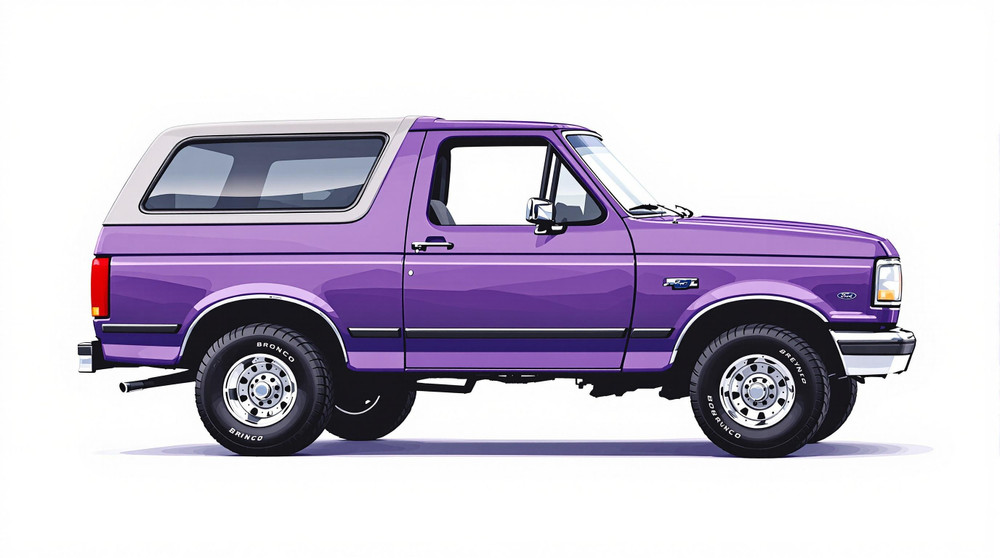
Image of 1990 Ford Bronco, Note: These illustrations use artistic license and may differ from actual historical models.
Performance Metrics
Fundamental Metrics
Emotional Appeal
MMP Rating
| Engine Specifications | |
|---|---|
| Engine Options: | 4.9L I6, 5.0L V8, 5.8L V8 |
| Displacement Range: | 4.9L - 5.8L |
| Horsepower Range: | 145-210 hp |
| Torque: | 265-325 lb-ft |
| Compression Ratio: | 8.8:1 - 9.0:1 |
| Ignition System: | Electronic |
| Cooling System: | Liquid-cooled |
| Performance Specifications | |
| 0-60 Time: | 10-12 seconds |
| 1/4 Mile Time: | 17-18 seconds |
| Top Speed: | 100-105 mph |
| Transmission and Drive | |
| Drive Type: | Rear-wheel drive (RWD) or Four-wheel drive (4WD) |
| Transmission Type: | 4-speed automatic or 5-speed manual |
| Fuel and Efficiency | |
| Fuel System Type: | Fuel injection |
| MPG: | 12-15 mpg |
| Dimensions and Brakes | |
| Brakes: | Front disc, rear drum |
| Wheelbase: | 104.7 inches |
| Weight: | 4,500-5,000 lbs |
Note: Specifications for classic cars are given to the best of our ability, considering the limited and variant data available.
1990 Ford Bronco: The Full-Size SUV With a Removable Roof
The 1990 Ford Bronco could haul a family, crawl down a muddy trail, and turn heads simply by taking its roof off. Built by Ford in the United States, this full-size, two-door 4x4 belonged to the Bronco’s fourth generation, produced from 1987 through 1991. It blended the rugged underpinnings of Ford’s F-Series pickup with the enclosed cabin and versatility of an SUV.
By 1990, the Bronco was part of a growing shift toward trucks that could serve as everyday transportation as well as work and recreation vehicles. Its biggest rival was Chevrolet’s K5 Blazer, with Dodge’s Ramcharger also competing for buyers. One detail that still defines the Bronco is its removable fiberglass hardtop. Unlike most modern SUVs, the 1990 model could be transformed into an open-air truck, with the rear glass lowering into the tailgate before the top was removed.
Square-Jawed Styling, Built for the Trail
The fourth-generation Bronco retained a traditional, upright shape but looked more modern than earlier models. Its broad hood, squared-off fenders, prominent grille, and large windows gave it a confident, truck-based stance. Ford revised the front styling for this generation, including more aerodynamic headlamps and a smoother-looking grille, while keeping the proportions unmistakably Bronco.
It came in one basic body style: a two-door, full-size SUV with a short wheelbase. There was no four-door version, and the removable rear hardtop was a defining part of the design. The tailgate’s retractable rear window was both practical and distinctive, although its motor, wiring, and seals can require attention on surviving examples.
Buyers could choose among trim levels such as the entry-oriented Custom, the better-equipped XLT, and the upscale Eddie Bauer model. Eddie Bauer versions are especially recognizable for their two-tone paint and more comfort-focused equipment. Available colors varied by trim and year, but the palette included classic truck shades such as white, black, red, blue, silver, and tan. White and two-tone Eddie Bauer combinations are among the looks most often associated with the period.
A Work-Truck Cabin With Useful Technology
Inside, the Bronco prioritized durability and visibility over luxury-car polish. The dashboard and door panels used hard-wearing plastics, while cloth upholstery was common and vinyl could be found on more utilitarian versions. Higher trims could add upgraded seating, carpeting, air conditioning, power accessories, and cruise control. The cabin was roomy for two-door SUV, though rear-seat access could be awkward compared with a four-door vehicle.
Its technology was appropriate for a truck from 1990: electronic fuel injection, power steering, power brakes, and available automatic transmissions made it much easier to live with than an older, carbureted 4x4. Rear-wheel anti-lock braking was also part of the period’s move toward improved braking control. Equipment varied by trim and option package, so buyers restoring one should check the original door-jamb information and build documentation rather than assume every Bronco had the same features.
Three Engines and Proper 4x4 Hardware
Ford offered three familiar engines. The 4.9-liter inline-six, also known as the 300, was valued for low-speed pulling power and straightforward service. V8 choices included a 5.0-liter and a 5.8-liter. Output depended on engine and configuration, but approximate figures were around 150 horsepower for the six, 185 horsepower for the 5.0-liter V8, and 210 horsepower for the 5.8-liter V8.
Four-wheel drive and a transfer case made the Bronco a genuine off-road machine, not just a tall station wagon. Transmission availability depended on engine and equipment, with manual and automatic options offered across the range. Many examples have since been modified, so it is worth verifying the drivetrain rather than relying only on badges or seller descriptions.
For a stock truck in good condition, expect roughly 10 to 16 seconds to reach 60 mph, depending on engine, gearing, transmission, and vehicle weight. A healthy V8 example generally feels quicker than the six-cylinder truck, but neither was built for drag-strip duty. Top speed is not a particularly useful measure for a heavy, upright 4x4; a reasonable estimate for an unmodified example is around 90 to 100 mph, though condition and gearing make a major difference.
How the Bronco Drives
The Bronco feels like a classic pickup because, fundamentally, that is what it is: a body-on-frame truck with a solid rear axle and substantial mass. On pavement, the steering is slower and less precise than that of a modern crossover, and the body leans through corners. The high roof and boxy shape also make crosswinds noticeable, especially at highway speeds.
On rough roads, the suspension and tall tires take the sting out of many bumps, but the truck can bounce or feel unsettled over sharp, repeated impacts. On a winding road, smooth inputs suit it best. The payoff comes when the pavement ends. With suitable tires and a properly working 4x4 system, the Bronco handles dirt roads, snow, and moderate trails with confidence.
The engine character is part of the appeal. The inline-six delivers a steady, workmanlike rumble, while the V8s add a deeper exhaust note and stronger passing response. From behind the wheel, the Bronco feels substantial and mechanical. You sit high, see well over traffic, and operate controls that are simple by modern standards. It is an involving drive, not a quiet or especially refined one.
Why the 1990 Bronco Matters
The Bronco helped establish the full-size, two-door 4x4 as a vehicle that could bridge work and recreation. Its truck chassis offered towing and ruggedness, while the enclosed cabin made it more useful for families and everyday errands. That combination helped shape the market for later SUVs, even as competitors and eventually four-door models shifted buyers toward more practical layouts.
What set the 1990 Bronco apart was its blend of familiar Ford truck hardware and a removable roof. The design was less sophisticated than a modern SUV, but it was easy to understand, adaptable, and capable. The removable top also became a signature feature. Ford redesigned the Bronco for 1992, retaining the two-door format but moving away from the easily removable hardtop arrangement.
Everyday Use, Repairs, and Known Issues
Today, a 1990 Bronco can serve as a weekend driver, trail rig, hunting or camping vehicle, or vintage-truck project. A clean, original example can also attract attention at classic-car events. It is less suited to someone seeking modern fuel economy, compact parking dimensions, or a quiet daily commute.
Mechanical repairs are generally approachable for a capable home mechanic, and the truck shares much of its engineering with Ford’s F-Series pickups. Parts for common engine and chassis repairs remain available, though trim pieces, interior components, and some Bronco-specific items can be harder to source. The basic engines are known for durability when maintained, but age matters more than reputation now.
Before buying, inspect the frame and body for rust, particularly around the floor, wheel arches, tailgate, and body mounts. Check the rear window operation and hardtop seals, look for leaks, and test the transfer case and front axle engagement. Worn suspension components, aging fuel and brake lines, electrical faults, and neglected cooling systems are common realities of a 35-year-old truck. A Bronco that has spent years off-road may need more than a clean exterior suggests.
Bronco Trivia and Common Criticisms
The famous 1994 Los Angeles freeway chase involving O.J. Simpson took place in a white fifth-generation Bronco, not a 1990 model. The vehicles are related, but the chase Bronco was a later example. It is an easy model-year mix-up because the fifth-generation truck kept the same basic two-door, removable-top identity.
Another frequent criticism is fuel consumption. With a large engine, four-wheel-drive hardware, and a boxy body, the Bronco is thirsty by modern standards. Owners also point to its wide turning circle, heavy feel, and the potential hassle of maintaining the tailgate glass and removable roof. Those drawbacks are part of the trade-off for a robust, open-air-capable full-size 4x4.
Collector Values and Market Outlook
There is no single dependable production total for every 1990 Bronco configuration, but a reasonable estimate is roughly 50,000 to 60,000 vehicles sold in the United States for the model year. That makes the Bronco far from an ultra-rare collector vehicle. The rarer find is a well-preserved, largely original example with sound bodywork, working equipment, and limited modifications.
As a broad 2026 market estimate, a project or rough-running truck may sell for around $3,000 to $8,000. A usable driver in fair-to-good condition commonly falls in the $8,000 to $20,000 range, while a clean, well-maintained example may bring $20,000 to $30,000 or more. Exceptional restorations and especially desirable configurations can exceed that range, but condition, rust, originality, and documentation matter greatly.
Values for classic Broncos have generally strengthened as buyers rediscover vintage SUVs, though the market is selective. Rust-free, original trucks and quality restorations tend to hold interest better than poorly executed lifts or heavily modified vehicles. The 1990 model is not as coveted as the earliest Broncos, but its combination of updated styling, useful fuel injection, and classic removable-top character gives it a solid place in the collector market.
The 1990 Bronco’s Lasting Appeal
The 1990 Ford Bronco is a genuine old-school 4x4: truck-based, mechanically straightforward, spacious, and capable of changing character when its hardtop comes off. It is not fast, economical, or especially nimble, but it offers the kind of uncomplicated utility that modern SUVs often trade away. For enthusiasts who want a classic Ford with real trail ability and unmistakable presence, the Bronco remains more than a nostalgia piece. It is a working reminder of when an SUV could still feel like a pickup with the sky above it.
1990 Ford Bronco Catalog of Parts
 1990 Ford Bronco Brake Pedal Pad. 4-3/4" wide X 2-1/4" long-CB 111-NBrake Pedal Pad. 4-3/4" wide X 2-1/4" long. Replaces OEM #'s BC3Z2457B, D3TZ2457A, D3TZ2457B. Each
 1990 Ford Bronco Door Seal (Imported). 154" Long-IS-LM 110Door Seal (Imported). 154" Long. Fits right or left, front and rear doors. Each
 1990 Ford Bronco Flocked Window Channel (Imported). Fits left and right side-IS-WC 6600-23Flocked Window Channel (Imported). Fits left and right side. Each
Why Choose Metro?
For over 100 years, Metro Moulded Parts has been the pinnacle of quality in classic car restoration parts. Our commitment to precision and authenticity in every component ensures a perfect fit and an OEM-level appearance.
- Expert Craftsmanship & Quality: Each part is a testament to our dedication to reliability and perfection, crafted from original designs and thoroughly tested.
- Advanced Technology: We use cutting-edge techniques to create flawless, long-lasting parts that surpass others in performance.
- SuperSoft Sponge – The Ultimate Door Seal: Not only are our door seals 30% softer than competitors', but they're also guaranteed to never leak. They effectively reduce wind and road noise, enhancing your classic car's comfort and driving experience.
- Proudly American: Our parts are a product of American craftsmanship, made in the USA with a spirit of excellence and heritage.
- Unrivaled Warranty: We back our products with a 30-year industry-leading warranty, a testament to our confidence in their quality.
Join us in preserving the legacy of classic cars with parts that are crafted for perfection, not just made.