
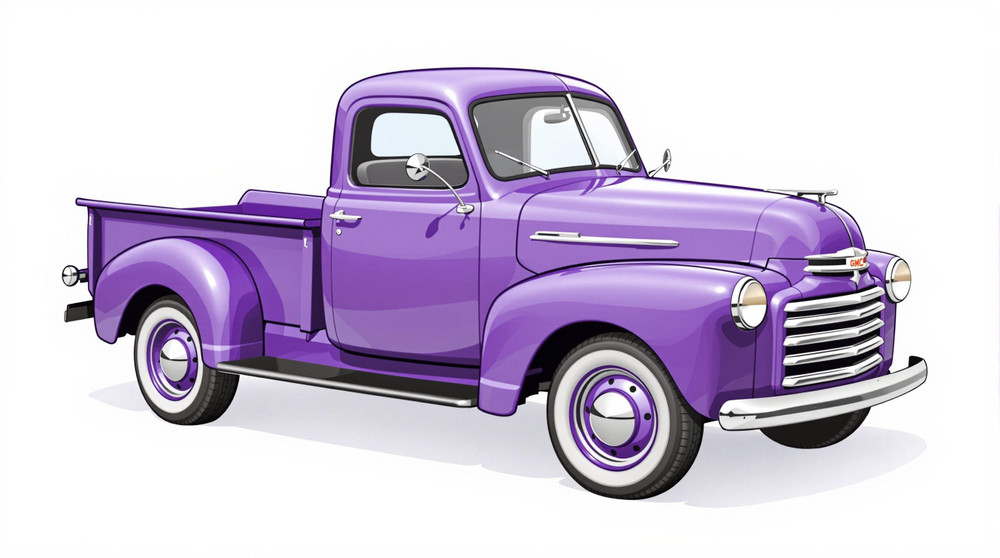
Image of 1946 Gmc Cc102, Note: These illustrations use artistic license and may differ from actual historical models.
Performance Metrics
Fundamental Metrics
Emotional Appeal
MMP Rating
| Engine Specifications | |
|---|---|
| Engine: | Inline 6 |
| Displacement: | 228 cubic inches |
| Horsepower: | Estimated 90-95 hp |
| Torque: | 175 lb-ft |
| Compression Ratio: | Estimated 6.6:1 |
| Ignition System: | Distributor and coil |
| Cooling System: | Liquid-cooled |
| Performance Specifications | |
| 0-60 Time: | Not available due to the age and type of vehicle |
| 1/4 Mile Time: | Not available due to the age and type of vehicle |
| Top Speed: | 70 mph |
| Transmission and Drive | |
| Drive Type: | Rear-wheel drive |
| Transmission Type: | 3-speed manual |
| Fuel and Efficiency | |
| Fuel System Type: | Carburetor |
| MPG: | Estimated 10-15 mpg |
| Dimensions and Brakes | |
| Brakes: | Drum brakes |
| Wheelbase: | 125 inches |
| Weight: | Estimated 3,500 lbs |
Note: Specifications for classic cars are given to the best of our ability, considering the limited and variant data available.
1946 GMC CC-102: A Postwar Workhorse With Art Deco Style
The 1946 GMC CC-102 brings together the rounded, prewar look of an earlier era and the practical optimism of America’s postwar comeback. Built by General Motors Truck and Coach, GMC’s truck division, it was a light-duty pickup designed for farms, tradespeople, small businesses, and everyday hauling. Today, its curved fenders, upright cab, and straightforward mechanicals make it a distinctive survivor from the years just before pickup design changed dramatically.
The CC-102 belongs to GMC’s pre-Advance Design generation. Its basic design dated back to the early 1940s, when wartime production interrupted the normal pace of civilian vehicle development. When civilian truck manufacturing resumed after World War II, buyers could once again order a practical GMC with familiar, proven engineering. One intriguing detail is that the CC-102 is not part of the better-known 1947-and-later Advance Design family. It represents the final chapter of GMC’s earlier rounded-cab trucks, making it a useful marker between prewar styling and the modern postwar pickup.
Art Deco Lines and a Purpose-Built Cab
The CC-102’s exterior is defined by flowing sheet metal rather than the flat panels and squared-off proportions that would become common later. A rounded hood slopes toward a tall, upright grille, while separate bulbous front fenders frame the wheels. The cab sits high and compact behind the engine compartment, and the running boards visually connect the front and rear fenders. Its proportions look substantial without being oversized, giving the truck a sturdy, almost sculptural presence.
Inside, the emphasis is on function. The cab has a painted metal dashboard with a simple instrument cluster, practical controls, and a broad bench seat. Materials were durable and work-focused, not luxurious: painted steel, basic upholstery, and straightforward trim. Compared with a modern pickup, the cabin is narrow and spare, but its uncluttered layout is part of the appeal. Many surviving trucks have replacement seat coverings or updated gauges, so original interior details can vary from example to example.
Technology was conventional for a working truck of its time. The CC-102 used a front-engine, rear-wheel-drive layout, a manual transmission, leaf-spring suspension, and hydraulic brakes. Its straight-six engine was designed for usable low-speed pulling power and serviceability, not high-revving performance. A 1946 truck generally relied on simple mechanical systems that a competent owner or local mechanic could understand and repair without specialized diagnostic equipment.
Paint availability depended on GMC’s ordering practices, body type, and commercial requirements. Period trucks could be supplied in practical solid colors, while fleet buyers might choose colors to match a business. Today, restored examples often wear deep green, red, black, or other traditional truck colors, but those popular restoration choices should not be mistaken for a complete factory color list. The most recognizable configuration is the open pickup with a steel cargo bed. Depending on the chassis and order, related commercial versions could be fitted with different bodies or equipment, such as stake or platform bodies.
Where the CC-102 Fits in GMC History
The CC-102 did not introduce a revolutionary new chassis or a groundbreaking powertrain. Its importance lies in what it represents: a proven GMC design returning to civilian service at a moment when American businesses and households were preparing for a new period of growth. Buyers needed dependable trucks to move building supplies, farm goods, tools, and merchandise. A familiar, repairable GMC answered that need.
It also captures the last phase of an older design language. In 1947, GMC moved into the Advance Design era, with a more modern-looking cab and a fresh visual identity. The CC-102 therefore stands apart from many postwar pickups. Its rounded fenders and upright cab preserve a distinctly prewar character, while its postwar production history gives it a place in the transition back to civilian manufacturing.
Six-Cylinder Power and Vintage Road Manners
A typical CC-102 is powered by GMC’s 228-cubic-inch inline-six, rated at roughly 93 horsepower in period specifications, though engine equipment and published figures can vary by configuration and source. Power goes through a manual transmission to the rear wheels. This is a low-speed working setup: the engine is best understood as a steady, torquey six rather than a source of quick acceleration.
There is no single dependable factory 0-to-60 mph figure for the CC-102, and period trucks were not generally evaluated by modern acceleration standards. As a rough real-world estimate, a healthy, lightly loaded truck may take around 25 to 35 seconds to reach 60 mph, if it can comfortably do so. Top speed is also affected by gearing, tire size, engine condition, and load. A ballpark range of 55 to 65 mph is reasonable, but sustained high-speed cruising is not what this truck was built for.
On the road, expect a deliberate driving experience. The steering is manual, the wheel is large, and the driver feels connected to the front axle and road surface. Leaf springs and a solid axle can make the ride bouncy over rough pavement, particularly when the bed is empty. On winding roads, the truck responds slowly compared with a modern pickup, and its tall stance calls for measured cornering. The straight-six has a steady mechanical note, accompanied by the sounds of the transmission, tires, and working chassis. Driving one is less about speed and more about enjoying the rhythm of an older machine.
Owning and Maintaining a 1946 GMC
Most CC-102s today are used as weekend drivers, show trucks, parade vehicles, or vintage advertising and business displays. Some remain capable of light hauling, but regular heavy work can put extra strain on aged frames, brakes, axles, and engines. The truck’s size and low-speed nature make it best suited to local roads and relaxed outings rather than long stretches of modern highway traffic.
Routine maintenance is approachable for an owner comfortable with older vehicles. Oil changes, ignition service, carburetor work, brake adjustment, and many engine repairs are relatively straightforward. The bigger challenges are often sourcing correct body panels, trim, and model-specific parts, then addressing decades of wear or previous repairs. Before buying, inspect the frame, cab corners, floorboards, bed, and areas around the fenders for rust. Check the braking system carefully, since an old truck that starts and runs well is not necessarily safe to drive.
Parts availability is generally better for common mechanical service items than for rare original trim or sheet metal. A vehicle that has been maintained with compatible parts may be easier to keep on the road than one requiring a strict, factory-correct restoration. For a first-time owner, a running, structurally sound truck is usually a more enjoyable starting point than a low-priced project with extensive corrosion.
CC-102 Trivia and Common Criticisms
The CC-102’s most notable distinction is its timing. It was part of GMC’s return to civilian truck production after wartime manufacturing, and it belongs to the final pre-Advance Design generation. It is not widely associated with a particular speed record, endurance achievement, or celebrity owner. Its historical interest is more everyday than glamorous: trucks like this supported the farms, shops, and small businesses rebuilding their routines after the war.
Exact production figures for the CC-102 specifically are not readily established in commonly available model histories. GMC built trucks in several configurations, and production totals are often reported for broader model families rather than this exact designation. A reasonable, clearly unofficial estimate is that production reached several thousand trucks, but an exact number would require factory records or a verified production ledger. Surviving examples are less common than later Advance Design pickups, especially in original, unmodified condition.
Common criticisms are typical of prewar-era trucks: modest power, slow acceleration, basic comfort, heavy steering, and limited suitability for high-speed traffic. Owners may also find that restoration costs rise quickly when rust repair or hard-to-find original parts are involved. Those limitations are part of the truck’s character, but they matter when deciding whether to buy one as a working vehicle or as a collectible.
Collector Values and Market Outlook
As a broad 2026 U.S. market estimate, a rough project CC-102 might sell for about $5,000 to $12,000, depending heavily on completeness and rust. A running, usable driver could fall around $15,000 to $30,000. A well-restored example may bring roughly $35,000 to $55,000, with exceptional, highly original, or unusually well-documented trucks potentially exceeding that range. These are general estimates, not a formal appraisal, and local markets can differ considerably.
There is no reliable published count of surviving CC-102s, so rarity is best described comparatively: it is a less frequently encountered model than the more familiar 1947-and-later GMC pickups, but it is not necessarily a one-of-a-kind find. Values tend to favor solid, complete trucks with quality restorations and documented history. Over time, interest in prewar-styled pickups has supported good examples, while project vehicles remain sensitive to restoration costs. The market is best described as steady to gradually appreciating for desirable examples, rather than guaranteed rapid growth.
A Distinctive Link Between Two Eras
The 1946 GMC CC-102 is a practical old truck with a history that reaches beyond its workaday specification. Its rounded Art Deco-inspired body, simple six-cylinder engineering, and postwar return to civilian service give it a character all its own. It is not fast, plush, or effortless by modern standards, but it offers a direct connection to the way American trucks were built and used at a pivotal moment in automotive history.
For collectors, restorers, and drivers who value mechanical simplicity and period style, the CC-102 is more than a predecessor to later GMC pickups. It is a rolling piece of the transition from wartime restraint to postwar possibility, and every mile makes that story tangible.
1946 Gmc Cc102 Catalog of Parts
 1946 GMC CC102 Rear Window Seal '42-'66 GM Full Size Trucks With Small Window-VWS 7313-URear Window Seal '42-'66 GM Full Size Trucks With Small Window, Includes Lockstrip, Set of 2.
Why Choose Metro?
For over 100 years, Metro Moulded Parts has been the pinnacle of quality in classic car restoration parts. Our commitment to precision and authenticity in every component ensures a perfect fit and an OEM-level appearance.
- Expert Craftsmanship & Quality: Each part is a testament to our dedication to reliability and perfection, crafted from original designs and thoroughly tested.
- Advanced Technology: We use cutting-edge techniques to create flawless, long-lasting parts that surpass others in performance.
- SuperSoft Sponge – The Ultimate Door Seal: Not only are our door seals 30% softer than competitors', but they're also guaranteed to never leak. They effectively reduce wind and road noise, enhancing your classic car's comfort and driving experience.
- Proudly American: Our parts are a product of American craftsmanship, made in the USA with a spirit of excellence and heritage.
- Unrivaled Warranty: We back our products with a 30-year industry-leading warranty, a testament to our confidence in their quality.
Join us in preserving the legacy of classic cars with parts that are crafted for perfection, not just made.