
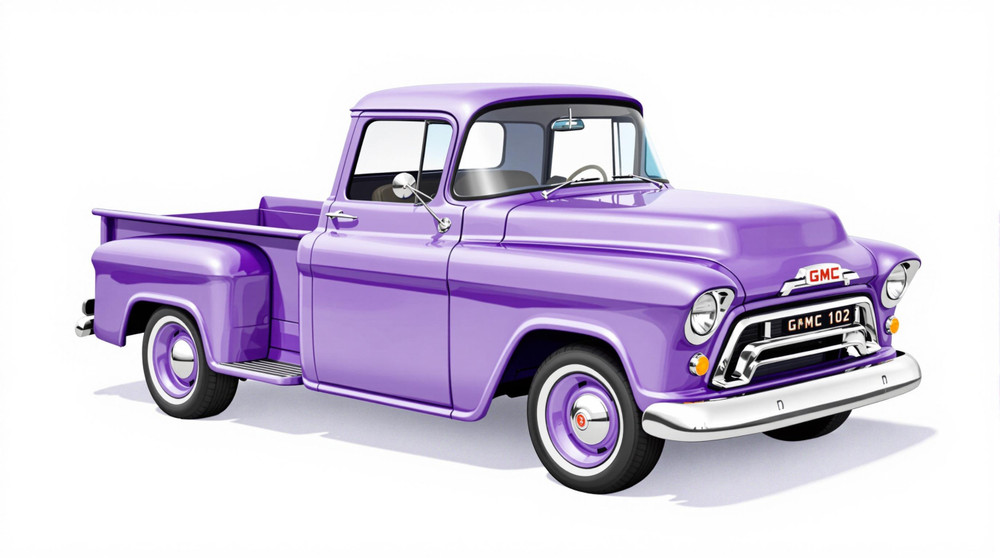
Image of 1956 Gmc Series 102, Note: These illustrations use artistic license and may differ from actual historical models.
Performance Metrics
Fundamental Metrics
Emotional Appeal
MMP Rating
| Engine Specifications | |
|---|---|
| Engine Options: | 248.5 cu in (4.1 L) I6, 270 cu in (4.4 L) I6 |
| Displacement Range: | 248.5 - 270 cu in |
| Horsepower Range: | 125 - 140 hp |
| Torque: | 210 - 240 lb-ft |
| Compression Ratio: | 7.4:1 |
| Ignition System: | Distributor and coil |
| Cooling System: | Liquid-cooled |
| Performance Specifications | |
| 0-60 Time: | Information not available |
| 1/4 Mile Time: | Information not available |
| Top Speed: | 70 - 75 mph |
| Transmission and Drive | |
| Drive Type: | Rear-wheel drive |
| Transmission Type: | 3-speed manual, 4-speed manual |
| Fuel and Efficiency | |
| Fuel System Type: | Carburetor |
| MPG: | 10 - 12 mpg |
| Dimensions and Brakes | |
| Brakes: | Drum brakes |
| Wheelbase: | 114 in (2,896 mm) for short wheelbase, 125.25 in (3,180 mm) for long wheelbase |
| Weight: | 3,400 - 3,800 lbs |
Note: Specifications for classic cars are given to the best of our ability, considering the limited and variant data available.
1956 GMC Series 102: A Classic Task Force Pickup
The 1956 GMC Series 102 brings together the toughness of a working truck and the unmistakable style of postwar American design. Built by General Motors’ GMC truck division, it belongs to the second-generation Task Force family, introduced in 1955 to replace the earlier Advance-Design trucks. Its bold front end, practical cab and sturdy inline-six power made it a useful farm, business and family vehicle, while its distinct GMC identity set it apart from its Chevrolet cousins.
One point of terminology is worth knowing: “Series 102” is commonly used by enthusiasts and sellers to describe a light-duty GMC pickup, but surviving records do not always make it easy to pin down production totals for that exact model designation. For buyers, the truck’s year, body configuration, wheelbase and original equipment are often more useful identifiers than the badge alone.
Task Force Styling and Cab Details
The 1956 GMC has the confident proportions typical of mid-century pickups: a broad hood, upright cab and separate front fenders that give it a solid, purposeful stance. At the front, the wide grille and prominent GMC lettering make the truck easy to distinguish from a contemporary Chevrolet. Hooded headlamps and bright trim add polish without disguising its work-truck roots. From the side, the long hood and simple body lines lead to an open cargo bed framed by rounded fenders.
Inside, the cabin is straightforward and durable. Painted metal surfaces, a broad bench seat and clear, functional gauges put utility ahead of luxury. Depending on how it was ordered and how it has been restored, the upholstery may be vinyl or cloth, with trim and colors varying by specification. The tall seating position gives the driver a commanding view, while the large steering wheel and simple controls reflect an era before power accessories and elaborate dashboards became commonplace.
Period GMC pickups were available in a range of factory colors, including solid hues and two-tone combinations. Red and white, blue and white, and green and white are popular choices among restored examples, though an individual truck’s original paint code is the best guide to authenticity. Options and availability could vary by market and production run.
The Series 102 is most often encountered as a conventional pickup. GMC also offered its light-truck chassis in other working configurations, such as cab-and-chassis and commercial body applications, while pickup buyers could choose different bed and equipment arrangements. The familiar fendered pickup is the most recognizable version today, particularly in restored form.
Engineering for Work, Not Show
The Series 102’s importance lies less in a single revolutionary feature than in how it helped define the modern postwar pickup. The Task Force trucks combined a more contemporary, car-influenced appearance with the frame, payload capability and mechanical simplicity expected of a commercial vehicle. Their styling helped move pickups beyond purely utilitarian transportation and into everyday family and recreational use.
GMC also gave buyers a meaningful alternative to a Chevrolet-badged truck. Although the two divisions shared much of General Motors’ engineering and production infrastructure, GMC was known for its own truck identity and robust inline-six engines. That distinction matters to collectors: the GMC is not simply a Chevrolet with different lettering, even though the trucks share some components and broad design principles.
Equipment was practical for the time. A manual transmission was typical, with transmission and convenience options depending on the truck’s original order. The electrical system was 12-volt, part of the broader move toward more capable electrical equipment in postwar vehicles. Today, the relatively uncomplicated mechanical layout is one of the truck’s biggest advantages for owners who want a classic they can understand and maintain.
GMC 270 Power and Road Manners
Many light-duty GMC pickups of this period used an overhead-valve inline-six, with engine availability and ratings varying by specification. The 248-cubic-inch six is commonly associated with the lighter trucks, while the larger 270-cubic-inch GMC six was a notable option in the range. Period ratings differ by engine and year, but the 270 was generally quoted in the neighborhood of 130 horsepower. Check the engine number and original documentation when evaluating a particular truck, since decades of swaps and rebuilds are common.
There is no single dependable factory 0-to-60-mph figure for every Series 102 configuration. With modest power, a manual gearbox and work-oriented gearing, acceleration is slow by modern standards. A well-running example might reach 60 mph in roughly 20 seconds or more, depending on engine, transmission, axle ratio, tires and load. Top speed is similarly configuration-dependent, but around 65 to 75 mph is a reasonable broad estimate for a healthy truck. Sustained high-speed driving is less comfortable than cruising at moderate road speeds.
On the road, the truck feels substantial and mechanical. The inline-six produces a steady, low-pitched rumble, and the driver works a large steering wheel and a deliberate gearshift rather than simply pointing the truck down the road. The leaf-spring suspension is designed to carry loads, so an empty pickup can hop or feel firm over broken pavement. Add cargo and the ride can settle, though the handling remains that of a tall, solid-axle truck, not a modern SUV. On winding roads, measured inputs are rewarded; sharp corners and crosswinds call for respect.
Living With a 1956 GMC Pickup
Today, Series 102 trucks serve as weekend drivers, farm and ranch runabouts, parade vehicles and show trucks. Some are restored to factory appearance, while others wear period-correct upgrades such as more comfortable seats, improved brakes or modernized engines. Their design also makes them popular candidates for tasteful custom builds, though modifications can affect originality and collector value.
Routine maintenance is generally approachable for an owner with basic mechanical experience. The engine bay is comparatively open, many systems are mechanically simple, and common service tasks do not require the diagnostic equipment used on modern vehicles. Parts support is good for many wear items and restoration pieces, though finding the correct original trim, gauges or model-specific details may take patience. Rust is a major concern: inspect the cab corners, floor, doors, inner and outer fenders, bed, frame and areas around the windshield carefully.
Reliability depends heavily on condition and restoration quality. A well-maintained truck can be dependable for local use, but age brings familiar issues such as tired wiring, leaks, worn steering components, cooling-system problems and brakes that need careful attention. Before regular road use, inspect the entire braking system, tires, fuel lines and electrical system rather than assuming a truck is safe because it starts and drives.
Trivia, Myths and Common Complaints
The GMC’s inline-six heritage is a point of pride among enthusiasts. Its reputation for sturdy, straightforward service helped make GMC a serious truck brand rather than merely a styling alternative. Another appealing detail is the way original work trucks often tell their stories through practical evidence: patched beds, accessory mirrors, dealer-installed equipment and honest wear can reveal how they were used.
There is no widely recognized speed or endurance record associated with the Series 102, and it is not especially tied to a single landmark historical event. Its significance is broader: it represents the rapidly growing role of pickups in postwar American life, from commercial work to personal transportation. Nor is there a dependable, widely documented production total for the exact “102” designation. As a cautious estimate rather than a confirmed factory figure, a specific Series 102 configuration may have been built in the thousands to low tens of thousands, with roughly 10,000 to 20,000 as a very rough guess. That figure should not be treated as an official production count.
Common criticisms are familiar to anyone who has driven a 1950s truck: slow acceleration, heavy steering, limited modern safety equipment, a firm unladen ride and modest highway comfort. The cabin can also feel cramped by current standards. Those drawbacks are part of the honest experience, and they are why a Series 102 is best viewed as a classic vehicle rather than a modern daily driver.
Collector Values and Availability
Values vary widely with rust, originality, mechanical condition and restoration quality. As a broad U.S. market guide, a project truck might sell for about $8,000 to $15,000. A solid driver can fall around $18,000 to $30,000, while a well-restored example may bring approximately $35,000 to $60,000 or more. Exceptional restorations, rare factory equipment or especially desirable configurations can exceed that range. These are general estimates, not a formal appraisal, and local markets can differ substantially.
Good examples are available, but the best trucks are not always easy to find. GMC production was smaller than Chevrolet’s, and trucks with documented history, sound metal and correct GMC components attract particular interest. Prices for well-presented classic pickups rose strongly over the past couple of decades, then became more selective. The market still favors clean, usable trucks, but condition and quality now matter more than simply having a vintage pickup. A sound, mostly original example is often a safer collector choice than a rushed restoration or heavily modified build.
Why the 1956 GMC Series 102 Still Matters
The 1956 GMC Series 102 captures a useful moment in truck history: pickups were becoming more stylish and versatile while retaining the rugged construction that made them dependable tools. Its distinctive GMC face, simple cabin and durable six-cylinder character give it an identity of its own among 1950s trucks. It may not be fast or polished by modern standards, but it offers something more enduring: a direct, hands-on connection to the era when a pickup could work hard all week and still look right parked in front of the house.
1956 Gmc Series 102 Catalog of Parts
 1956 GMC Series 102 Rear Window Seal '42-'66 GM Full Size Trucks With Small Window-VWS 7313-URear Window Seal '42-'66 GM Full Size Trucks With Small Window, Includes Lockstrip, Set of 2.
 1956 GMC Series 102 Rear Window Seal '55-'66 GM Full Size Truck w/ black lockstrip-VWS 7313-VRear Window Seal '55-'66 GM Full Size Truck, Second Series With Large Window. Includes Lockstrip, Set of 2.
 1956 GMC Series 102 Rear Window Seal, 55-66 GM Full Size Truck w/ Chrome Lockstrip-VWS 7313-WRear Window Seal, 55-66 GM Full Size Truck, Second Series With Large Window. Chrome Lockstrip Included, Set Of 2.
Why Choose Metro?
For over 100 years, Metro Moulded Parts has been the pinnacle of quality in classic car restoration parts. Our commitment to precision and authenticity in every component ensures a perfect fit and an OEM-level appearance.
- Expert Craftsmanship & Quality: Each part is a testament to our dedication to reliability and perfection, crafted from original designs and thoroughly tested.
- Advanced Technology: We use cutting-edge techniques to create flawless, long-lasting parts that surpass others in performance.
- SuperSoft Sponge – The Ultimate Door Seal: Not only are our door seals 30% softer than competitors', but they're also guaranteed to never leak. They effectively reduce wind and road noise, enhancing your classic car's comfort and driving experience.
- Proudly American: Our parts are a product of American craftsmanship, made in the USA with a spirit of excellence and heritage.
- Unrivaled Warranty: We back our products with a 30-year industry-leading warranty, a testament to our confidence in their quality.
Join us in preserving the legacy of classic cars with parts that are crafted for perfection, not just made.