
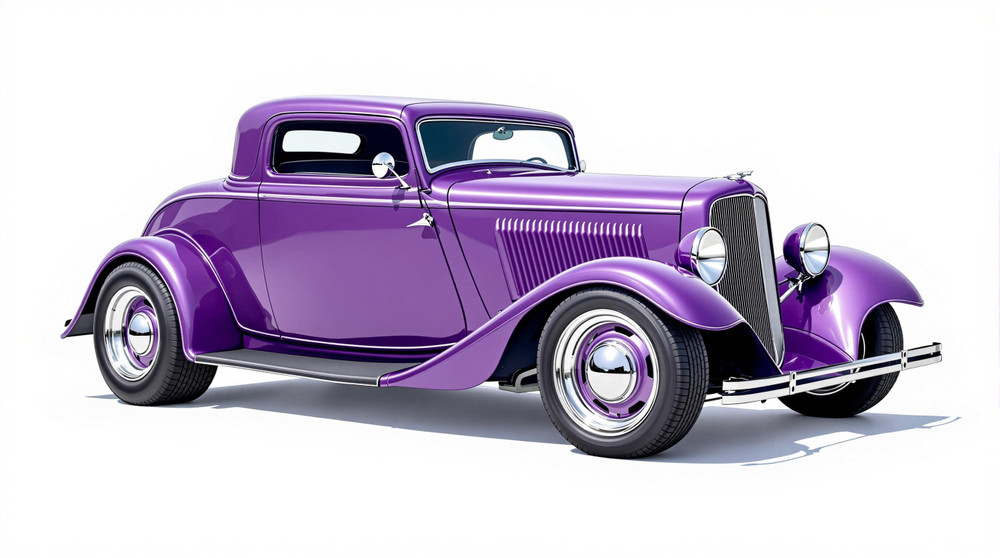
Image of 1932 Horch 780, Note: These illustrations use artistic license and may differ from actual historical models.
Performance Metrics
Fundamental Metrics
Emotional Appeal
MMP Rating
| Engine Specifications | |
|---|---|
| Engine Options: | Straight 8 |
| Displacement Range: | 4.9L |
| Horsepower Range: | Estimated 100-120 HP |
| Torque: | Not available |
| Compression Ratio: | Not available |
| Ignition System: | Distributor and coil |
| Cooling System: | Water-cooled |
| Performance Specifications | |
| 0-60 Time: | Not available |
| 1/4 Mile Time: | Not available |
| Top Speed: | 90 mph |
| Transmission and Drive | |
| Drive Type: | Rear-wheel drive |
| Transmission Type: | Manual |
| Fuel and Efficiency | |
| Fuel System Type: | Carburetor |
| MPG: | Not available |
| Dimensions and Brakes | |
| Brakes: | Drum brakes |
| Wheelbase: | 135 inches |
| Weight: | Estimated 2,200 lbs |
Note: Specifications for classic cars are given to the best of our ability, considering the limited and variant data available.
1932 Horch 780: A German Luxury Eight-Cylinder
The 1932 Horch 780 was built for people who expected a car to be more than transportation: it was a quiet, imposing display of engineering and status. Produced by Horch in Zwickau, Germany, the 780 belonged to the company’s celebrated family of large eight-cylinder automobiles. Its arrival came at a pivotal moment for the marque, just as Horch joined Audi, DKW, and Wanderer in the new Auto Union combine.
Horch had earned a reputation for refined, high-quality cars aimed at Germany’s wealthiest buyers. The 780 carried that ambition forward with a large straight-eight engine, substantial chassis, and coachwork that could be tailored to a buyer’s taste. One intriguing detail is how brief its production life appears to have been: the model was offered for only a short period before Horch moved toward its next generation of cars, making surviving examples exceptionally scarce.
Formal Lines and Hand-Finished Comfort
The 780’s styling was unmistakably early-1930s luxury. Its long hood announced the eight-cylinder engine beneath, while a tall upright radiator, broad fenders, and separate running boards gave the car a stately profile. Large headlamps flanked the grille, and a rear-mounted spare wheel was a common feature on cars of the period. Depending on the body, the silhouette could be restrained and formal or dramatically elongated.
Inside, the emphasis was on craftsmanship rather than gadgets. Buyers could expect a spacious cabin, generously padded seating, quality upholstery, polished wood trim, and carefully finished metal fittings. A limousine or Pullman-style body could provide a partition between the driver and rear passengers, reflecting the era’s chauffeur-driven luxury-car culture. Exact interiors varied with body style and coachbuilder, so no two surviving cars need be quite alike.
Horch offered the 780 as a complete car with factory-associated bodies as well as through specialist coachbuilding. Available forms included formal sedans and limousines, larger Pullman-style cars, and open touring or cabriolet bodies. The enclosed limousine was among the most fitting and recognizable choices for a model of this size, while open versions showed off its long proportions to striking effect.
Period color choices depended on the body and buyer. Black and deep, sober shades suited formal limousines, while dark blue, maroon, and green could give a car a more personal character. Two-tone finishes were also possible, particularly on coachbuilt cars. These are period-appropriate possibilities rather than a single fixed factory palette for every 780.
Engineering at a Turning Point
At the heart of the Horch 780 was a large inline-eight, generally listed at about 4.9 liters and roughly 100 metric horsepower. That smooth engine configuration was a hallmark of high-end motoring in the period. An eight-cylinder engine could deliver power more evenly than many smaller engines, helping a heavy luxury car gather speed with less fuss and move along at a relaxed cruising pace.
The 780’s significance lies less in one revolutionary feature than in the way it represented Horch’s approach to luxury: substantial engineering, smooth power delivery, and coachbuilt individuality. It competed in a market where prestige brands such as Mercedes-Benz and Maybach also offered expensive, imposing cars. Horch distinguished itself with a strong reputation for finish and the particular refinement of its large straight-eight models.
The year 1932 also brought a major change in the company’s history. Horch became part of Auto Union, whose four-ring emblem represented the four founding marques. The 780 therefore belongs to the end of one chapter in Horch history and the beginning of another. It was a traditional, costly luxury car produced just as the German auto industry was reorganizing around larger corporate groups.
How the Horch 780 Drives
With around 100 horsepower moving a heavy chassis, the 780 was built for dignified progress, not traffic-light sprints. Period references commonly put its maximum speed at roughly 125 to 130 km/h, or about 78 to 81 mph, depending on bodywork, gearing, and condition. A reliable factory 0-to-60-mph figure is difficult to establish. As a modern estimate, a sound, correctly tuned example might take roughly 25 to 30 seconds or more, especially with a heavy limousine body. Treat that as an approximation, not a published test result.
On a smooth road, the car’s long wheelbase and substantial mass would help it feel composed. It was designed to cover distance in comfort, rather than carve through tight corners. On bumpy roads, the weight and period suspension could soften some impacts, but modern expectations of ride control and isolation do not apply. On winding roads, the driver would need to plan ahead: a large prewar car responds more slowly than a modern vehicle, and its brakes, tires, steering, and body lean all reward a measured pace.
The driving experience is part of the appeal. The straight-eight’s sound would be a deep, even mechanical murmur rather than a sharp sporting bark. The driver sits high, looks out over a long hood, and operates controls that demand more physical involvement than a contemporary car. A well-preserved 780 can feel graceful and surprisingly smooth, but it asks its driver to be attentive and unhurried.
Ownership: A Careful Stewardship
Today, a Horch 780 is best understood as a collector car, museum piece, or occasional tour participant, not a daily driver. Its size, age, rarity, and specialist parts needs make routine commuting impractical. Owners may take one to concours events, vintage rallies, or carefully planned historic tours, where the car’s presence and engineering can be appreciated at an appropriate pace.
Maintenance requires experienced help and patient sourcing. The engine, chassis, electrical system, brakes, and body fittings need attention from specialists familiar with prewar European automobiles. Some work can be approached by an experienced vintage-car mechanic, but the average owner should not expect modern parts availability or straightforward repairs. Original components and correct coachwork can be difficult to replace, so careful preventive maintenance is essential.
Reliability depends heavily on the individual car’s history and restoration quality. A properly sorted example can undertake suitable tours, but age alone makes inspection important. Before purchase, a prospective owner should commission a detailed review of the engine, cooling system, gearbox, brakes, chassis structure, and any previous restoration. Documentation and provenance matter, particularly when the body or mechanical specification has changed over time.
Rare Details and Common Misconceptions
The 780’s strongest claim to rarity is its short production run. A figure of around 250 cars is often cited, though surviving records and published totals can vary. The exact number of surviving examples is not firmly established, and body styles further divide an already small population. A well-documented car with unusual coachwork can be especially interesting to collectors.
The model is not widely known for a specific speed record or celebrity-owner story, and it is better not to attach famous names to individual cars without documentary evidence. Its notable historical setting is more securely grounded: the 780 appeared as Horch was becoming part of Auto Union, during a period of major change for the German car industry.
Common criticisms are tied to its intended purpose. The car is large, heavy, slow to accelerate by modern standards, and expensive to maintain. Its brakes and handling cannot match a modern luxury vehicle, and the driving position and controls may take adjustment. Those shortcomings are also part of its character: the 780 was designed to deliver comfort, presence, and smoothness, not efficiency or nimble performance.
Collector Values and Market Outlook
There is no dependable, high-volume market for the Horch 780, so values are difficult to pin down. As a broad estimate, a complete but unrestored or partially restored example might fall around $150,000 to $350,000. A well-restored, documented car could plausibly bring about $350,000 to $750,000, with exceptional coachwork, provenance, or concours-level quality potentially pushing beyond that range. These are estimates, not a substitute for recent comparable sales or a specialist appraisal.
Availability is very limited. A prospective buyer may wait years for the right car to appear, and the small number produced makes condition and originality especially important. Prices for important prewar European luxury cars have generally benefited from their historical significance and scarcity, but the market is selective. Restoration costs can exceed expectations, and unusual body styles may appeal to a narrower group of buyers. Over the long term, the 780 has strong attributes for appreciation, though its value is not guaranteed and can vary sharply from one example to another.
Why the 1932 Horch 780 Still Matters
The Horch 780 combines a smooth, large-displacement straight-eight with formal styling, tailored coachwork, and the craftsmanship expected of a German luxury car. It is rare, demanding to maintain, and far from quick by modern standards, yet it offers a vivid connection to the last years of Horch as an independent marque and the birth of Auto Union.
For collectors, the 780 is more than a handsome prewar automobile. It is a rolling piece of industrial history, built when luxury meant individual coachwork, mechanical substance, and the quiet authority of a long eight-cylinder engine. Its greatest appeal is the way it makes that vanished world tangible.
1932 Horch 780 Catalog of Parts
 1932 HORCH 780 Headlight Pads. 3-1/8" wide X 4-1/4" long. Pair-MP 7971-AHeadlight Pads. 3-1/8" wide X 4-1/4" long. Pair
 1932 HORCH 780 Luggage Rack Pad. 1-3/4" wide X 6" long. Each-MP 7971-BLuggage Rack Pad. 1-3/4" wide X 6" long. Each
 1932 HORCH 780 Door Handle (with lock) Pads. 1-7/8" wide X 3-1/2" long-MP 7971-CDoor Handle (with lock) Pads. 1-7/8" wide X 3-1/2" long. Pair
 1932 HORCH 780 Door handle pads. 1-7/8 in. W x 2-1/2 in. L. Pair. R&L.-MP 7971-DDoor handle pads. 1-7/8 in. W x 2-1/2 in. L. Pair. R&L.
 1932 HORCH 780 Trunk Light Pad. 3-3/4" long X 8-3/4" wide. Each-MP 7971-ETrunk Light Pad. 3-3/4" long X 8-3/4" wide. Each
Why Choose Metro?
For over 100 years, Metro Moulded Parts has been the pinnacle of quality in classic car restoration parts. Our commitment to precision and authenticity in every component ensures a perfect fit and an OEM-level appearance.
- Expert Craftsmanship & Quality: Each part is a testament to our dedication to reliability and perfection, crafted from original designs and thoroughly tested.
- Advanced Technology: We use cutting-edge techniques to create flawless, long-lasting parts that surpass others in performance.
- SuperSoft Sponge – The Ultimate Door Seal: Not only are our door seals 30% softer than competitors', but they're also guaranteed to never leak. They effectively reduce wind and road noise, enhancing your classic car's comfort and driving experience.
- Proudly American: Our parts are a product of American craftsmanship, made in the USA with a spirit of excellence and heritage.
- Unrivaled Warranty: We back our products with a 30-year industry-leading warranty, a testament to our confidence in their quality.
Join us in preserving the legacy of classic cars with parts that are crafted for perfection, not just made.