
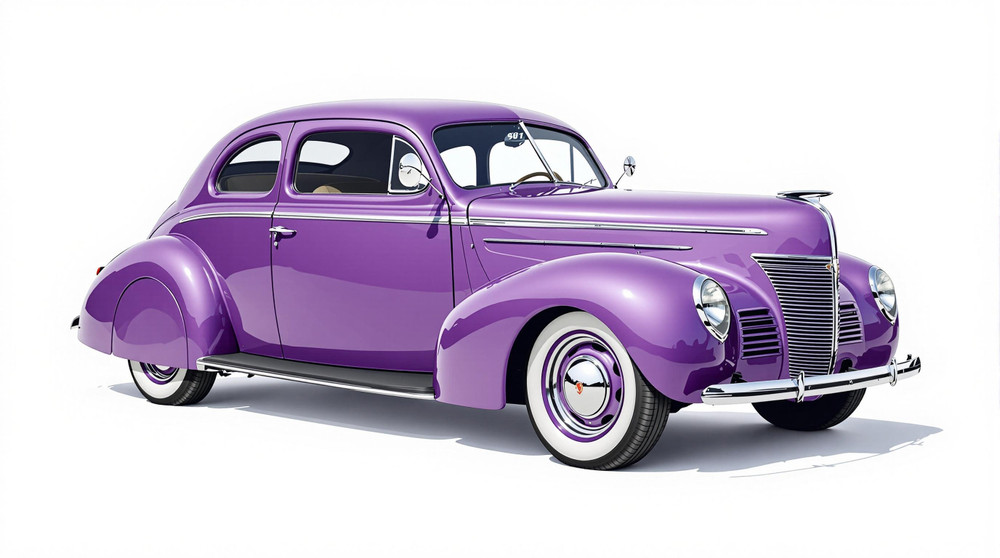
Image of 1939 Horch 901, Note: These illustrations use artistic license and may differ from actual historical models.
Performance Metrics
Fundamental Metrics
Emotional Appeal
MMP Rating
| Engine Specifications | |
|---|---|
| Engine: | V8 |
| Displacement: | 3.5L |
| Horsepower: | Estimated 80-100 HP |
| Torque: | Not available |
| Compression Ratio: | Not available |
| Ignition System: | Distributor and coil |
| Cooling System: | Liquid-cooled |
| Performance Specifications | |
| 0-60 Time: | Not available |
| 1/4 Mile Time: | Not available |
| Top Speed: | 70 mph |
| Transmission and Drive | |
| Drive Type: | Rear-wheel drive |
| Transmission Type: | Manual |
| Fuel and Efficiency | |
| Fuel System Type: | Carburetor |
| MPG: | Not available |
| Dimensions and Brakes | |
| Brakes: | Drum brakes |
| Wheelbase: | 112 inches |
| Weight: | Estimated 3500 lbs |
Note: Specifications for classic cars are given to the best of our ability, considering the limited and variant data available.
1939 Horch 901: The German Army’s V8 Cross-Country Car
The 1939 Horch 901 was not a luxury car dressed for adventure. It was a purpose-built military vehicle, designed to carry officers and personnel over roads that ordinary cars could not manage. Built by Horch, part of the German Auto Union group, the 901 combined a powerful V8 engine with four-wheel drive and a distinctive open-bodied layout.
Its story belongs to the era when European armies sought standardized vehicles that could handle a wide range of duties. The Horch 901 was one of Germany’s medium-class cross-country passenger cars, serving as a staff car, personnel carrier, and communications vehicle. A striking detail is that some early versions featured four-wheel steering, an unusual solution that helped the long vehicle maneuver but added mechanical complexity.
Open Body, Military Purpose
The 901’s styling was practical rather than decorative. Its long, upright hood led to a nearly vertical windshield and a boxy passenger compartment with four doors. Exposed spare wheels, high ground clearance, broad fenders, and a folding canvas top gave it a distinctly purposeful silhouette. With the top raised, it offered some protection from the weather; with the windshield folded down, it took on an even more stripped-back, field-ready appearance.
Inside, the priorities were durability and function. The cabin used straightforward metal fittings, simple instruments, and hard-wearing upholstery rather than the polished wood and plush carpeting associated with Horch’s civilian luxury cars. Seating and trim could vary by body and production run, but the overall feel was utilitarian. The controls were arranged for use in rough conditions, not for an elegant motoring experience.
The most recognizable configuration was the open four-door touring body used for staff and personnel duties. Other body arrangements and equipment fit-outs served roles such as communications and command transport. These were military specifications, not a consumer range of trim levels. Paint followed service requirements: early vehicles were commonly finished in dark gray, while later wartime vehicles could receive other military finishes, including dark yellow. A buyer choosing from a palette of fashionable civilian colors was not part of the 901’s world.
Engineering for Rough Ground
At the heart of the Horch 901 was a 3.5-liter, water-cooled V8, generally rated at about 80 horsepower. Power went through a manual gearbox and a transfer case to the four-wheel-drive system. That combination gave the car useful traction on mud, loose gravel, and uneven tracks, where a conventional rear-wheel-drive staff car would quickly struggle.
Independent suspension helped the wheels follow irregular terrain, while features such as the transfer case and, on some early versions, four-wheel steering made the 901 more capable than its upright body suggested. These systems were advanced for a military passenger vehicle of the period. They also meant more parts to inspect and maintain than in a simpler utility car.
A Standardized Car with a Complicated Legacy
The Horch 901 was part of Germany’s effort to develop standardized military passenger cars in different weight classes. Its medium class placed it between lighter cross-country cars and heavier military transport. The broader aim was to make vehicles adaptable to many duties and simplify procurement, but a technically ambitious design could be expensive and demanding to keep in service.
That trade-off shaped the 901’s reputation. Its V8, four-wheel drive, and sophisticated running gear made it capable, but the mechanical complexity could be a disadvantage in the field. As wartime conditions intensified, the German military increasingly needed vehicles that were easier to build, repair, and supply. The 901 therefore stands as both an impressive engineering effort and a reminder that clever design is only useful if an army can support it at scale.
Performance and Driving Character
Published performance figures vary with body style, equipment, gearing, and production version. A typical Horch 901 is generally quoted with a top speed around 80 km/h, or roughly 50 mph. A reliable factory 0-to-60-mph figure is not commonly documented, and that sprint was not a meaningful measure for a heavy, military-focused vehicle. As a broad modern estimate, acceleration to 60 mph would likely take well over 20 seconds, assuming the vehicle could reach that speed at all under its particular gearing and load.
On the road, the V8 would have delivered a steady, low-pitched mechanical note rather than the sharp sound of a high-revving sports engine. The manual transmission, transfer case, and weight of the vehicle demanded deliberate inputs. Its suspension and four-wheel drive were intended to make rough routes manageable, not to deliver the precise, quiet ride of a luxury touring car. On winding roads, its tall body and military tires called for measured cornering; on broken tracks, the extra traction and ground clearance were the real advantages.
Living with a Horch 901 Today
In service, the Horch 901 was used for transport, staff duties, and other military assignments. Today, surviving examples are primarily museum pieces, preserved military vehicles, or show and reenactment cars. It is not a realistic daily driver for most owners. Age, scarcity, fuel consumption, and the difficulty of sourcing correct parts make regular use a serious commitment.
Maintenance is best approached by a specialist familiar with prewar German military vehicles. The V8 and four-wheel-drive system are not impossible to work on, but they are far from a straightforward project for an average modern-car owner. Original components can be difficult to find, and repairs may require custom fabrication or careful restoration of worn parts. A running example is only the start: keeping it reliable and historically correct is a long-term undertaking.
Horch 901 Facts and Common Criticisms
The 901 is sometimes confused with Horch’s prestigious civilian cars because they shared the same manufacturer name. In reality, the 901 was a military cross-country vehicle, not a luxury sedan. Its most intriguing technical talking point is the four-wheel steering fitted to some early examples, a feature that could aid maneuverability but also contributed to complexity.
There is no widely recognized speed or endurance record associated with the Horch 901. Its significance comes from military service and engineering rather than competition. It also appeared in the broader events of the Second World War as a German military vehicle, though individual survivors can be difficult to trace to a specific wartime episode. Common criticisms include its complicated mechanical layout, high maintenance demands, and the mismatch between sophisticated engineering and the harsh realities of wartime repair and supply.
Rarity, Values, and Collectability
Exact production totals are not consistently reported, and figures can differ depending on which Horch 901 versions and related chassis are counted. A reasonable estimate for Horch 901 production is around 14,000 vehicles, with the total including multiple wartime configurations. That may sound substantial, but comparatively few complete, identifiable examples survive today.
Values depend heavily on originality, completeness, restoration quality, provenance, and whether the vehicle runs. As a broad 2026 estimate, a project or incomplete example might fall around US$30,000 to $60,000, while a well-restored, complete vehicle could be roughly US$70,000 to $150,000 or more. Exceptional examples with strong documentation may exceed that range, while missing major components can sharply reduce value. These are guide figures rather than a formal appraisal, and the market is thin enough that individual sales can vary widely.
The long-term trend for rare, historically significant military vehicles has generally been positive, but the Horch 901 is a specialist purchase, not a guaranteed investment. Restoration costs can exceed expectations, and finding the right buyer may take time. Condition and documentation matter at least as much as a gleaming finish.
Why the Horch 901 Still Matters
The 1939 Horch 901 brought a V8, four-wheel drive, and advanced cross-country engineering together in a vehicle built for military work. Its open body and practical cabin reflected its role, while its sophisticated systems showed how far designers were willing to go in pursuit of mobility. That ambition came with a cost: complexity could make field maintenance difficult.
Today, the Horch 901 is a rare and compelling piece of automotive and military history. It is remembered not as a fast luxury car or a racing legend, but as a distinctive attempt to make a passenger vehicle capable of going almost anywhere the road disappeared.
1939 Horch 901 Catalog of Parts
 1939 HORCH 901 Headlight Pads. 3-1/8" wide X 4-1/4" long. Pair-MP 7971-AHeadlight Pads. 3-1/8" wide X 4-1/4" long. Pair
 1939 HORCH 901 Luggage Rack Pad. 1-3/4" wide X 6" long. Each-MP 7971-BLuggage Rack Pad. 1-3/4" wide X 6" long. Each
 1939 HORCH 901 Door Handle (with lock) Pads. 1-7/8" wide X 3-1/2" long-MP 7971-CDoor Handle (with lock) Pads. 1-7/8" wide X 3-1/2" long. Pair
 1939 HORCH 901 Door handle pads. 1-7/8 in. W x 2-1/2 in. L. Pair. R&L.-MP 7971-DDoor handle pads. 1-7/8 in. W x 2-1/2 in. L. Pair. R&L.
 1939 HORCH 901 Trunk Light Pad. 3-3/4" long X 8-3/4" wide. Each-MP 7971-ETrunk Light Pad. 3-3/4" long X 8-3/4" wide. Each
 1939 HORCH 901 Fender Light Pads. 1-1/2" wide X 2-3/8" long. Pair-MP 7971-HFender Light Pads. 1-1/2" wide X 2-3/8" long. Pair
Why Choose Metro?
For over 100 years, Metro Moulded Parts has been the pinnacle of quality in classic car restoration parts. Our commitment to precision and authenticity in every component ensures a perfect fit and an OEM-level appearance.
- Expert Craftsmanship & Quality: Each part is a testament to our dedication to reliability and perfection, crafted from original designs and thoroughly tested.
- Advanced Technology: We use cutting-edge techniques to create flawless, long-lasting parts that surpass others in performance.
- SuperSoft Sponge – The Ultimate Door Seal: Not only are our door seals 30% softer than competitors', but they're also guaranteed to never leak. They effectively reduce wind and road noise, enhancing your classic car's comfort and driving experience.
- Proudly American: Our parts are a product of American craftsmanship, made in the USA with a spirit of excellence and heritage.
- Unrivaled Warranty: We back our products with a 30-year industry-leading warranty, a testament to our confidence in their quality.
Join us in preserving the legacy of classic cars with parts that are crafted for perfection, not just made.