
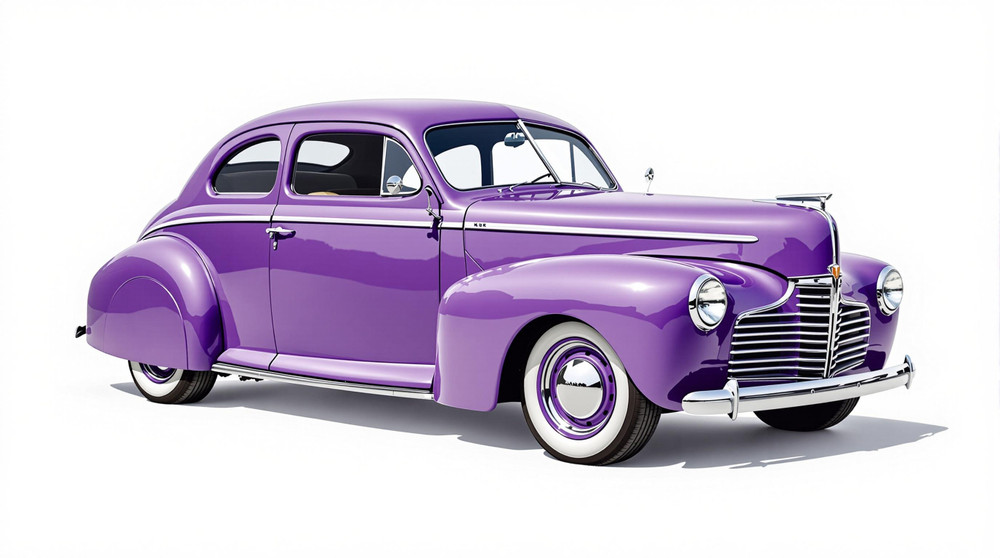
Image of 1941 Horch 108, Note: These illustrations use artistic license and may differ from actual historical models.
Performance Metrics
Fundamental Metrics
Emotional Appeal
MMP Rating
| Engine Specifications | |
|---|---|
| Engine Options: | Horch 3.8L I8 |
| Displacement Range: | 3.8L |
| Horsepower Range: | Estimated 92 HP |
| Torque: | Not available |
| Compression Ratio: | Not available |
| Ignition System: | Distributor and coil |
| Cooling System: | Liquid-cooled |
| Performance Specifications | |
| 0-60 Time: | Not available |
| 1/4 Mile Time: | Not available |
| Top Speed: | 80 mph |
| Transmission and Drive | |
| Drive Type: | Rear-wheel drive |
| Transmission Type: | 4-speed manual |
| Fuel and Efficiency | |
| Fuel System Type: | Carburetor |
| MPG: | Not available |
| Dimensions and Brakes | |
| Brakes: | Drum brakes |
| Wheelbase: | 3,200 mm |
| Weight: | 2,000 kg |
Note: Specifications for classic cars are given to the best of our ability, considering the limited and variant data available.
1941 Horch 108: A German Heavy-Duty 4x4
The 1941 Horch 108 was built for a job most luxury cars could never manage: carrying officers and equipment across rough ground in wartime conditions. Made by Horch, the prestigious German marque that had joined Auto Union in 1932, it combined a smooth V8 engine with four-wheel drive and a rugged military chassis. It was not a civilian touring car with a few extra accessories. The Horch 108 was a purpose-built heavy off-road vehicle, and its unusual early versions even used four-wheel steering.
Horch had earned its reputation before the war with refined, technically ambitious passenger cars. By the late 1930s, however, the German military was seeking standardized vehicles that could serve across a wide range of units. The Horch 108 was the heavy-class answer: a large, open staff car designed to transport people and supplies over roads that were little more than tracks. One striking detail is that some early examples could steer with both the front and rear wheels, helping the long vehicle maneuver in tight spaces. The system added complexity, though, and was dropped from later versions.
Military Styling and Practical Cabin
The Horch 108’s shape is all business. Its long, upright hood sits ahead of a broad, flat-fronted grille, with round headlamps mounted on the fenders and large wheels tucked beneath high arches. The body is tall and angular, with a near-vertical windshield and an open passenger compartment. A folding canvas roof and removable side curtains offered basic protection from weather without making the vehicle hard to adapt in the field.
Inside, the cabin favored durability over luxury. The seats were upholstered for hard use, and the dashboard was arranged around straightforward, legible instruments. Metal surfaces, simple fittings, and easy-to-reach controls suited a vehicle expected to be operated by military personnel rather than pampered by a private chauffeur. Compared with a Horch road car, the 108 felt utilitarian, but its sturdy construction still reflected the company’s experience building high-quality automobiles.
Military paint was dictated by service and period, not a retail color catalogue. Early vehicles commonly wore gray or other subdued finishes; later wartime vehicles might appear in dark yellow and field-applied camouflage. The most recognizable look today is usually a restored open staff-car body in military gray or olive-toned paint.
The best-known configuration was the open, multi-seat staff or personnel carrier. Horch 108 vehicles appeared in different military body and equipment forms, including command and transport roles, so fittings and seating could vary. These were not interchangeable consumer trims in the modern sense: the body and equipment depended on the vehicle’s assigned task.
Engineering Ahead of the Mud
The Horch 108’s defining feature was its combination of a large V8 and four-wheel drive. A 3.8-liter side-valve V8 produced about 80 metric horsepower, or roughly 79 horsepower by U.S. measurement. Power went through a four-speed gearbox and a transfer case to all four wheels. The drivetrain gave the vehicle a useful advantage on loose soil, snow, and uneven tracks compared with a conventional rear-drive staff car.
Early versions also paired four-wheel drive with four-wheel steering. That was an ambitious solution for a heavy vehicle, potentially reducing its turning circle and making it easier to place on narrow roads. The extra steering hardware was complicated to maintain, however. Later models simplified the arrangement, a reminder that clever engineering has to prove itself in everyday service, not just on a drawing board.
Exact equipment and specifications can vary by year and variant. The Horch 108 was part of a broader effort to standardize German military vehicles, but it remained a complex machine with more specialized hardware than an ordinary civilian car. Its most important innovation was not a single gadget. It was the integration of a powerful V8, four-wheel drive, and a large practical body into a vehicle intended for difficult terrain.
Horch 108 Performance and Road Manners
Published specifications generally put the Horch 108’s top speed at about 80 km/h, or 50 mph, though condition, gearing, load, and variant can affect real-world performance. A reliable factory 0-to-60-mph figure is not generally quoted, and a standard 80 km/h top speed means 60 mph is beyond its nominal maximum. For this vehicle, low-speed traction and the ability to keep moving over rough ground mattered far more than a fast acceleration run.
On a paved road, the Horch feels tall and substantial. Its steering is slower and heavier than that of a modern car, and the upright body rolls more through bends. On a bumpy track, the tall tires and rugged suspension help it cope with uneven surfaces, while four-wheel drive provides valuable grip. It is not a modern rock crawler, and age, restoration quality, and tire choice make a major difference to how confidently an example handles rough terrain.
The V8 is the characterful centerpiece. Rather than a sharp sports-car bark, it produces a deep, steady mechanical note, with the transmission and drivetrain adding their own old-fashioned sounds. The driver works with a manual gearbox, a large steering wheel, and straightforward controls. The experience is physical and deliberate: you plan ahead, choose a gear, and let the engine pull instead of expecting quick responses.
Service Life and Ownership Today
In its original life, the Horch 108 served as a staff, transport, and utility vehicle. It was intended for military use, not as a daily commuter or competition car. Today, surviving examples are primarily restoration projects, museum vehicles, or show and historic-display cars. Some owners may exercise them on private land or at suitable events, but regular public-road use is constrained by their age, specialized parts, and military design.
Maintenance is best approached by someone familiar with prewar German vehicles or vintage military machinery. The V8 and mechanical systems are serviceable in principle, but parts can be scarce, and the four-wheel-drive components require careful attention. Early four-wheel-steering versions are especially specialized. An average owner without workshop experience should budget for professional help, parts sourcing, and ongoing inspection rather than expecting inexpensive, routine-car upkeep.
Wartime Facts and Common Criticisms
The Horch 108’s four-wheel steering is its most memorable technical talking point. It made the early design unusually advanced for a military staff car, but it also illustrates a common criticism: the vehicle was mechanically complicated. Its size, weight, fuel consumption, and maintenance demands were further drawbacks when compared with simpler, lighter vehicles. A powerful engine and sophisticated drivetrain were useful, but they came with a cost in logistics and repair effort.
The Horch 108 is associated with the German military of the Second World War, rather than with racing records or civilian sales milestones. It did not establish a famous speed or endurance record, and surviving production figures are not consistently reported by variant. A reasonable estimate is that roughly 4,000 to 5,000 Horch 108 vehicles were built across the model’s wartime versions, but that should be treated as an informed estimate rather than a definitive factory total.
Horch 108 Collector Values and Rarity
A genuine, complete Horch 108 is rare on today’s market. Prices vary sharply according to originality, running condition, documented history, and the quality of any restoration. As a broad current-market estimate, a project or incomplete example might fall around $40,000 to $80,000, while a well-restored, running vehicle could bring approximately $100,000 to $200,000 or more. Exceptional provenance or a particularly rare configuration can push a price higher. These are guide ranges, not a formal appraisal, and international sales may differ substantially.
Interest in historically important military vehicles has helped keep the Horch 108 collectible, and the scarcity of surviving examples supports long-term appeal. Prices can still be uneven: restoration costs are high, specialist buyers are a limited group, and originality matters greatly. A finished vehicle is not automatically a profitable one if its restoration bill exceeds its market value. The best examples are likely to remain desirable, but buyers should prioritize condition and documentation over optimistic projections of appreciation.
Why the 1941 Horch 108 Still Matters
The Horch 108 brought together a respected luxury-car maker’s engineering skill and the demanding requirements of wartime transport. Its V8, four-wheel drive, and early four-wheel steering made it an unusually sophisticated military vehicle, while its open body and practical layout kept the focus on service rather than comfort. It was powerful and capable, but also heavy and complex, with the compromises that came from trying to make one vehicle do many difficult jobs.
Today, the Horch 108 stands out as a rare piece of automotive and military history: not simply a big old 4x4, but a bold experiment in how much capability could be built into a prewar staff car. Its presence is hard to mistake, and its engineering still tells a compelling story of ambition meeting the realities of the field.
1941 Horch 108 Catalog of Parts
 1941 HORCH 108 Headlight Pads. 3-1/8" wide X 4-1/4" long. Pair-MP 7971-AHeadlight Pads. 3-1/8" wide X 4-1/4" long. Pair
 1941 HORCH 108 Luggage Rack Pad. 1-3/4" wide X 6" long. Each-MP 7971-BLuggage Rack Pad. 1-3/4" wide X 6" long. Each
 1941 HORCH 108 Door Handle (with lock) Pads. 1-7/8" wide X 3-1/2" long-MP 7971-CDoor Handle (with lock) Pads. 1-7/8" wide X 3-1/2" long. Pair
 1941 HORCH 108 Door handle pads. 1-7/8 in. W x 2-1/2 in. L. Pair. R&L.-MP 7971-DDoor handle pads. 1-7/8 in. W x 2-1/2 in. L. Pair. R&L.
 1941 HORCH 108 Trunk Light Pad. 3-3/4" long X 8-3/4" wide. Each-MP 7971-ETrunk Light Pad. 3-3/4" long X 8-3/4" wide. Each
Why Choose Metro?
For over 100 years, Metro Moulded Parts has been the pinnacle of quality in classic car restoration parts. Our commitment to precision and authenticity in every component ensures a perfect fit and an OEM-level appearance.
- Expert Craftsmanship & Quality: Each part is a testament to our dedication to reliability and perfection, crafted from original designs and thoroughly tested.
- Advanced Technology: We use cutting-edge techniques to create flawless, long-lasting parts that surpass others in performance.
- SuperSoft Sponge – The Ultimate Door Seal: Not only are our door seals 30% softer than competitors', but they're also guaranteed to never leak. They effectively reduce wind and road noise, enhancing your classic car's comfort and driving experience.
- Proudly American: Our parts are a product of American craftsmanship, made in the USA with a spirit of excellence and heritage.
- Unrivaled Warranty: We back our products with a 30-year industry-leading warranty, a testament to our confidence in their quality.
Join us in preserving the legacy of classic cars with parts that are crafted for perfection, not just made.