
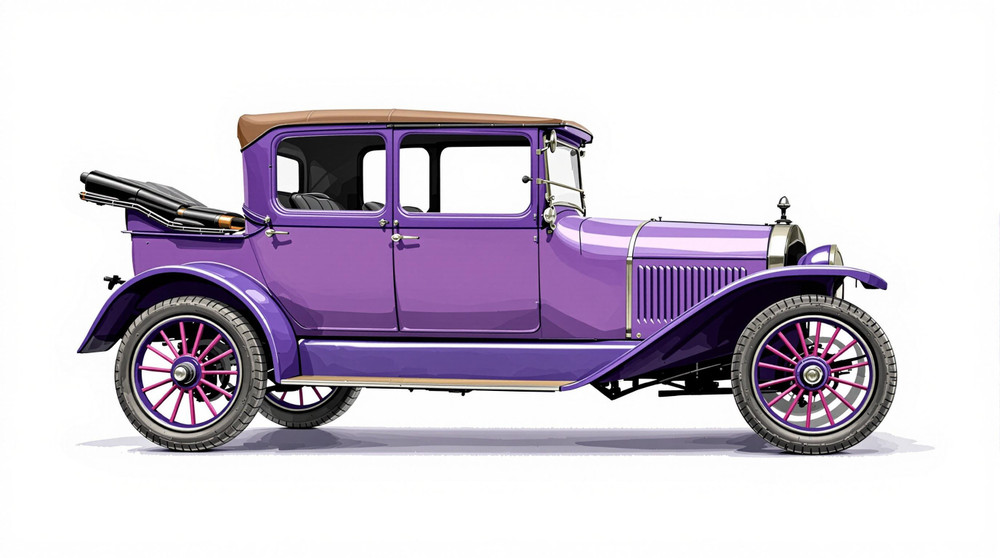
Image of 1910 Hupmobile Model 20, Note: These illustrations use artistic license and may differ from actual historical models.
Performance Metrics
Fundamental Metrics
Emotional Appeal
MMP Rating
| Engine Specifications | |
|---|---|
| Engine: | Single-cylinder engine |
| Displacement: | 2.8 liters |
| Horsepower: | Estimated 17-20 HP |
| Torque: | Not available |
| Compression Ratio: | Not available |
| Ignition System: | Magneto ignition system |
| Cooling System: | Water-cooled |
| Performance Specifications | |
| 0-60 Time: | Not available |
| 1/4 Mile Time: | Not available |
| Top Speed: | 45 mph |
| Transmission and Drive | |
| Drive Type: | Rear-wheel drive |
| Transmission Type: | 2-speed manual |
| Fuel and Efficiency | |
| Fuel System Type: | Gravity feed |
| MPG: | Not available |
| Dimensions and Brakes | |
| Brakes: | Mechanical drum brakes |
| Wheelbase: | 100 inches |
| Weight: | 1,200 lbs |
Note: Specifications for classic cars are given to the best of our ability, considering the limited and variant data available.
1910 Hupmobile Model 20: An American Brass-Era Original
The 1910 Hupmobile Model 20 put a practical, reasonably priced American automobile within reach of more buyers, without asking them to settle for a crude machine. Built by the Hupp Motor Car Company of Detroit, Michigan, it was the company’s first model and helped establish Hupmobile as a serious name in the young U.S. auto industry.
The company was founded by Robert Craig Hupp, an experienced automotive engineer who had worked in the rapidly developing Detroit car business. The Model 20 arrived in 1909 and continued into the early 1910s. Its name referred to its advertised 20-horsepower rating, a useful sales shorthand in an era when power figures were often more promise than standardized measurement.
One striking fact is how quickly the new marque found buyers. Hupmobile reportedly built 1,618 cars in its first year, an impressive start for a fledgling manufacturer. The Model 20 was not just a novelty for wealthy motorists. Its relatively accessible price and straightforward engineering helped make the automobile seem like usable transportation, not merely a rich person’s amusement.
Brass-Era Styling and Open-Car Charm
The Model 20 has the unmistakable look of a Brass Era car. Its upright radiator, exposed brass lamps and fittings, tall wheels, and narrow tires give it a delicate, almost carriage-like stance. The long hood leads the eye toward the engine, while the open body and high seating position leave passengers exposed to the air, road dust, and weather. On a well-preserved example, polished brass catches the light against the dark paint and wood-spoked wheels.
Depending on body style, the car could appear as a compact roadster or runabout, or as a touring car with room for more passengers. Roadsters favored a simple, sporty silhouette, while touring models added a longer body and extra seating for family outings. These open configurations are the most characteristic Model 20 forms today. Closed-car choices were limited compared with later automobiles, and body availability could vary by year and factory offering.
The cabin was functional rather than luxurious. Expect exposed or simply finished surfaces, basic upholstery, and relatively little weather protection. Materials and trim varied with body style and equipment, but the emphasis was on lightness and utility rather than plush appointments. A folding top and windshield could make an open car more adaptable, though neither transformed it into a quiet, all-weather vehicle.
Paint choices were not as standardized or consistently documented as modern factory color charts. Dark, conservative shades such as black, deep blue, or green suit the period and appear on surviving cars, while individual cars could have different trim and finish details. Brass hardware was a popular visual accent and is a defining part of the Model 20’s appeal.
Simple Technology for a New Motoring Public
At its heart, the Model 20 used a water-cooled, four-cylinder engine rated at about 20 horsepower. It was a substantial step beyond the small, single- or twin-cylinder powerplants found in many early runabouts. A two-speed transmission kept the controls and mechanical layout relatively simple, while shaft drive sent power to the rear wheels. In an era when chain drive was still common, enclosed driveline components offered a cleaner, more familiar arrangement for owners.
Starting and driving still required more attention than a modern car. The driver had to manage period controls, monitor the engine, and anticipate stops well in advance. There were no modern conveniences such as an electric starter, power steering, or synchronized shifting. The Model 20’s achievement was not electronic sophistication; it was packaging useful power and practical road-going ability into a car ordinary owners could learn to operate.
Why the Model 20 Mattered
The Model 20 helped define Hupmobile’s early identity: sturdy, straightforward cars offered at a competitive price. Its success gave the young company a foundation for growth and showed that a new Detroit manufacturer could find customers alongside better-known names. The car also reflected a broader shift in automotive design. Buyers increasingly wanted a dependable machine with a recognizable front-engine layout, a proper body, and enough power for everyday roads.
Compared with many contemporaries, the Hupmobile’s four-cylinder engine and shaft-drive layout made it feel like a thoughtfully engineered automobile rather than a motorized buggy. It was not the only car to use these ideas, and it did not invent the modern car, but it brought a practical combination of them to a growing market. Its lasting influence is best understood through Hupmobile’s survival and expansion as a marque, rather than through one revolutionary patent or record-setting feature.
20 Horsepower on Early Roads
Period performance figures are not perfectly consistent, and the condition of an individual antique car makes a major difference. A sound Model 20 could likely reach roughly 35 to 40 mph under favorable conditions. That was brisk motoring for its day, but it is not a machine for modern highway traffic. A 0-to-60-mph time is not meaningful: most Model 20s were not capable of reaching 60 mph, and the car was not designed for that kind of test.
On a smooth road, the Hupmobile feels lively by early-automobile standards. Its narrow tires, tall wheels, and relatively simple suspension transmit bumps more directly than a modern car’s suspension would. On rough or rutted roads, the driver needs to slow down and choose a careful line. The high, open body can also feel affected by crosswinds, while tight or uneven corners call for measured steering and conservative speed.
The driving experience is as much about involvement as speed. The engine produces a mechanical putter and exhaust note, accompanied by the sound of tires on the road and the movement of the driveline. Steering, braking, shifting, and engine management all demand attention. There is no power assistance to hide the work, and stopping distances are long by current standards. The reward is a close connection to the machinery and the landscape that modern cars largely screen out.
Ownership, Maintenance, and Reliability
In its own time, a Model 20 could serve as personal transportation, a family touring car, or a weekend runabout. Today, most examples are used for antique-car tours, club events, museum displays, and local shows. Their pace and braking limitations make them better suited to quiet roads and organized vintage-car outings than to routine commuting.
Maintenance is hands-on, but the basic mechanical layout is comparatively understandable to someone comfortable with vintage machinery. Regular attention to lubrication, ignition, cooling, tires, bearings, and the transmission is essential. Parts availability is more specialized than for a mass-produced postwar classic, and body, upholstery, and brass restoration can be costly. The simplicity of the design helps with diagnosis, but age, previous repairs, and scarcity of correct components can make a restoration challenging for an average owner.
Reliability depends heavily on condition and preparation. A properly restored example can tour reliably at period speeds, but it should not be treated like a modern, maintenance-free vehicle. Before a drive, owners should check fluid levels, tires, controls, and fasteners, and they should carry basic tools and a sensible roadside plan.
Model 20 Facts and Common Misconceptions
The Model 20’s best-known distinction is its role as the first Hupmobile, and its rapid early sales helped turn the Hupp Motor Car Company into a significant American manufacturer. There is no widely recognized speed or endurance record associated specifically with the 1910 Model 20. Its historic achievement was commercial: helping a new maker establish itself during the automobile industry’s formative years.
There is also no well-documented celebrity ownership story that defines the model. Its appeal is broader and more representative of early motoring: it was the sort of car that could carry its owners on an outing or a journey when paved roads were still the exception. The Model 20 belongs to the period when simply arriving by automobile could be an event in itself.
Common criticisms are fair but should be judged in context. The car is slow by modern standards, offers little weather protection, and requires frequent mechanical attention. Its brakes and handling demand respect, especially on hills or rough roads. Those drawbacks are part of owning a century-old automobile, not evidence that the Model 20 was poorly conceived for its time.
Collector Values and Rarity
Exact production figures for every Model 20 body style and model year are difficult to establish. As a broad estimate, Hupmobile production in 1910 is often placed around 5,000 cars across the company’s offerings, though published totals can differ. The Model 20 continued beyond 1910, but surviving examples are scarce compared with later mass-market classics. A reasonable estimate is that several thousand Model 20s were built during its production run, with far fewer surviving today. These figures should be treated as informed estimates rather than a definitive factory count.
As a 2026 market guide, a project car with substantial restoration needs might fall around $10,000 to $20,000. A running, presentable example could be roughly $25,000 to $45,000, while a high-quality, correctly restored car may bring about $45,000 to $75,000 or more. Body style, originality, documented history, restoration quality, and the condition of the engine and brasswork all affect value. Exceptional examples can sit outside these ranges, and prices vary by region and auction demand.
Brass-era cars have a dedicated but relatively small collector market. The Model 20’s historical importance and visual character support its appeal, though its limited usability can narrow the pool of buyers. Prices are best described as condition-sensitive rather than guaranteed to rise steadily. Well-restored, documented examples may hold interest over time, but restoration costs can exceed any increase in market value.
A Small Car With a Big Early Legacy
The 1910 Hupmobile Model 20 combined a 20-horsepower four-cylinder engine, straightforward mechanical engineering, and distinctive Brass Era styling in a car that helped a new Detroit company find its footing. It was neither a modern-speed machine nor a luxury carriage. Its significance lies in making early motoring feel more practical and in giving Hupmobile a strong start.
More than a century later, the Model 20 remains a vivid reminder of how quickly the automobile moved from experiment to everyday ambition. Its brass lamps, open cockpit, and steady mechanical beat make every drive a small journey back to the beginning of American motoring.
1910 Hupmobile Model 20 Catalog of Parts
 1910 Hupmobile Model 20 Accessory Floor Mat - 12"X17"-AC 39Accessory Floor Mat - made of high quality black rubber with molded original emblem. Also designed to be sewn into new carpets. 12"X17", Each
 1910 Hupmobile Model 20 Clutch and Brake Pedal Pads. 3" wide X 4-1/8" long. Pair-CB 52Clutch and Brake Pedal Pads. 3" wide X 4-1/8" long. Pair
Why Choose Metro?
For over 100 years, Metro Moulded Parts has been the pinnacle of quality in classic car restoration parts. Our commitment to precision and authenticity in every component ensures a perfect fit and an OEM-level appearance.
- Expert Craftsmanship & Quality: Each part is a testament to our dedication to reliability and perfection, crafted from original designs and thoroughly tested.
- Advanced Technology: We use cutting-edge techniques to create flawless, long-lasting parts that surpass others in performance.
- SuperSoft Sponge – The Ultimate Door Seal: Not only are our door seals 30% softer than competitors', but they're also guaranteed to never leak. They effectively reduce wind and road noise, enhancing your classic car's comfort and driving experience.
- Proudly American: Our parts are a product of American craftsmanship, made in the USA with a spirit of excellence and heritage.
- Unrivaled Warranty: We back our products with a 30-year industry-leading warranty, a testament to our confidence in their quality.
Join us in preserving the legacy of classic cars with parts that are crafted for perfection, not just made.