
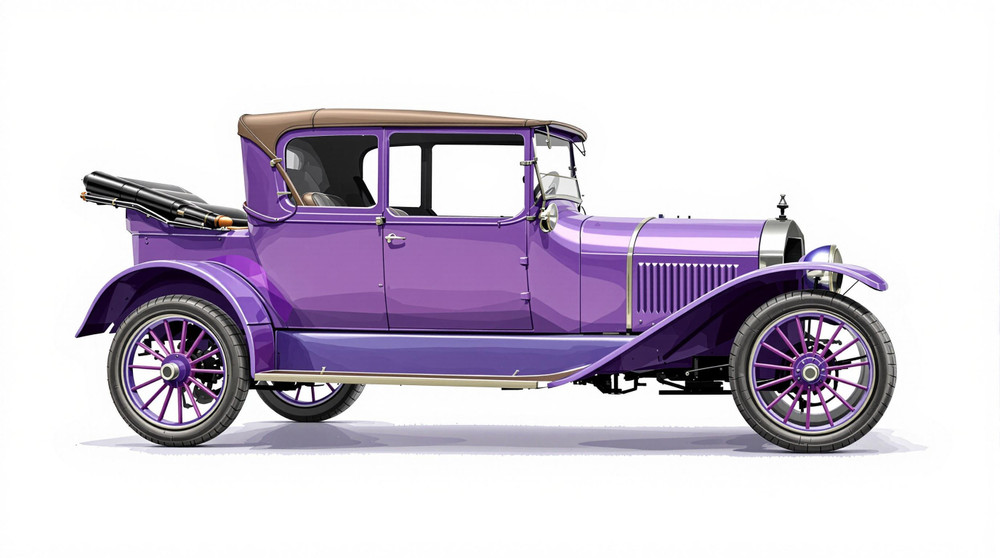
Image of 1913 Hupmobile Model 20, Note: These illustrations use artistic license and may differ from actual historical models.
Performance Metrics
Fundamental Metrics
Emotional Appeal
MMP Rating
| Engine Specifications | |
|---|---|
| Engine Options: | Single engine option |
| Displacement Range: | 112 cubic inches |
| Horsepower Range: | Estimated 16-20 HP |
| Torque: | Not available |
| Compression Ratio: | Not available |
| Ignition System: | Magneto ignition system |
| Cooling System: | Water-cooled |
| Performance Specifications | |
| 0-60 Time: | Not available |
| 1/4 Mile Time: | Not available |
| Top Speed: | 45 mph |
| Transmission and Drive | |
| Drive Type: | Rear-wheel drive |
| Transmission Type: | 2-speed manual |
| Fuel and Efficiency | |
| Fuel System Type: | Gravity feed |
| MPG: | Not available |
| Dimensions and Brakes | |
| Brakes: | Mechanical drum brakes |
| Wheelbase: | 100 inches |
| Weight: | 1,500 lbs |
Note: Specifications for classic cars are given to the best of our ability, considering the limited and variant data available.
1913 Hupmobile Model 20: An Affordable Brass-Era Pioneer
The 1913 Hupmobile Model 20 was built for people who wanted the freedom of an automobile without paying the price of a luxury car. Compact, comparatively straightforward, and powered by a four-cylinder engine, it helped make motoring more accessible during the years when cars were still a novelty on many American roads.
The car came from the Hupp Motor Car Company of Detroit, Michigan, founded in 1908 by Robert Craig Hupp and his associates. The company’s first automobile was the Model 20, introduced for 1909. By 1913, the name had become associated with practical, reasonably priced motoring. The Model 20 was an important early success for the young company, though exact specifications and body offerings could vary by model year and market.
One appealing detail is the Model 20’s name: its “20” referred to its approximate horsepower rating, not its engine size or a guaranteed top speed. In an era when automobile makers often advertised power using optimistic ratings, the figure offered buyers a simple way to compare cars.
Brass-Era Style and Cabin Details
The 1913 Hupmobile has the upright, purposeful look associated with the Brass Era. Its tall, narrow radiator and separate front fenders give it a distinctly early-automobile profile. Exposed lamps, a high seating position, slim tires, and a relatively open engine compartment add to its mechanical, almost carriage-like character. Brass trim is a defining visual cue of the period, although the amount of brass and the precise fittings can differ between cars and restorations.
Inside, the emphasis was on function rather than modern comfort. Depending on body style, occupants sat on a simple upholstered bench or individual seats, with leather or leather-like trim used on many period cars. The dashboard was spare by today’s standards, carrying only the essential controls and instruments. The open bodywork left passengers exposed to wind, dust, rain, and road spray, so motoring accessories such as a folding top, side curtains, and windscreen could make a real difference on longer trips.
Paint choices were not necessarily identical across every dealer, body, or production batch. Dark, practical colors such as black, deep green, and maroon suit the period and are common choices on restored examples. A specific surviving car’s original color is best confirmed through paint layers, factory documentation, or other vehicle records rather than assumed from a modern restoration.
Model 20 body styles included open touring and roadster forms, with availability varying by year. The touring car, with room for several passengers and a folding top, is among the most recognizable configurations. A roadster offered a sportier, more compact look. Buyers could also encounter other body arrangements depending on the catalog and coachwork offered for a particular year.
Simple Engineering, Meaningful Impact
The Model 20’s importance was less about a single revolutionary invention than about making a usable automobile at a price more buyers could consider. The Hupp Motor Car Company entered a crowded market dominated by firms trying to prove that cars could be dependable transportation rather than expensive toys. A modestly sized four-cylinder car with conventional controls and practical body choices helped advance that idea.
Period Model 20 specifications generally describe a four-cylinder engine rated at about 20 horsepower. The layout and equipment reflect the transition from carriage-style vehicles to more familiar automobiles, with a steering wheel, pedals, and a geared transmission. Exact details can vary across the Model 20’s production years, so a surviving 1913 car should be checked against its own factory literature and components before assigning precise specifications.
What set the Hupmobile apart was its balance of price, manageable size, and everyday usefulness. It was not a luxury machine, but it gave buyers a practical way to travel under their own power. That approachable character helped establish Hupp as a serious early manufacturer and contributed to the broader shift toward cars as ordinary transportation.
1913 Hupmobile Model 20 Performance
With roughly 20 horsepower, the Model 20 was built for steady progress rather than speed. A sound, correctly tuned example might reach approximately 30 to 40 mph in favorable conditions, though gearing, mechanical condition, tire choice, road surface, and body style all affect the result. These are useful estimates, not guaranteed factory-tested figures for every 1913 car.
A modern 0-to-60-mph time is not meaningful for the Model 20. The car was not designed to reach 60 mph, and reliable standardized acceleration tests from the period are not generally available. It accelerates gradually, with the driver managing the throttle and transmission rather than expecting brisk, effortless response.
On the road, the car feels mechanical in a way that modern drivers rarely experience. The engine’s steady four-cylinder beat, transmission sounds, and tire noise are part of the soundtrack. Steering is slower and heavier than in a modern car, and the narrow tires and high, relatively light body call for calm inputs. On bumpy roads, the suspension absorbs some movement but cannot disguise rough surfaces. On winding roads, the driver needs to anticipate turns, maintain a sensible pace, and allow generous stopping distance.
Wind and weather are constant companions in an open Model 20. A folding top and side curtains improve comfort, but they do not provide the sealing or protection of a closed modern cabin. The reward is a direct, engaging driving experience: the driver is closely involved in every gear change, adjustment, and decision.
Owning and Maintaining a Model 20
Today, a 1913 Hupmobile Model 20 is best suited to careful touring, vintage-car gatherings, parades, and museum or private collections. It can be driven, but it is not a practical daily driver in the modern sense. Traffic speed, braking distance, lighting, weather protection, and the availability of parts all place limits on routine use.
Maintenance is approachable for an owner with mechanical experience, but “simple” does not mean maintenance-free. Ignition, lubrication, fuel delivery, cooling, brakes, tires, and fasteners require regular attention. Some routine work is straightforward, while worn or missing period-specific components can take time to find, reproduce, or repair. A pre-purchase inspection by a mechanic familiar with brass-era cars is especially valuable. The condition of the engine, transmission, chassis, and wooden body structure can matter more than shiny paint.
Reliability depends heavily on careful upkeep and correct setup. A well-sorted example can take part in local tours, but owners should plan routes around modest speeds and have basic tools and spares available. The car rewards patient maintenance and a driver who understands that preservation and mechanical sympathy come first.
Hupmobile Model 20 Facts and Myths
The Model 20 belongs to the early Hupp story, when the company was establishing its reputation and building cars in relatively small numbers by later mass-production standards. Its reputation for practical motoring helped the Hupp name endure beyond the Model 20, as the company later produced a broad range of cars before closing in 1941.
No widely recognized speed or endurance record is associated specifically with the 1913 Model 20, and there is no well-established celebrity ownership story that defines the model. That does not make it historically unimportant. Its significance lies in the everyday promise it represented: a car that ordinary buyers could aspire to own, rather than a machine reserved only for the wealthy.
Common criticisms are familiar to anyone who has driven an early automobile. The Model 20 is slow by modern standards, offers limited weather protection, and requires more driver attention than a contemporary car. Parts availability can also be challenging. For enthusiasts, those drawbacks are inseparable from the experience and part of what makes a careful drive feel like a genuine step into the early motoring era.
Rarity and Collector Value
Reliable production totals for the 1913 Model 20 alone are difficult to establish from commonly available records. A reasonable working estimate is that several thousand may have been produced for that model year, with perhaps tens of thousands built across the Model 20’s full production run. These are estimates, not confirmed factory totals. Many cars have disappeared, and surviving examples are scattered among private collections, museums, and specialist clubs.
As a broad 2026 collector-market estimate, a project car might fall around $5,000 to $15,000, depending on completeness and structural condition. A running, presentable example could land roughly in the $15,000 to $30,000 range, while a high-quality restoration may bring approximately $30,000 to $55,000 or more. These are guide ranges rather than formal appraisals: body style, originality, documented history, restoration quality, and market timing can shift a sale substantially.
Values for brass-era cars tend to be selective rather than uniformly rising. Exceptional, well-documented cars can attract strong interest, while incomplete projects may be harder to sell because restoration requires specialist knowledge and costly parts. The Model 20’s modest scale and historical appeal give it a devoted audience, but buyers should prioritize condition and provenance over optimistic assumptions about future appreciation.
Why the 1913 Hupmobile Model 20 Still Matters
The 1913 Hupmobile Model 20 captures a turning point in American motoring. Its four-cylinder power, practical proportions, and relatively accessible mission reflect an industry learning how to build cars for more than a privileged few. It is not fast, quiet, or effortless, but it offers an unusually direct connection to the people and roads of its time.
More than a century later, the Model 20 remains a reminder that automotive history was shaped not only by record-breakers and luxury flagships, but also by useful cars that helped make driving part of everyday life.
1913 Hupmobile Model 20 Catalog of Parts
 1913 Hupmobile Model 20 Accessory Floor Mat - 12"X17"-AC 39Accessory Floor Mat - made of high quality black rubber with molded original emblem. Also designed to be sewn into new carpets. 12"X17", Each
 1913 Hupmobile Model 20 Clutch and Brake Pedal Pads. 3" wide X 4-1/8" long. Pair-CB 52Clutch and Brake Pedal Pads. 3" wide X 4-1/8" long. Pair
Why Choose Metro?
For over 100 years, Metro Moulded Parts has been the pinnacle of quality in classic car restoration parts. Our commitment to precision and authenticity in every component ensures a perfect fit and an OEM-level appearance.
- Expert Craftsmanship & Quality: Each part is a testament to our dedication to reliability and perfection, crafted from original designs and thoroughly tested.
- Advanced Technology: We use cutting-edge techniques to create flawless, long-lasting parts that surpass others in performance.
- SuperSoft Sponge – The Ultimate Door Seal: Not only are our door seals 30% softer than competitors', but they're also guaranteed to never leak. They effectively reduce wind and road noise, enhancing your classic car's comfort and driving experience.
- Proudly American: Our parts are a product of American craftsmanship, made in the USA with a spirit of excellence and heritage.
- Unrivaled Warranty: We back our products with a 30-year industry-leading warranty, a testament to our confidence in their quality.
Join us in preserving the legacy of classic cars with parts that are crafted for perfection, not just made.