
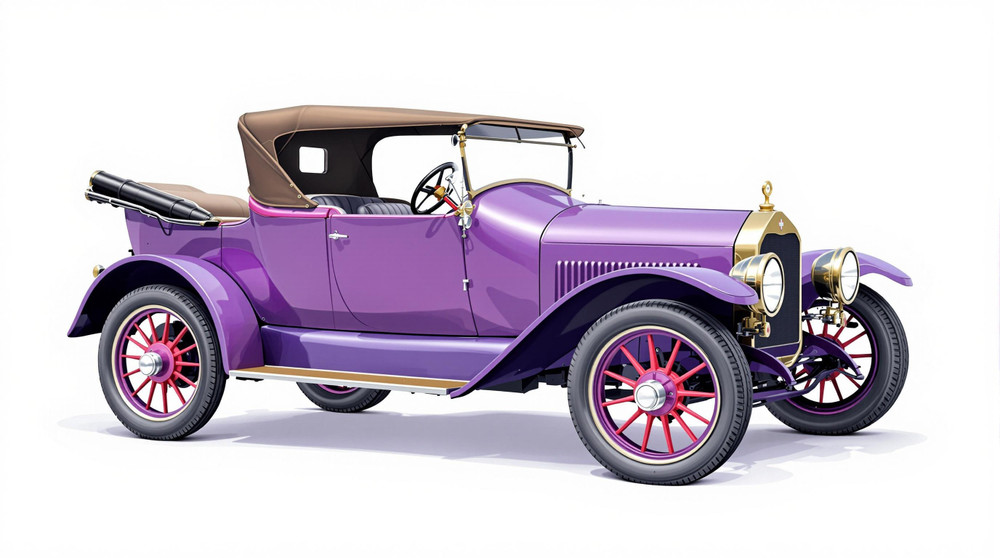
Image of 1913 Hupmobile Model 32, Note: These illustrations use artistic license and may differ from actual historical models.
Performance Metrics
Fundamental Metrics
Emotional Appeal
MMP Rating
| Engine Specifications | |
|---|---|
| Engine Options: | Single engine option |
| Displacement Range: | 4.0L |
| Horsepower Range: | Estimated 32-35 HP |
| Torque: | Not available |
| Compression Ratio: | Not available |
| Ignition System: | Magneto ignition system |
| Cooling System: | Water-cooled |
| Performance Specifications | |
| 0-60 Time: | Not available |
| 1/4 Mile Time: | Not available |
| Top Speed: | 50 mph |
| Transmission and Drive | |
| Drive Type: | Rear-wheel drive |
| Transmission Type: | 3-speed manual |
| Fuel and Efficiency | |
| Fuel System Type: | Carburetor |
| MPG: | Not available |
| Dimensions and Brakes | |
| Brakes: | Mechanical drum brakes |
| Wheelbase: | 112 inches |
| Weight: | Estimated 1,800 lbs |
Note: Specifications for classic cars are given to the best of our ability, considering the limited and variant data available.
1913 Hupmobile Model 32: A Practical Brass-Era Classic
The 1913 Hupmobile Model 32 was built for people who wanted more than a novelty on four wheels. It was a substantial, usable automobile from a young American company, with a four-cylinder engine, open touring-car proportions, and the confident presence of a machine moving into the modern motoring age. Its name referred to its 32-horsepower rating, a meaningful figure for a car of its time.
The Hupmobile came from the Hupp Motor Car Company of Detroit, founded in 1909 by automotive engineer and entrepreneur Robert Craig Hupp. The company’s first car, the Model 20, helped establish its reputation for offering a well-engineered automobile at a relatively accessible price. The Model 32 represented a step up in power and size as American buyers increasingly looked beyond small, basic runabouts.
One intriguing point is how quickly the Hupmobile name gained recognition. The company grew from its first production car into a serious manufacturer in just a few years, competing in a crowded market dominated by firms of very different sizes. The Model 32 belongs to that brisk period of expansion, when a car could still be assembled around a straightforward mechanical layout yet feel like a major purchase and a major step toward independence.
Open Touring-Car Style and Period Craftsmanship
The Model 32 wore the upright, purposeful look typical of the early 1910s. Its tall radiator and bonnet led the eye toward a passenger compartment set high behind the engine. Separate curved fenders covered the wheels, while running boards bridged the space between them. Large, thin-rimmed steering wheels, exposed lamps, and spoked wheels completed a silhouette that was elegant without being ornamental for ornament’s sake.
On an open touring model, passengers sat in a relatively upright cabin with the road and weather close at hand. Upholstery was generally leather or leather-like material, with painted or finished wood and metal trim rather than the insulated, fully enclosed interiors familiar in later cars. The finish and detailing varied by body and specification, but the craftsmanship was part of the appeal: these were hand-finished machines, not disposable transport.
Touring cars and roadsters were the most characteristic body styles of the period and are the forms most closely associated with the Model 32. Closed bodies, such as coupes or sedans, could be offered in the broader Hupmobile range, but availability depended on the model year and catalog specification. Buyers could also encounter differences in seating, equipment, lamps, top arrangements, and wheel or tire details.
Factory paint choices could vary, and surviving cars may have been repainted, so a single definitive color list is difficult to establish. Black was a practical and common choice, while dark blues, reds, and other deep shades were also used in the period. A dark body paired with bright brass or nickel-plated fittings gave an early touring car a particularly striking finish.
Engineering for the Road
The Model 32’s central feature was its four-cylinder engine, rated at 32 horsepower by the contemporary system. That rating should not be read as a modern, precisely comparable horsepower measurement. Early manufacturers used period rating conventions, and real-world output depended on engine condition, fuel, adjustment, and how the car was equipped.
Its conventional layout, with a front-mounted engine driving the rear wheels, was familiar to motorists and mechanics. The Model 32 used the kind of mechanical transmission and controls common to the era, rather than the automatic conveniences or synchronized gear changes found in later cars. The driver had to coordinate throttle, clutch, and gear selection with care. That directness was not a gimmick. It was simply how driving worked.
The car’s significance lies less in one revolutionary invention than in the way it packaged useful power and established engineering into a marketable, reasonably practical automobile. Hupp’s early success helped demonstrate that a newer independent maker could earn buyers’ trust through a well-built product and steady growth. In that sense, the Model 32 reflects an important shift from experimental motoring toward automobiles as serious personal transportation.
Speed, Ride, and Driving Character
Reliable factory figures for a 1913 Model 32’s top speed and acceleration are not consistently available, and surviving cars can differ considerably in mechanical condition and gearing. A sound, correctly tuned example might manage roughly 40 to 50 mph under favorable conditions. That is a period-appropriate estimate, not a guaranteed specification. A modern 0-to-60-mph time is not especially meaningful: many cars of this class would struggle to reach 60 mph, and acceleration tests were not standardized as they are today.
Behind the wheel, the Model 32 would feel tall, open, and mechanically present. The engine’s exhaust note would be a steady, unfiltered four-cylinder beat, accompanied by gear noise, tire sound, and the movement of the chassis over the road. Steering would require more effort than in a modern car, and braking performance would be modest by current standards. The driver is part of the machinery, not insulated from it.
On smooth roads, the car’s long, upright stance and period suspension could make for a comfortable touring pace. Broken surfaces would bring more body movement and jolts than a modern vehicle, while tight or winding roads called for anticipation and measured steering inputs. Crosswinds could be noticeable with an open body and raised top. The right approach is to drive smoothly, leave plenty of room, and treat speed as something earned by road conditions rather than demanded by the engine.
Owning and Maintaining a Model 32
Today, a Model 32 is best suited to touring events, car shows, historic motoring gatherings, and careful pleasure drives. It can be driven, but it is not a practical substitute for a modern daily vehicle. Weather protection, lighting, braking, traffic speeds, and the availability of specialized parts all shape how and where an owner will use it.
The mechanical layout is relatively straightforward compared with that of a modern car, and an owner with experience in early automobiles can often understand much of the routine service work. Ignition, lubrication, fuel delivery, cooling, clutch adjustment, and brake maintenance all require regular attention. Simple design does not mean zero maintenance: old materials, wear, previous repairs, and long periods of storage can create complicated problems.
Parts support is more limited than for a Ford Model T, so a prospective buyer should look closely at the engine, transmission, running gear, body wood, and completeness of the car. Original lamps, instruments, trim, and body fittings can be difficult or expensive to find. A car that runs is not automatically a car ready for safe touring. A careful mechanical inspection and a test drive by someone familiar with brass-era vehicles are strongly recommended.
Hupmobile Facts and Common Criticisms
The Model 32 does not have a widely documented, model-specific speed or endurance record that defines its legacy. Nor is there a famous celebrity ownership story that is firmly associated with the 1913 model. Its more interesting story is the broader one: Hupp Motor Car Company grew rapidly in the early years of the American auto industry, and its cars helped build a recognizable national marque from a Detroit manufacturer that had only recently entered production.
Period advertisements and surviving examples help establish the Model 32 as a higher-powered Hupmobile of its day, but exact production totals by model and body style are difficult to verify. A reasonable working estimate is that production reached several thousand cars, perhaps in the range of 3,000 to 6,000 for the model year. That is an informed estimate, not a confirmed factory figure, and it should not be confused with total Hupmobile production across all models.
Common criticisms are familiar to anyone who collects early cars: modest braking, limited weather protection, demanding controls, and the need for frequent adjustment. Parts availability can also be a challenge. These are not flaws unique to the Hupmobile so much as the realities of operating a car built more than a century ago. Compared with a basic runabout, the Model 32 offered stronger performance, but it still belongs to an era when driving required attention and mechanical sympathy.
Collector Value and Availability
Values depend heavily on body style, originality, completeness, restoration quality, and whether the car is running and roadworthy. As a broad 2026 estimate in the United States, a project or incomplete example might bring roughly $15,000 to $30,000. A sound, presentable car could fall around $30,000 to $60,000, while a high-quality restoration with desirable bodywork and strong documentation could reach approximately $60,000 to $90,000 or more. These are guide ranges, not appraisals, and a rare body style or exceptional provenance can change the result.
Model 32s appear far less often than mass-produced early Fords, and buyers may wait a long time for the right example. Their scarcity can support interest among brass-era collectors, but the market is relatively specialized. Over the long term, well-restored early touring cars have generally held appeal, yet prices can move unevenly because restoration costs are high and the pool of buyers is smaller than for later classics. Condition and provenance usually matter more than a broad claim that the car is “rare.”
Why the 1913 Hupmobile Model 32 Matters
The 1913 Hupmobile Model 32 captures a moment when American motoring was becoming more capable, more established, and increasingly available beyond the earliest automobile pioneers. Its 32-horsepower four-cylinder engine, upright touring-car design, and practical mechanical layout made it a serious road car in its day. It was not defined by one famous record or a single breakthrough, but by the role it played in Hupp’s rapid rise and in the wider development of the American automobile.
More than a century later, the Model 32 remains engaging because it asks its driver to participate. Its engine, controls, exposed cabin, and period proportions make every journey feel deliberate. It is a reminder that the early automobile was not merely transportation. It was engineering you could hear, feel, and help operate.
1913 Hupmobile Model 32 Catalog of Parts
 1913 Hupmobile Model 32 Accessory Floor Mat - 12"X17"-AC 39Accessory Floor Mat - made of high quality black rubber with molded original emblem. Also designed to be sewn into new carpets. 12"X17", Each
 1913 Hupmobile Model 32 Clutch and Brake Pedal Pads. 3" wide X 4-1/8" long. Pair-CB 52Clutch and Brake Pedal Pads. 3" wide X 4-1/8" long. Pair
Why Choose Metro?
For over 100 years, Metro Moulded Parts has been the pinnacle of quality in classic car restoration parts. Our commitment to precision and authenticity in every component ensures a perfect fit and an OEM-level appearance.
- Expert Craftsmanship & Quality: Each part is a testament to our dedication to reliability and perfection, crafted from original designs and thoroughly tested.
- Advanced Technology: We use cutting-edge techniques to create flawless, long-lasting parts that surpass others in performance.
- SuperSoft Sponge – The Ultimate Door Seal: Not only are our door seals 30% softer than competitors', but they're also guaranteed to never leak. They effectively reduce wind and road noise, enhancing your classic car's comfort and driving experience.
- Proudly American: Our parts are a product of American craftsmanship, made in the USA with a spirit of excellence and heritage.
- Unrivaled Warranty: We back our products with a 30-year industry-leading warranty, a testament to our confidence in their quality.
Join us in preserving the legacy of classic cars with parts that are crafted for perfection, not just made.