
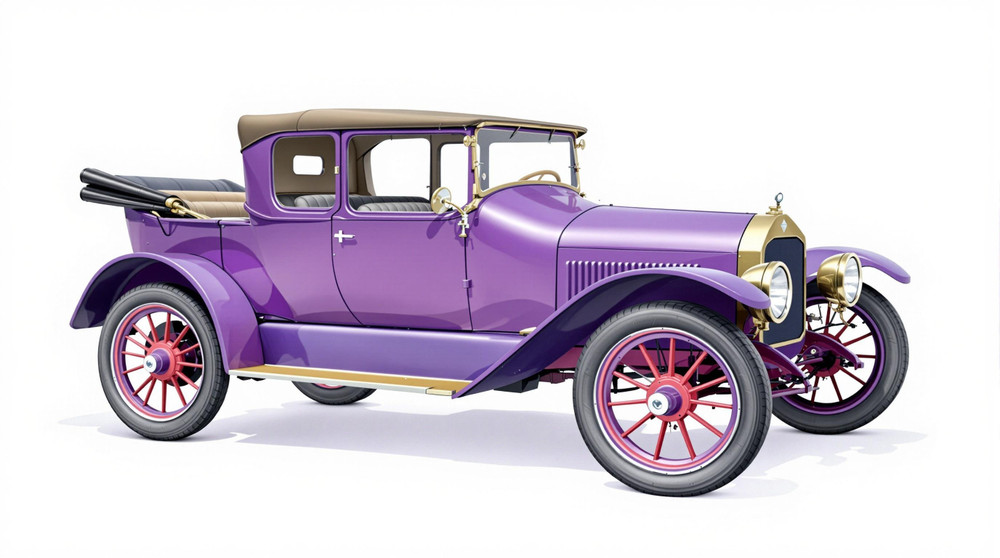
Image of 1914 Hupmobile Model 32, Note: These illustrations use artistic license and may differ from actual historical models.
Performance Metrics
Fundamental Metrics
Emotional Appeal
MMP Rating
| Engine Specifications | |
|---|---|
| Engine Options: | 4-cylinder, in-line, L-head |
| Displacement Range: | 2.8L |
| Horsepower Range: | Estimated 16-20 HP |
| Torque: | Not available |
| Compression Ratio: | Not available |
| Ignition System: | Magneto |
| Cooling System: | Water-cooled |
| Performance Specifications | |
| 0-60 Time: | Not available |
| 1/4 Mile Time: | Not available |
| Top Speed: | 50 mph |
| Transmission and Drive | |
| Drive Type: | Rear-wheel drive |
| Transmission Type: | 3-speed manual |
| Fuel and Efficiency | |
| Fuel System Type: | Carburetor |
| MPG: | Not available |
| Dimensions and Brakes | |
| Brakes: | Mechanical drum brakes |
| Wheelbase: | 112 inches |
| Weight: | 1,800 lbs |
Note: Specifications for classic cars are given to the best of our ability, considering the limited and variant data available.
1914 Hupmobile Model 32: A Practical Pioneer
The 1914 Hupmobile Model 32 brought early motoring within reach of more Americans, combining a sturdy four-cylinder engine with straightforward engineering and a growing choice of body styles. It was built by the Hupp Motor Car Company of Detroit, Michigan, the company founded by brothers Robert and Louis Hupp. Their first car, the Model 20, made its debut at the 1909 Detroit Auto Show. The Model 32 followed as a larger, more powerful entry in Hupmobile’s lineup, helping the young company establish a reputation for dependable, well-made cars.
Its name referred to its period-rated 32 horsepower, not a modern measurement of engine output. In 1914, that figure represented useful power for a family car, particularly when paired with a relatively light body. The Model 32 captures an important moment in American motoring: automobiles were moving beyond novelty and becoming practical transportation for people who could afford the purchase price, fuel, and upkeep.
Brass-Era Style and Model 32 Bodies
The Model 32 has the upright, purposeful look associated with prewar cars. Its tall radiator and hood form a long, level front profile, while exposed lamps, narrow fenders, running boards, and slim wire wheels emphasize its mechanical character. Depending on the body, the rear could be an open passenger compartment with a folding top or a more enclosed cabin. Details varied by body and equipment, so surviving examples may not look exactly alike.
Open touring cars and roadsters are the most familiar Model 32 forms today. Touring bodies offered room for several passengers and a folding top, making them practical for family outings and longer trips. Roadsters were more compact and sportier in appearance. Hupmobile also offered more enclosed bodywork in its range, though exact offerings and availability could vary by catalog, market, and production year.
Inside, expect functional rather than luxurious accommodation: a simple instrument panel, exposed controls, and seating upholstered in period materials such as leather or durable cloth, depending on specification. The cabin was designed to be used, not cosseting by modern standards. Wind, road dust, and weather were part of the experience, especially in an open car.
Period paint choices were not necessarily as uniform as modern factory color charts suggest. Dark shades such as black, navy, maroon, and deep green are plausible choices for surviving cars and restorations, but finishes could differ by body and order. Black is a particularly common restoration choice, though a car’s original color is best established through factory records, surviving paint layers, or period documentation.
Engineering Ahead of the Horse
The Model 32 used a four-cylinder engine rated at 32 horsepower, a multi-speed manual transmission, and conventional rear-wheel drive. Its mechanical layout was familiar to experienced motorists of the day, but it also reflected the industry’s rapid move toward practical, repeatable automobile engineering. A steering wheel and foot-operated controls made the car more intuitive than earlier, less standardized machines, while the enclosed powertrain and shaft drive helped make everyday use less cumbersome than horse-drawn travel.
The Model 32 was not a radical design breakthrough on its own. Its significance lies in how it brought established automotive ideas together in a relatively accessible package. Hupmobile was building cars for customers who wanted usable transportation, not just a flashy machine for wealthy enthusiasts. That approach helped the company grow quickly during the early years of American automobile production.
Road Manners, Speed, and Driving Feel
With a 32-horsepower rating, the Model 32 was capable of useful road speeds for its time. A reasonable estimate for a well-maintained example is a top speed in the neighborhood of 45 to 50 mph, though gearing, body style, mechanical condition, tires, and road surface all matter. Reliable period acceleration figures are difficult to establish. A modern 0-to-60-mph time is not especially meaningful here: many examples would struggle to reach 60 mph, and some would not reach it at all. Acceleration to more modest speeds was slow by modern standards, requiring deliberate gear changes and patience.
On a smooth road, the car feels mechanical and direct. The engine produces a steady, low-revving thrum, accompanied by gear noise, tire sound, and the clatter of an open car’s fittings. Steering takes more effort than in a modern vehicle, and the driver must plan stops well ahead. Leaf springs and tall tires absorb some road irregularities, but sharp bumps can send a noticeable jolt through the chassis. On winding roads, narrow tires and period steering geometry call for measured inputs rather than quick corrections.
Driving a Model 32 is an active experience. The driver manages the clutch, throttle, gear lever, brakes, and road position with little assistance from the car. There are no modern safety systems, and visibility, braking performance, and lighting are limited by contemporary standards. It is best driven at a relaxed pace, with space around it and an appreciation for the conditions in which it was designed to operate.
Ownership, Maintenance, and Reliability
When new, the Model 32 could serve as a family car, a touring car, or practical local transportation. Today, it is primarily a show car, touring-event participant, or collection centerpiece. Some owners do drive their cars on organized vintage tours, but regular commuting is impractical and may be restricted by local road conditions or vehicle regulations.
The car’s mechanical simplicity is a real advantage for an experienced antique-car owner. Its engine, transmission, brakes, and chassis are understandable by the standards of early motoring, and many repairs can be performed with ordinary workshop skills. However, simple does not mean effortless. Wear in the engine or transmission, damaged castings, incorrect replacement parts, and the need to reproduce period components can make restoration expensive. Parts availability is less convenient than for more common later classics, and a qualified specialist may be needed for major work.
Reliability depends heavily on the quality of the restoration and the car’s maintenance history. Before buying, inspect the engine for oil pressure and unusual noise, check the transmission and clutch, examine the frame and woodwork, and confirm that the brakes and steering operate properly. A car that starts and moves under its own power is not automatically roadworthy.
Hupmobile Model 32 Facts and Myths
The Model 32 belongs to the early Hupmobile era, when the company was building its reputation after the successful launch of the Model 20. Hupp’s early growth was impressive, and its cars became part of the broader shift from experimental motoring toward mass-produced American automobiles. The Model 32 was not known for a single headline-grabbing speed or endurance record; its appeal was rooted in practical design and broad-market ambition.
Exact production figures for the 1914 Model 32 are difficult to pin down by model and body style. A reasonable estimate is that thousands were built during the model’s production run, with total Model 32 production across its years likely reaching into the tens of thousands. That is an informed estimate, not a confirmed factory total. Original cars are now scarce because more than a century of use, scrapping, and changing tastes took a heavy toll on early automobiles.
One common criticism of the Model 32 is shared by nearly every car of its era: it is slow, noisy, exposed to the weather, and demanding to drive compared with anything modern. Its simple construction can also be misleading to newcomers, since sourcing correct parts and maintaining a century-old machine require patience and specialist knowledge. Those limitations are part of its historical character, but they should be understood before purchase.
Collector Value and Availability
Values depend strongly on body style, originality, restoration quality, completeness, and documentation. As a broad current-market estimate, a project or incomplete car might fall around $10,000 to $25,000. A usable, older restoration could bring roughly $25,000 to $45,000, while a high-quality, correctly restored example may reach approximately $45,000 to $75,000 or more. Exceptional cars, rare configurations, and well-documented examples can depart from these ranges. These are estimates rather than formal appraisals, and actual sale prices vary by market and condition.
Availability is limited. A prospective buyer may need to wait for the right car, consult antique-car clubs and specialist dealers, and be prepared to travel. Values for early cars can rise in nominal dollars, but the market is selective. Restoration costs often exceed the increase in resale value, and demand can shift with collector interest. A sound, authentic Model 32 is generally a better long-term proposition than an ambitious restoration project, though no antique car should be treated as a guaranteed investment.
Why the 1914 Hupmobile Model 32 Matters
The 1914 Hupmobile Model 32 represents the practical side of America’s early automotive boom. Its four-cylinder power, straightforward controls, and range of open and enclosed body styles made it part of the transition from luxury novelty to useful transportation. It may not offer modern speed or comfort, but it provides a vivid connection to the period when driving demanded skill and every journey felt like an event.
More than a century later, the Model 32’s lasting attraction is its honest, mechanical character. It is a reminder that the automobile’s story was built not only by record-breakers and luxury marques, but also by sturdy cars like the Hupmobile that helped make motoring part of everyday life.
1914 Hupmobile Model 32 Catalog of Parts
 1914 Hupmobile Model 32 Accessory Floor Mat - 12"X17"-AC 39Accessory Floor Mat - made of high quality black rubber with molded original emblem. Also designed to be sewn into new carpets. 12"X17", Each
 1914 Hupmobile Model 32 Clutch and Brake Pedal Pads. 3" wide X 4-1/8" long. Pair-CB 52Clutch and Brake Pedal Pads. 3" wide X 4-1/8" long. Pair
Why Choose Metro?
For over 100 years, Metro Moulded Parts has been the pinnacle of quality in classic car restoration parts. Our commitment to precision and authenticity in every component ensures a perfect fit and an OEM-level appearance.
- Expert Craftsmanship & Quality: Each part is a testament to our dedication to reliability and perfection, crafted from original designs and thoroughly tested.
- Advanced Technology: We use cutting-edge techniques to create flawless, long-lasting parts that surpass others in performance.
- SuperSoft Sponge – The Ultimate Door Seal: Not only are our door seals 30% softer than competitors', but they're also guaranteed to never leak. They effectively reduce wind and road noise, enhancing your classic car's comfort and driving experience.
- Proudly American: Our parts are a product of American craftsmanship, made in the USA with a spirit of excellence and heritage.
- Unrivaled Warranty: We back our products with a 30-year industry-leading warranty, a testament to our confidence in their quality.
Join us in preserving the legacy of classic cars with parts that are crafted for perfection, not just made.