
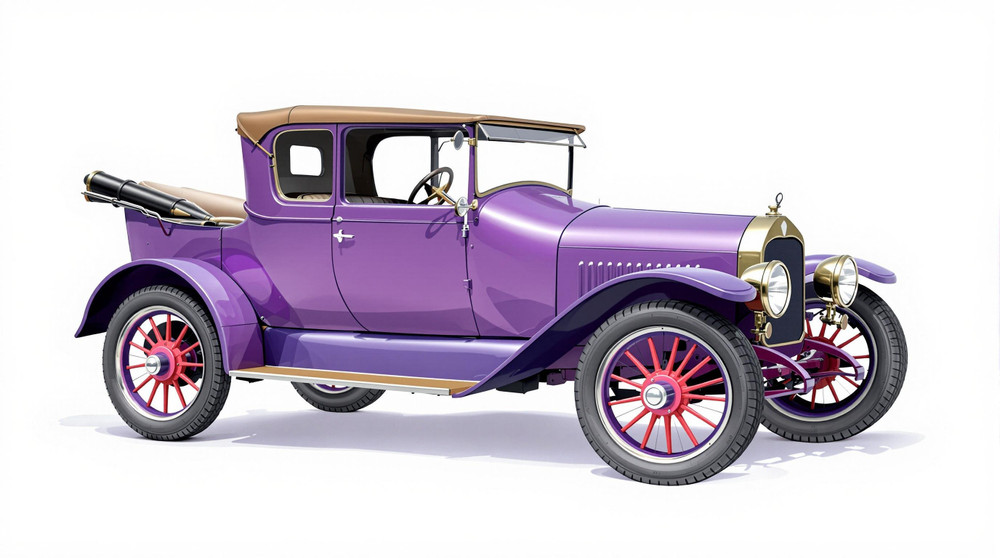
Image of 1915 Hupmobile Model 32, Note: These illustrations use artistic license and may differ from actual historical models.
Performance Metrics
Fundamental Metrics
Emotional Appeal
MMP Rating
| Engine Specifications | |
|---|---|
| Engine Options: | 4-cylinder, in-line, L-head |
| Displacement Range: | 112 cubic inches |
| Horsepower Range: | Estimated 16-20 HP |
| Torque: | Not available |
| Compression Ratio: | Not available |
| Ignition System: | Magneto |
| Cooling System: | Water-cooled |
| Performance Specifications | |
| 0-60 Time: | Not available |
| 1/4 Mile Time: | Not available |
| Top Speed: | 50 mph |
| Transmission and Drive | |
| Drive Type: | Rear-wheel drive |
| Transmission Type: | 3-speed manual |
| Fuel and Efficiency | |
| Fuel System Type: | Carburetor |
| MPG: | Not available |
| Dimensions and Brakes | |
| Brakes: | Mechanical drum brakes |
| Wheelbase: | 112 inches |
| Weight: | 1,800 lbs |
Note: Specifications for classic cars are given to the best of our ability, considering the limited and variant data available.
1915 Hupmobile Model 32: A Prewar American Classic
The 1915 Hupmobile Model 32 brought a confident 32-horsepower four-cylinder engine and practical American engineering to an era when motoring was still an adventure. Built by the Hupp Motor Car Company of Detroit, Michigan, it came from a manufacturer that had earned a reputation for making well-built cars at prices within reach of more than just the wealthiest buyers.
Hupp Motor Car Company was founded by Robert Craig Hupp and his associates in 1909. Its first car, the Model 20, helped establish the young firm, and the Model 32 represented a more powerful step in the company’s early lineup. The timing matters: in 1915, the automobile industry was moving from the brass-era pioneer years toward more standardized production, while roads, repair services, and driving habits were still developing.
A small but telling detail is the Model 32’s name: it referred to its advertised horsepower, not its displacement or model year. It offered owners a noticeably stronger engine than many early low-priced cars, while retaining the straightforward mechanical layout that made cars of the period understandable to a capable owner or local mechanic.
Touring-Car Style and Period Comfort
The Model 32’s appearance is unmistakably early twentieth century. Its upright radiator and hood lead into a long, narrow bonnet, with exposed lamps, separate fenders, running boards, and tall, thin wheels completing the profile. Depending on body style and equipment, nickel-plated details and wire wheels added a touch of polish, but the overall look remained purposeful rather than extravagant.
The open touring body was the most recognizable choice. It typically had seating for several passengers, a folding fabric top, and side curtains that could be fitted for protection from wind and rain. A roadster offered a sportier, more compact alternative. Closed bodies, including coupe or sedan-type configurations, could also appear in the period Hupmobile range, though exact availability varied with year and market. Touring cars were especially practical when enclosed bodies were more expensive and less common.
Inside, the cabin was functional by modern standards but carefully finished for its time. Depending on body and trim, owners could expect upholstered seating in leather or durable cloth, a simple instrument panel, and painted or varnished wood details. The open body made weather protection limited even with a top and curtains, and the driver sat high with a direct view over the long hood.
Factory paint choices were not necessarily identical across every body and dealer order. Dark, conservative colors such as black, deep blue, or maroon suited the period and were common choices across contemporary cars. Bright brass was already giving way to nickel and painted finishes, so the Model 32’s visual appeal came more from its proportions and trim than from extensive brightwork.
Engineering for the Road
At the heart of the Model 32 was a four-cylinder engine rated at 32 horsepower. Power was sent through a manual transmission and driveshaft to the rear wheels, a layout that was becoming the industry norm. The car also used conventional mechanical controls and systems that rewarded a driver who understood the basics of starting, shifting, lubrication, and routine adjustment.
Compared with many early cars, the Model 32’s appeal was its combination of useful power and familiar engineering rather than a single headline-grabbing invention. It belonged to a period when manufacturers were refining practical features such as reliable ignition, improved driveline arrangements, and more standardized controls. These developments helped make motoring more usable for everyday travel, even though operating an early car still required more attention than driving a modern vehicle.
What It Was Like to Drive
There is no dependable factory 0-to-60-mph figure for the 1915 Model 32, and such a test was not a standard way to describe performance when the car was new. A reasonable modern estimate is that reaching 60 mph, if the gearing, engine condition, tires, and road allowed it, could take roughly 35 to 50 seconds or more. That estimate is not a period test result. A top speed in the neighborhood of 45 to 55 mph is plausible for a sound example, but sustained high-speed driving would not be its natural role.
On a smooth road, the Model 32 would feel deliberate and mechanical. The engine’s steady four-cylinder thrum, the vibration through the chassis, and the need to coordinate clutch and gear changes are all part of the experience. Steering and braking require more effort and anticipation than in a modern car, and the driver must plan ahead rather than rely on quick acceleration or powerful brakes.
Its suspension and tall tires could take the edge off modest bumps, but rough roads would still make themselves known through the seat and steering wheel. On a winding road, the narrow tires and period chassis call for measured cornering. The Model 32 is best enjoyed at a relaxed pace, with smooth inputs and plenty of room to stop.
Its Place in American Motoring
The Model 32 helped Hupmobile occupy an important middle ground: more capable than the simplest entry-level cars, yet less exclusive than expensive luxury automobiles. Its power and range of body styles made it suitable for family outings, local business travel, and longer drives on the roads of the day. It was not a dedicated racing machine, but it reflected the growing expectation that a car should be useful beyond a short trip around town.
Its significance is less about one revolutionary feature than about the broader shift it represents. Cars such as the Model 32 helped turn motoring from a novelty into a practical form of transportation. Hupmobile’s early reputation also gave the company a foundation for decades of production. The firm continued building cars until 1940, long after this prewar model had become a reminder of the industry’s formative years.
Ownership, Maintenance, and Reliability
In 1915, a Model 32 might serve as a family car, a touring car, or a business vehicle. Today, surviving examples are primarily collector cars, used for vintage motoring events, local parades, museum displays, and careful pleasure drives. Their open bodies and period controls make them especially engaging at low speeds and in fair weather.
Maintenance is manageable for an owner with mechanical skill, patience, and access to parts knowledge. The engine, transmission, ignition, cooling, and chassis systems are relatively direct compared with those of later cars, but components are old and often require specialist attention. Correct tires, ignition parts, bearings, and body fittings can be harder to source than routine modern service items. Reliability depends heavily on the quality of restoration and regular upkeep, not simply on the car’s original reputation.
Common frustrations include limited weather protection, modest braking performance, slower travel, and the need for frequent checks and adjustments. Parts interchangeability can also be complicated: details may differ by production run, body style, or previous repairs. A prospective owner should look closely at the frame, wood structure in the body, engine condition, and completeness of trim before buying.
Facts, Myths, and Common Criticisms
The Model 32 belongs to the prewar touring era, when a long drive could involve unpaved roads, roadside repairs, and careful route planning. That makes it a compelling participant in vintage events, but there is no widely established record that the 1915 Model 32 held a major speed, endurance, or sales milestone. Likewise, celebrity ownership claims should be treated cautiously unless supported by documentation.
One reasonable production estimate is several thousand Model 32s for the 1915 model year, perhaps in the range of 5,000 to 10,000. This is a best guess rather than a verified factory figure: reliable model-by-model production totals are not readily available, and annual figures for the company can include other models. The number of surviving, well-documented examples is much smaller.
The most frequent criticism is also part of its character: by modern standards, the Model 32 is slow, noisy, exposed to the weather, and demanding to drive. It asks for more attention than a later classic. For enthusiasts, those traits are not necessarily defects. They make the car feel like a piece of living engineering rather than a modern vehicle dressed in vintage clothes.
Collector Value and Availability
Values vary substantially with body style, originality, condition, and the quality of restoration. As a broad current-market estimate, a project or incomplete car might fall around $5,000 to $15,000. A sound, usable example could bring roughly $15,000 to $30,000, while a high-quality restoration or particularly desirable body style may reach approximately $30,000 to $50,000 or more. These are guide ranges, not appraisals, and individual sales can land outside them.
Model 32s are uncommon but not necessarily one-of-a-kind rarities. They appear less often than better-known mass-market survivors, and buyers may need to search specialist clubs, auctions, and prewar-car networks. Over the long term, well-restored early cars have benefited from collector interest, but prices are sensitive to restoration costs, condition, and the smaller market for cars that require hands-on driving. The best-preserved examples are likely to hold interest better than cars needing extensive work.
Why the 1915 Hupmobile Model 32 Matters
The 1915 Hupmobile Model 32 combines a useful 32-horsepower engine, classic open-car styling, and the direct mechanical character of early American motoring. It was built by a Detroit company that helped make automobiles more practical and appealing during a pivotal period in the industry. Its value today lies not in modern speed or convenience, but in the way it brings that transition to life.
For collectors, the Model 32 is more than a handsome prewar touring car. It is a reminder of when every drive demanded participation, and when a dependable automobile could change how far a family or business could reach.
1915 Hupmobile Model 32 Catalog of Parts
 1915 Hupmobile Model 32 Accessory Floor Mat - 12"X17"-AC 39Accessory Floor Mat - made of high quality black rubber with molded original emblem. Also designed to be sewn into new carpets. 12"X17", Each
 1915 Hupmobile Model 32 Clutch and Brake Pedal Pads. 3" wide X 4-1/8" long. Pair-CB 52Clutch and Brake Pedal Pads. 3" wide X 4-1/8" long. Pair
Why Choose Metro?
For over 100 years, Metro Moulded Parts has been the pinnacle of quality in classic car restoration parts. Our commitment to precision and authenticity in every component ensures a perfect fit and an OEM-level appearance.
- Expert Craftsmanship & Quality: Each part is a testament to our dedication to reliability and perfection, crafted from original designs and thoroughly tested.
- Advanced Technology: We use cutting-edge techniques to create flawless, long-lasting parts that surpass others in performance.
- SuperSoft Sponge – The Ultimate Door Seal: Not only are our door seals 30% softer than competitors', but they're also guaranteed to never leak. They effectively reduce wind and road noise, enhancing your classic car's comfort and driving experience.
- Proudly American: Our parts are a product of American craftsmanship, made in the USA with a spirit of excellence and heritage.
- Unrivaled Warranty: We back our products with a 30-year industry-leading warranty, a testament to our confidence in their quality.
Join us in preserving the legacy of classic cars with parts that are crafted for perfection, not just made.