
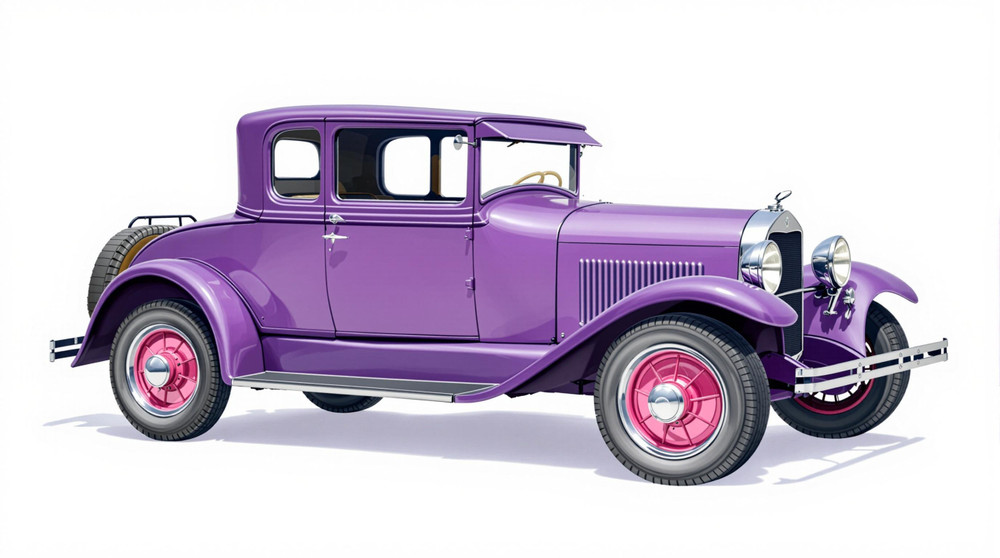
Image of 1925 Hupmobile Model E-1, Note: These illustrations use artistic license and may differ from actual historical models.
Performance Metrics
Fundamental Metrics
Emotional Appeal
MMP Rating
| Engine Specifications | |
|---|---|
| Engine Options: | Inline 4-cylinder |
| Displacement Range: | 2.8L |
| Horsepower Range: | Estimated 20-30 HP |
| Torque: | Not available |
| Compression Ratio: | Not available |
| Ignition System: | Battery and coil |
| Cooling System: | Water-cooled |
| Performance Specifications | |
| 0-60 Time: | Not available |
| 1/4 Mile Time: | Not available |
| Top Speed: | 45-50 mph |
| Transmission and Drive | |
| Drive Type: | Rear-wheel drive |
| Transmission Type: | 3-speed manual |
| Fuel and Efficiency | |
| Fuel System Type: | Carburetor |
| MPG: | Not available |
| Dimensions and Brakes | |
| Brakes: | Mechanical drum brakes |
| Wheelbase: | 112.75 inches |
| Weight: | Estimated 2,400 lbs |
Note: Specifications for classic cars are given to the best of our ability, considering the limited and variant data available.
1925 Hupmobile Model E-1: A Six-Cylinder Classic with Quiet Confidence
The 1925 Hupmobile Model E-1 brought six-cylinder smoothness to buyers who wanted a substantial, well-made American car without stepping up to a luxury marque. Built by the Hupp Motor Car Company of Detroit, it reflects an era when electric starting, enclosed bodies, and more powerful engines were quickly changing what motorists expected from everyday transportation.
Hupmobile was founded by Robert Craig Hupp, whose company began building cars in 1909. The firm earned a reputation for solid engineering and practical value. A notable twist in its history came much later: Hupmobile hired industrial designer Raymond Loewy in the 1930s, helping bring streamlined styling to the company’s cars. The Model E-1 belongs to an earlier, more upright era, but it represents the engineering and manufacturing foundation behind that later design ambition.
Classic Lines, Comfortable Cabin
The Model E-1 has the dignified profile typical of a mid-1920s American car. Its tall radiator, upright windshield, separate fenders, running boards, and narrow tires give it a formal, purposeful stance. Long hood lines draw attention to the six-cylinder engine, while a rear-mounted spare tire and bright metal lamps add the period details that make the car instantly recognizable today.
Inside, the experience depended on body style and trim level. Buyers could expect a straightforward, carefully finished cabin rather than modern-style convenience equipment. Upholstery might be leather or cloth, with broad seats, a large steering wheel, simple instrumentation, and wood or painted-metal trim. Closed bodies offered welcome protection from weather and road dust, while open models made the cabin feel airy but left occupants exposed to wind and rain.
Available paint and upholstery combinations varied by body and production details, so there is no single color scheme that defines every E-1. Period cars commonly appeared in dark, conservative shades, including black, dark blue, and maroon, often complemented by contrasting trim. Today, restored examples may wear colors selected to suit a particular owner’s taste or a documented factory finish.
The E-1 was offered in several body styles during the period, with availability varying by catalog and market. Open touring and roadster forms appealed to buyers who wanted fresh-air motoring; coupes and sedans offered more shelter and year-round practicality. The closed sedan is especially evocative of the decade’s shift toward enclosed family transportation, while touring versions remain among the most photogenic choices for vintage-car events.
Six-Cylinder Power for the 1920s
At the heart of the Model E-1 was a conventional L-head inline-six, generally listed at about 212 cubic inches and 54 horsepower. It was paired with a three-speed manual transmission. Electric starting and lighting were important conveniences by this time, and the car’s six-cylinder layout promised smoother operation than the four-cylinder engines still common in less expensive cars.
The E-1 was not a radical technical breakthrough, nor was it intended to be. Its appeal came from combining established engineering with the increasingly desirable smoothness and flexibility of six-cylinder power. Four-wheel mechanical brakes were typical of cars in this class and period, though their feel and stopping performance are very different from modern hydraulic systems and should be treated accordingly.
That balance helped distinguish Hupmobile from basic transportation at the entry level. The E-1 offered a more refined engine and a substantial road presence, while avoiding the cost and extravagance associated with high-end luxury cars. Its significance lies less in one invention than in making smooth six-cylinder motoring a practical choice for a broader group of American buyers.
Road Manners and Driving Feel
Period performance figures are not as consistent or complete as modern test data. Common specifications put the E-1’s top speed in the neighborhood of 55 to 65 mph, depending on body, gearing, condition, and road surface. A reliable factory 0-to-60-mph figure is difficult to establish, and many surviving cars would be slow to reach that speed, if they can reach it at all. A cautious estimate is well over 30 seconds, rather than anything resembling modern acceleration.
On the road, the six should feel deliberate and comparatively smooth, with modest power arriving gradually. The engine’s sound is a steady mechanical hum, accompanied by the whir of the transmission, tire noise, and the movement of the chassis over an unsealed or uneven road. Gear changes require a practiced hand, and the driver must anticipate stops rather than rely on modern braking distances.
Its tall stance and narrow tires suit steady cruising more than aggressive cornering. The suspension can soften ordinary bumps, but sharp road edges may still produce a firm jolt, and the body can lean noticeably on winding roads. Crosswinds and rutted surfaces demand attention at the steering wheel. The reward is an involving, unfiltered drive that makes the driver part of the machinery rather than a passenger in a sealed cabin.
Living with a Hupmobile
Today, a Model E-1 is best suited to touring, car shows, parades, and occasional scenic drives. It can be driven regularly by an owner who understands antique-car maintenance, but it is not a sensible modern commuter. Its age, modest brakes, slower traffic pace, and limited safety equipment call for careful route planning and defensive driving.
Much of the basic mechanical work is approachable for an experienced home mechanic. The engine and transmission use technologies familiar to restorers of the period, and routine jobs such as lubrication, ignition service, and adjustment are manageable with the right manuals and tools. The bigger challenge is often finding correct parts, body components, upholstery materials, and specialist help. Before purchase, inspect the engine, cooling system, wood structure in the body where applicable, brakes, and chassis for wear or previous repairs.
Reliability depends heavily on restoration quality and upkeep. A properly maintained Hupmobile can be a dependable tour car at antique-car speeds, but an old car is only as reliable as its fuel, ignition, cooling, and lubrication systems. Regular checks matter, and modern traffic can place demands on a car that it was never designed to meet.
Hupmobile Facts and Common Criticisms
The Model E-1 is not generally known for a headline-grabbing speed record or a famous celebrity owner. Its appeal is more representative: it shows what a well-equipped American family car looked and felt like during the transition from open motoring to enclosed, more comfortable transportation. Hupmobile’s broader story includes ambitious engineering and later, highly influential styling, but the E-1 itself is a product of practical evolution rather than a one-off showpiece.
Common criticisms are familiar to owners of many cars from the 1920s. The brakes require more distance and planning than modern drivers expect, the cabin can be noisy and drafty, and parts availability can complicate repairs. Even a healthy example is slow by today’s standards. Those limitations are part of the period experience, but they also mean the car is best enjoyed on suitable roads and at a measured pace.
Collector Value and Rarity
Exact production totals for the Model E-1 are not consistently documented in readily available model-specific records. As a reasoned estimate rather than a confirmed factory figure, production may have been in the tens of thousands, perhaps roughly 15,000 to 25,000 cars across the relevant series and body variations. The number of surviving examples is far smaller, and condition, completeness, body style, and provenance make a major difference to desirability.
As a broad U.S. market estimate, a project car or incomplete example might sell for about $5,000 to $12,000. A presentable driver could fall around $15,000 to $30,000, while a high-quality restoration or particularly desirable body style may reach roughly $35,000 to $55,000 or more. These are guide ranges, not guaranteed sale prices; a rare configuration or exceptional restoration can change the result substantially.
Values for cars like the E-1 tend to be condition-sensitive. The market rewards complete, documented examples more than ambitious projects, while restoration costs can exceed the value of the finished car. Interest in well-presented prewar vehicles supports a steady collector market, but prices are not guaranteed to rise. Buyers should judge each car on its own merits and budget realistically for specialist work.
Why the 1925 Model E-1 Still Matters
The 1925 Hupmobile Model E-1 captures a meaningful moment in American motoring: six-cylinder power was becoming a practical selling point, enclosed bodies were gaining ground, and motorists were beginning to expect more comfort from a car used for everyday travel. Its upright styling and unhurried road manners may feel far removed from modern driving, but they are precisely what make it such an engaging piece of automotive history.
For collectors, the E-1 offers more than vintage looks. It is a tangible example of Hupmobile’s commitment to solid, accessible engineering, and a reminder that progress in the automobile often came through thoughtful refinement rather than a single dramatic invention.
1925 Hupmobile Model E-1 Catalog of Parts
 1925 Hupmobile Model E-1 Accessory Floor Mat - 12"X17"-AC 39Accessory Floor Mat - made of high quality black rubber with molded original emblem. Also designed to be sewn into new carpets. 12"X17", Each
 1925 Hupmobile Model E-1 Clutch and Brake Pedal Pads. 3" wide X 4-1/8" long. Pair-CB 52Clutch and Brake Pedal Pads. 3" wide X 4-1/8" long. Pair
Why Choose Metro?
For over 100 years, Metro Moulded Parts has been the pinnacle of quality in classic car restoration parts. Our commitment to precision and authenticity in every component ensures a perfect fit and an OEM-level appearance.
- Expert Craftsmanship & Quality: Each part is a testament to our dedication to reliability and perfection, crafted from original designs and thoroughly tested.
- Advanced Technology: We use cutting-edge techniques to create flawless, long-lasting parts that surpass others in performance.
- SuperSoft Sponge – The Ultimate Door Seal: Not only are our door seals 30% softer than competitors', but they're also guaranteed to never leak. They effectively reduce wind and road noise, enhancing your classic car's comfort and driving experience.
- Proudly American: Our parts are a product of American craftsmanship, made in the USA with a spirit of excellence and heritage.
- Unrivaled Warranty: We back our products with a 30-year industry-leading warranty, a testament to our confidence in their quality.
Join us in preserving the legacy of classic cars with parts that are crafted for perfection, not just made.