

Image of 1969 Jeep J-100, Note: These illustrations use artistic license and may differ from actual historical models.
Performance Metrics
Fundamental Metrics
Emotional Appeal
MMP Rating
| Engine Specifications | |
|---|---|
| Engine: | AMC 232, AMC 258, AMC 304, AMC 360, AMC 401 |
| Displacement: | 232-401 cu in (3.8-6.6 L) |
| Horsepower: | 100-215 hp (approximately) |
| Torque: | 185-320 lb-ft (approximately) |
| Compression Ratio: | 8.0:1 - 8.5:1 (approximately) |
| Ignition System: | Conventional, distributor |
| Cooling System: | Liquid-cooled |
| Performance Specifications | |
| 0-60 Time: | 15-20 seconds (estimated) |
| 1/4 Mile Time: | 20-25 seconds (estimated) |
| Top Speed: | 80-100 mph (estimated) |
| Transmission and Drive | |
| Drive Type: | Rear-wheel drive (RWD) or Four-wheel drive (4WD) |
| Transmission Type: | 3-speed manual, 4-speed manual, 3-speed automatic |
| Fuel and Efficiency | |
| Fuel System Type: | Carburetor |
| MPG: | 10-15 mpg (estimated) |
| Dimensions and Brakes | |
| Brakes: | Front disc, rear drum |
| Wheelbase: | 119 in (3,023 mm) |
| Weight: | 3,500-4,500 lbs (approximately) |
Note: Specifications for classic cars are given to the best of our ability, considering the limited and variant data available.
1969 Jeep J-100: A Working Truck with Jeep DNA
The 1969 Jeep J-100 was built for the kind of work that could take a truck from a muddy farm track to a town street without changing its personality. It came from Willys Motors, later known as Kaiser Jeep, as part of the J-series pickup family descended from the Gladiator introduced in 1962. The J-100 paired Jeep’s four-wheel-drive know-how with a practical pickup body, making it a distinctive alternative to the larger, more road-focused trucks from Ford, Chevrolet, and Dodge.
By 1969, the J-series had already established an unusual place in Jeep’s lineup. Its design shared much of its engineering and basic architecture with the Wagoneer, Jeep’s upscale four-wheel-drive station wagon. That connection gave the pickup a more modern feel than a simple adaptation of an older military-style truck. One intriguing part of its history is that the early Gladiator platform offered independent front suspension, an uncommon feature for a four-wheel-drive pickup at the time. A 1969 J-100’s exact equipment depends on how it was ordered, but the model belongs to a family that helped push utility trucks toward more versatile, civilized designs.
J-100 Styling and Cab Details
The J-100 has a purposeful, square-shouldered shape, with a broad hood, upright windshield, and a cab that looks ready for a long day’s work. Its front end wears a wide grille and round headlights, while the flat body sides and clearly defined wheel arches keep the design simple and easy to repair. It is handsome in the way a well-used tool can be handsome: the proportions are balanced, but nothing appears to have been added just for decoration.
Buyers could choose between two familiar pickup-bed treatments. The Thriftside used a stepside-style box with rear fenders outside the bed, while the Townside had smoother, slab-sided bodywork with the rear fenders integrated into the bed sides. Bed and chassis choices varied across the J-series range, and equipment could also be specified for work, hauling, or recreational use. The J-100 was the lighter-duty end of the lineup, while heavier J-series models served buyers who needed more payload capacity.
Inside, the J-100 was straightforward rather than luxurious. The dashboard was functional, with clear, legible instruments and controls laid out for practical use. Expect painted metal, durable vinyl, simple upholstery, and hard-wearing floor coverings on a typical truck, though equipment and materials varied with options and condition. The cabin’s appeal today is partly its simplicity: there are fewer layers of trim to hide the truck’s basic mechanical character, and a careful owner can usually understand what each control does without a manual.
Period paint choices varied by model year, trim, and market. Buyers could find work-truck neutrals such as white and black alongside stronger colors including red, blue, green, and yellow shades. A clean two-tone or vivid factory color can make a J-100 especially eye-catching, but many surviving examples have been repainted, so original paint codes and old finish traces are worth checking during a restoration.
Engines, 4x4 Hardware, and Innovation
Engine availability depended on configuration and market. The 1969 J-series could be ordered with an AMC 232-cubic-inch inline-six or a 350-cubic-inch Buick-derived V8, commonly called the Dauntless 350. The six-cylinder suited buyers who valued simplicity and economy for a working truck, while the V8 brought stronger torque for hauling and climbing. Manual transmissions were common, with automatic availability depending on the engine and specification. As with any classic Jeep, the engine and drivetrain in an individual truck should be verified by its serial numbers and components rather than assumed from its badges.
Four-wheel drive was a defining option, not a given on every truck. A properly equipped 4x4 J-100 used a transfer case and heavy-duty axles to send power to both ends of the truck when conditions demanded it. Some J-series trucks were two-wheel drive, so buyers looking for a genuine trail or winter truck should confirm the front axle, transfer case, and related controls are present and working.
The J-series’ biggest contribution was not a single high-tech gadget. It was the idea that a rugged four-wheel-drive pickup could share modern engineering and comfort-oriented development with a passenger vehicle. Its relationship to the Wagoneer helped distinguish it from more conventional work trucks, while the family’s independent-front-suspension option was an unusually forward-looking choice for a 4x4 pickup. That option was not fitted to every truck, and buyers should not confuse it with later Jeep systems such as Quadra-Trac, which arrived after 1969.
How the 1969 J-100 Drives
Period factory performance figures are not readily available for every engine, axle ratio, transmission, and body combination. As a practical estimate, a V8-equipped J-100 might reach 0 to 60 mph in roughly 14 to 18 seconds, while a six-cylinder truck could take 20 seconds or more. Top speed would generally fall in the neighborhood of 80 to 95 mph, depending on gearing, tires, condition, and load. These are estimates, not guaranteed factory specifications, and the J-100 was designed to work rather than chase modern traffic at high speed.
Behind the wheel, the truck feels substantial. The hood stretches ahead, the seating position is upright, and the controls have the direct, mechanical feel expected of a late-1960s utility vehicle. A healthy V8 makes a deep, unhurried rumble and provides useful low-speed pulling power. The six is quieter and more modest, but still suits steady farm, road, and light-duty use.
On smooth pavement, the J-100 can feel stable and reassuring, though its steering and braking will not have the precision of a modern pickup. Rough roads bring out its truck character: bumps and broken pavement are transmitted more clearly than they would be in a current SUV. On winding roads, it rewards a measured pace. Its high center of gravity, vintage tires, and relatively slow steering mean it is better driven with anticipation than hustled into corners. A four-wheel-drive version is most at home on gravel, snow, muddy access roads, and other low-grip surfaces, where its traction matters more than outright speed.
Living with a J-100
Owners use the J-100 as a weekend driver, farm truck, vintage show vehicle, camping rig, or restoration project. A well-sorted example can handle local errands and occasional longer trips, but it is not an effortless modern daily driver. Fuel consumption, braking distance, cabin noise, and highway comfort are all products of its era. A stock truck is generally more suited to relaxed cruising and practical use than to towing heavy modern loads or sustained high-speed travel.
Routine service is approachable for an owner comfortable with basic mechanical work. The truck’s straightforward construction, conventional engine layouts, and sturdy chassis make many repairs easier to understand than those on a modern vehicle. However, age matters. Rust in the frame, cab corners, floors, bed, and body mounts can turn an apparently simple project into a major one. Four-wheel-drive trucks also need careful inspection of the transfer case, front axle, driveshafts, and hubs. Parts availability is reasonable for common service items, but trim pieces, model-specific body parts, and some original components can take more searching.
J-100 Trivia and Common Complaints
The J-100 belongs to the Gladiator-era Jeep pickup family, but Jeep’s naming practices changed over time. “Gladiator” is strongly associated with the early J-series trucks, while J-series model designations such as J-100 identify the particular line and duty class. This can create confusion in listings, where sellers may use “Gladiator” broadly even when describing a specific J-series model.
There is no widely recognized J-100 land-speed record or famous competition victory that defines the model. Its reputation is built on everyday utility and four-wheel-drive capability rather than racing or celebrity ownership. That is part of its appeal: the truck represents the working side of Jeep history, alongside more famous vehicles such as the CJ and Wagoneer.
Common criticisms are predictable for a 1969 truck. The ride can be firm, the cabin can be noisy, and fuel economy is modest, especially with a V8 and four-wheel drive. Rust and deferred maintenance are often more important concerns than the original design. A neglected truck may need brake, steering, electrical, and cooling-system work before it is safe and dependable. Conversely, a well-maintained J-100 can be a satisfying classic because its mechanical systems are relatively direct and its character is unmistakable.
Collector Values and Rarity
Exact 1969 J-100 production totals are difficult to establish from commonly available public records. Jeep did not consistently publish model-by-model numbers that make a firm J-100 count easy to verify. As a cautious estimate rather than a factory figure, production may have been in the low thousands for the model year, perhaps around 1,500 to 4,000 trucks. The number surviving in good condition is considerably smaller, particularly for original, well-documented four-wheel-drive examples.
As a broad U.S. market estimate for 2026, a rough project might bring about $5,000 to $12,000, depending on completeness and rust. A running driver in solid condition could fall around $15,000 to $30,000. A carefully restored or unusually original example might reach $30,000 to $50,000 or more, with exceptional trucks potentially exceeding that range. These figures are estimates, not appraisals. Two-wheel-drive models, drivetrain condition, originality, bed style, rust, and the quality of any restoration can all shift the price substantially.
J-100 values have generally gained attention as interest in vintage 4x4s has grown, but they remain less consistently valuable than iconic Jeep models such as the Wagoneer or certain CJ variants. The best examples are likely to hold their appeal, while rough trucks can be costly to restore relative to their finished value. Buyers should compare recent sales of similar trucks and budget for mechanical sorting, not just the purchase price.
Why the Jeep J-100 Still Matters
The 1969 Jeep J-100 brought together a practical pickup body, Jeep’s four-wheel-drive heritage, and engineering shared with the Wagoneer. It was not the fastest or most polished truck of its era, but it offered a distinctive mix of capability, utility, and forward-looking design. Today, its direct mechanical character and uncommon shape make it an appealing classic for owners who want something more unusual than a mainstream vintage pickup.
A good J-100 is more than a rugged old truck. It is a snapshot of Jeep expanding beyond the trail and into the working lives of farmers, tradespeople, and outdoor enthusiasts. That blend of honest utility and pioneering Jeep character is what keeps the 1969 J-100 worth seeking out.
1969 Jeep J-100 Catalog of Parts
 1969 Jeep J-100 Shock Absorber Grommet. 1" bottom O.D-BN 11Shock Absorber Grommet. 1" bottom O.D., 3/4" high, with 5/8" I.D. Each
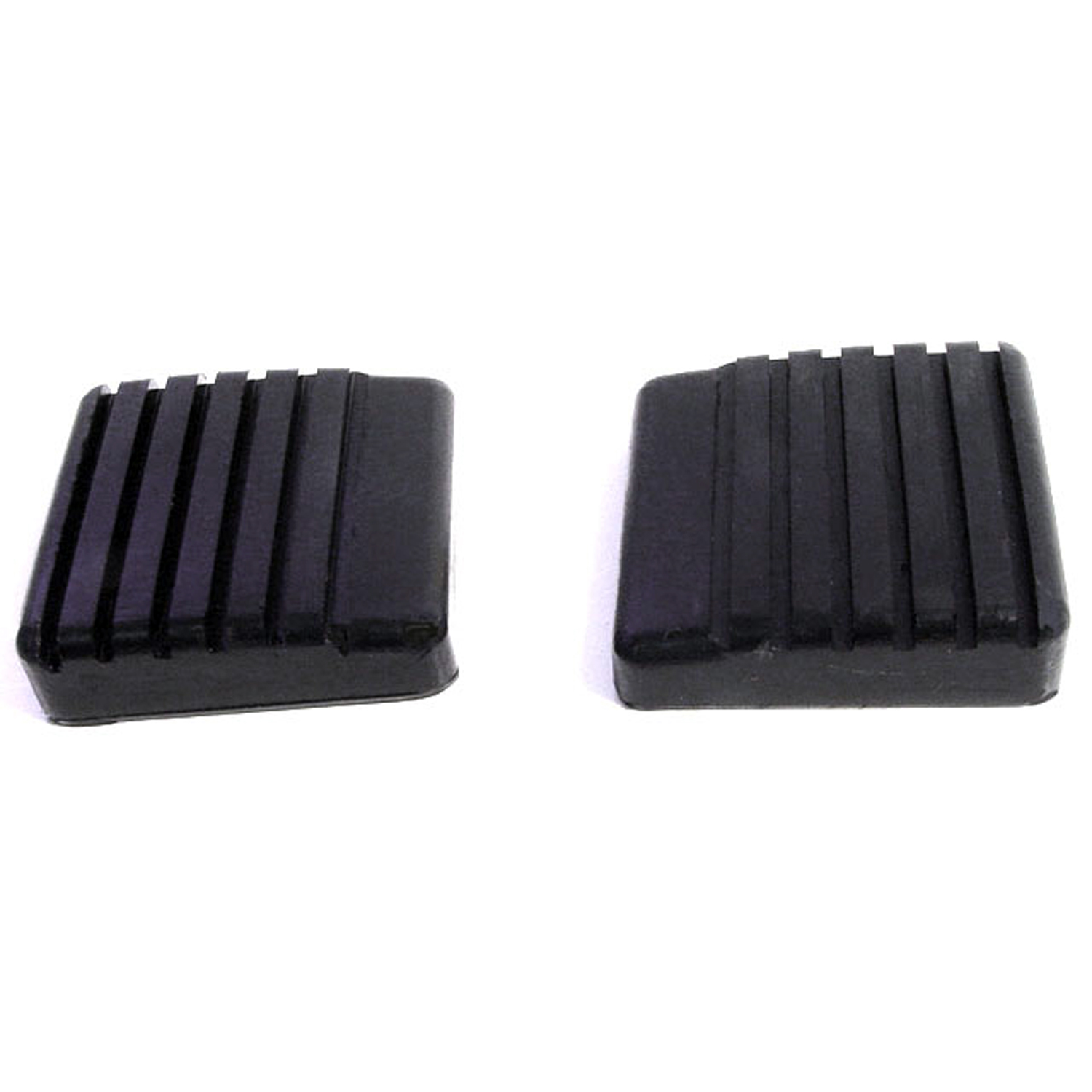 1969 Jeep J-100 Clutch and Brake Pedal Pads. Pair-CB 61-BClutch and Brake Pedal Pads. Pair
Why Choose Metro?
For over 100 years, Metro Moulded Parts has been the pinnacle of quality in classic car restoration parts. Our commitment to precision and authenticity in every component ensures a perfect fit and an OEM-level appearance.
- Expert Craftsmanship & Quality: Each part is a testament to our dedication to reliability and perfection, crafted from original designs and thoroughly tested.
- Advanced Technology: We use cutting-edge techniques to create flawless, long-lasting parts that surpass others in performance.
- SuperSoft Sponge – The Ultimate Door Seal: Not only are our door seals 30% softer than competitors', but they're also guaranteed to never leak. They effectively reduce wind and road noise, enhancing your classic car's comfort and driving experience.
- Proudly American: Our parts are a product of American craftsmanship, made in the USA with a spirit of excellence and heritage.
- Unrivaled Warranty: We back our products with a 30-year industry-leading warranty, a testament to our confidence in their quality.
Join us in preserving the legacy of classic cars with parts that are crafted for perfection, not just made.