
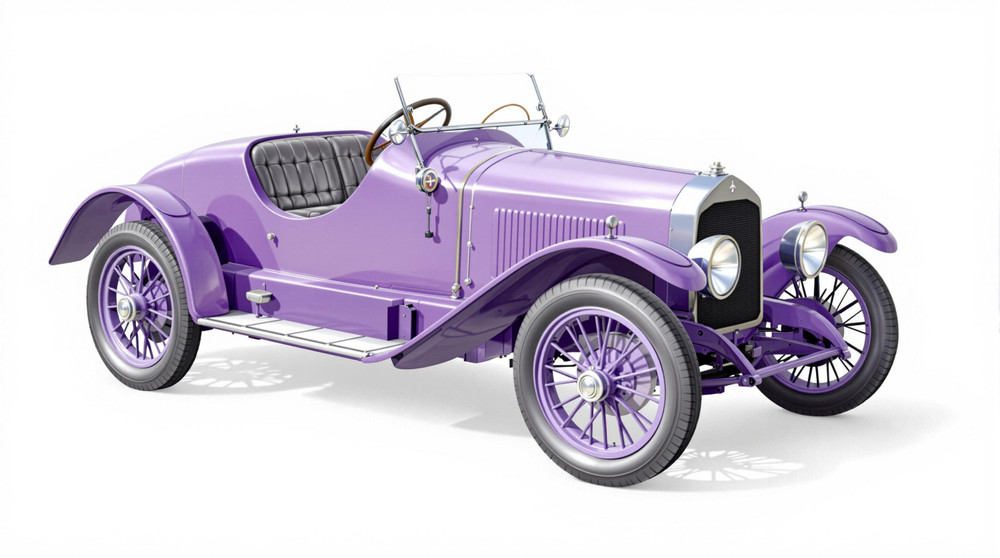
Image of 1917 Jordan Four, Note: These illustrations use artistic license and may differ from actual historical models.
Performance Metrics
Fundamental Metrics
Emotional Appeal
MMP Rating
| Engine Specifications | |
|---|---|
| Engine Options: | Inline 4 |
| Displacement Range: | 3.0L |
| Horsepower Range: | Estimated 20-30 HP |
| Torque: | Not available |
| Compression Ratio: | Not available |
| Ignition System: | Magneto |
| Cooling System: | Water-cooled |
| Performance Specifications | |
| 0-60 Time: | Not available |
| 1/4 Mile Time: | Not available |
| Top Speed: | 50 mph |
| Transmission and Drive | |
| Drive Type: | Rear-wheel drive |
| Transmission Type: | 3-speed manual |
| Fuel and Efficiency | |
| Fuel System Type: | Carburetor |
| MPG: | Not available |
| Dimensions and Brakes | |
| Brakes: | Mechanical drum brakes |
| Wheelbase: | 125 inches |
| Weight: | Estimated 2,500 lbs |
Note: Specifications for classic cars are given to the best of our ability, considering the limited and variant data available.
1917 Jordan Four: Cleveland’s Independent Innovator
The 1917 Jordan Four was a compact, four-cylinder touring car from a young Cleveland manufacturer determined to make motoring feel stylish as well as practical. Built by the Jordan Motor Car Company, it arrived as American automakers were expanding rapidly and the country was on the brink of entering the First World War. Although the Four was not a mass-market giant, it helped establish the independent company’s identity: a well-presented automobile with a distinctive name and a sales pitch aimed at drivers who wanted more than basic transportation.
The company was founded in 1916 by Edward S. “Ned” Jordan, an experienced automobile executive with a talent for promotion. The Four was among the cars offered during the company’s early years, before Jordan became especially famous for the more flamboyant Playboy models of the 1920s. A useful bit of context: the 1917 Four belongs to the company’s formative period, when Jordan was still building its reputation and refining the mix of purchased components and in-house design that characterized many independent automakers.
One detail that makes the Jordan story memorable is the company’s approach to advertising. Jordan understood that a car could be sold as an expression of taste and personality, not merely as a collection of mechanical parts. That idea would become particularly visible in later campaigns, but the ambition was already present in the company’s early cars.
Classic Open-Car Styling and Equipment
The Jordan Four wore the upright, purposeful proportions typical of a mid-1910s automobile, but its open bodywork gave it an inviting, sociable character. A tall, narrow radiator sat at the front, flanked by separate lamps and capped by a slim hood that led back toward a long passenger compartment. Exposed fenders followed the shape of the wheels, while running boards made it easier to climb aboard. The overall effect was elegant without being overly ornate: a car designed to look at home on a country road or outside a town hotel.
Open touring and roadster configurations are associated with early Jordan fours, though exact offerings could vary by model year and catalog. The touring body, with room for several passengers and a folding top, was a natural choice for family outings and longer drives. A roadster offered a more compact, sporting appearance. Closed-car bodies were available in the wider market at the time, but surviving evidence for specific 1917 Jordan Four body combinations is limited, so buyers and restorers should verify the exact configuration of an individual car rather than assume every style appeared in the catalog.
Inside, the Four would have been straightforward rather than luxurious by later standards. Expect a wood-framed body, upholstered bench seating, a large steering wheel, exposed controls, and a simple instrument panel. Leather or durable cloth upholstery and carefully finished trim were common in cars of this class, but original materials and colors depended on the body and factory specification. A surviving car may have been re-trimmed or repainted many times, so period photographs and documentation are valuable when assessing authenticity.
Paint choices were part of the era’s appeal, but a dependable, complete factory color list for the 1917 Four is difficult to establish. Dark, practical finishes were common across the industry, while brighter or contrasting treatments could be offered on some cars. Rather than assign a specific color palette without strong documentation, it is safest to regard original color as a car-by-car research question. Today, deep greens, burgundies, and black are popular restoration choices for cars of this period, whether or not they match a particular Jordan’s original finish.
Four-Cylinder Engineering for 1917
The Jordan Four used a conventional front-engine, rear-wheel-drive layout. Period references commonly identify it as a four-cylinder car in roughly the 25-horsepower class, paired with a manual transmission. Exact specifications can differ among surviving references, and early manufacturers sometimes changed equipment during a model run. For a restoration or concours entry, the chassis number, original literature, and physical components should take precedence over a generalized specification sheet.
By modern standards, its technology was simple. The driver managed a clutch, a manual gearbox, and mechanical controls, while braking and suspension systems reflected the standards of the day. There were no electronic aids, power steering, or modern safety systems. The advantage was mechanical accessibility: a capable owner or local mechanic could understand much of the car’s operation without specialized diagnostic equipment.
Jordan’s significance was not that the Four introduced a revolutionary engine or transmission. Its appeal lay in combining established mechanical ideas with a deliberate sense of presentation. At a time when many buyers judged cars primarily by reliability, price, and utility, Jordan was already working to make styling and personality part of the purchase.
Road Speed, Ride, and Driving Feel
Reliable factory acceleration figures for a 1917 Jordan Four are not generally available, and a modern 0-to-60-mph comparison is not especially useful for a car of this age. With output around the 25-horsepower range, a healthy example would be best understood as a steady road car rather than a fast one. A realistic period-style top-speed estimate is approximately 40 to 50 mph, depending on gearing, body style, mechanical condition, tire size, and road surface. Sustained high-speed running would not be wise in an unrestored or lightly maintained example.
Acceleration would feel measured. The driver would need to coordinate the clutch and gear changes, keep an eye on engine speed, and plan ahead when approaching hills or traffic. On rough roads, the suspension and tall tires would absorb some irregularities, but the ride would still be busy by modern standards. The high seating position and relatively narrow tires make the car feel connected to the road, while bumps and ruts demand attention through the steering wheel.
On a winding road, the Jordan rewards a deliberate pace. Steering effort is likely to be substantial at low speeds, and braking distances are long compared with a contemporary car. The engine’s mechanical sounds, along with the transmission and open-air rush around the body, are part of the experience. Driving one is less about quick acceleration than about managing the machinery and enjoying a very direct connection between driver, car, and road.
Why the Jordan Four Matters
The 1917 Four represents the early work of an independent automaker entering a crowded industry. Its place in automotive history is not based on a single technical breakthrough. Instead, it illustrates how a smaller manufacturer could compete by giving a conventional automobile a distinct identity. Jordan’s later advertising became particularly influential for its evocative, lifestyle-focused tone, most famously in the 1923 “Somewhere West of Laramie” campaign for the Jordan Playboy.
The Four also reflects a transitional moment. American motoring was moving from an activity for the well-to-do toward broader adoption, while the First World War brought uncertainty and pressure on labor and materials. Small automakers had to balance ambition with the practical challenges of sourcing components, maintaining production, and competing with firms that had much greater manufacturing scale.
Jordan did not reshape automotive engineering in the way that mass production or later safety innovations did. Its lasting influence is more cultural and commercial: the company helped show that styling, naming, and emotional advertising could distinguish a car in a market increasingly filled with similar mechanical formulas.
Ownership, Maintenance, and Reliability
A 1917 Jordan Four today is best suited to touring events, historic displays, and careful recreational drives. It is not a sensible daily driver in modern traffic. Its pace, braking, lighting, and lack of contemporary safety equipment call for calm routes and considerate driving. An experienced owner may enjoy short local outings, but long-distance use requires preparation, spare parts, and a realistic understanding of the car’s limitations.
Maintenance is hands-on. Owners should expect regular attention to lubrication, ignition, fuel delivery, cooling, wheel bearings, tires, and the braking system. Parts availability can be more challenging than it is for a Ford Model T, and some components may require specialist knowledge or custom fabrication. Even so, the basic mechanical layout is understandable to a skilled vintage-car mechanic. The difficult part is often finding correct parts and preserving the car’s originality, not deciphering complex technology.
Reliability depends heavily on condition. A well-sorted Jordan can be enjoyable on appropriate roads, but age, past repairs, and long periods of storage can create hidden problems. Before buying, inspect the frame, wood body structure, engine, transmission, steering, and brakes. Confirm that the car can be safely stopped and steered before considering any road use.
Jordan Four Trivia and Common Criticisms
The Jordan Four belongs to a brand whose identity grew far beyond its engineering specifications. Ned Jordan’s marketing instincts helped make the company one of the more recognizable independent names of its era, even though it never reached the production scale of the industry’s largest manufacturers. The later Playboy is the best-known Jordan, but the early Four offers a view of the company before its most famous advertising and styling moments.
No widely documented speed, endurance, or sales record is associated specifically with the 1917 Four. Nor is there a famous celebrity ownership story that can be confidently tied to the model. Its historical interest comes instead from its rarity and its connection to Jordan’s early years. As with many small-manufacturer cars, individual examples may have unusual bodywork or equipment, but unusual does not automatically mean factory-original.
Common criticisms are familiar to anyone who drives a prewar car: modest performance, heavy controls, limited braking, and the need for frequent maintenance. Parts can also be difficult to source. Those drawbacks are real, but they are part of the ownership equation rather than evidence that the car was poorly conceived for its time.
Collector Value and Availability
The Jordan Four is a scarce collector car, and surviving examples appear far less often than more common contemporary models. A precise production total for the 1917 Four is not readily established. As a cautious estimate, its output may have been in the low thousands or below, but that figure should not be treated as a documented factory total. Surviving cars are likely to number only a small fraction of original production.
As a broad present-day estimate in the U.S. market, a project car might bring roughly $15,000 to $30,000, while a sound, usable example could fall around $30,000 to $60,000. A high-quality restoration, especially one with a desirable body style and strong provenance, might reach $60,000 to $90,000 or more. These are indicative ranges, not formal appraisals. Condition, originality, completeness, documentation, and the quality of the restoration can move the price substantially.
Values for rare prewar cars are uneven. The Jordan’s limited availability can attract collectors, but its smaller name recognition and specialist parts needs narrow the buyer pool. Well-documented, correctly restored examples should hold interest better than poorly executed projects, though broad claims of steady appreciation would be unwise. Buyers should compare recent sales of similar cars and consult a marque specialist before making a major purchase.
A Small Car with a Big Personality
The 1917 Jordan Four is not remembered for setting a speed record or introducing a groundbreaking mechanical system. Its appeal is more personal: it is an early product of a company that understood the value of character, style, and storytelling. With its open touring-car lines, hands-on mechanical nature, and connection to Ned Jordan’s ambitious Cleveland enterprise, the Four offers a rewarding glimpse into an important chapter of American motoring.
For collectors who value rare independents as much as famous mass-market classics, the Jordan Four is a compelling survivor. It asks its driver to slow down, pay attention, and participate in the journey, which may be exactly what makes this century-old car feel so alive.
1917 Jordan Four Catalog of Parts
 1917 Jordan Four Accessory Floor Mat - 12"X17"-AC 50Accessory Floor Mat - made of high quality black rubber with molded original emblem. Also designed to be sewn into new carpets. 12"X17", Each
Why Choose Metro?
For over 100 years, Metro Moulded Parts has been the pinnacle of quality in classic car restoration parts. Our commitment to precision and authenticity in every component ensures a perfect fit and an OEM-level appearance.
- Expert Craftsmanship & Quality: Each part is a testament to our dedication to reliability and perfection, crafted from original designs and thoroughly tested.
- Advanced Technology: We use cutting-edge techniques to create flawless, long-lasting parts that surpass others in performance.
- SuperSoft Sponge – The Ultimate Door Seal: Not only are our door seals 30% softer than competitors', but they're also guaranteed to never leak. They effectively reduce wind and road noise, enhancing your classic car's comfort and driving experience.
- Proudly American: Our parts are a product of American craftsmanship, made in the USA with a spirit of excellence and heritage.
- Unrivaled Warranty: We back our products with a 30-year industry-leading warranty, a testament to our confidence in their quality.
Join us in preserving the legacy of classic cars with parts that are crafted for perfection, not just made.