
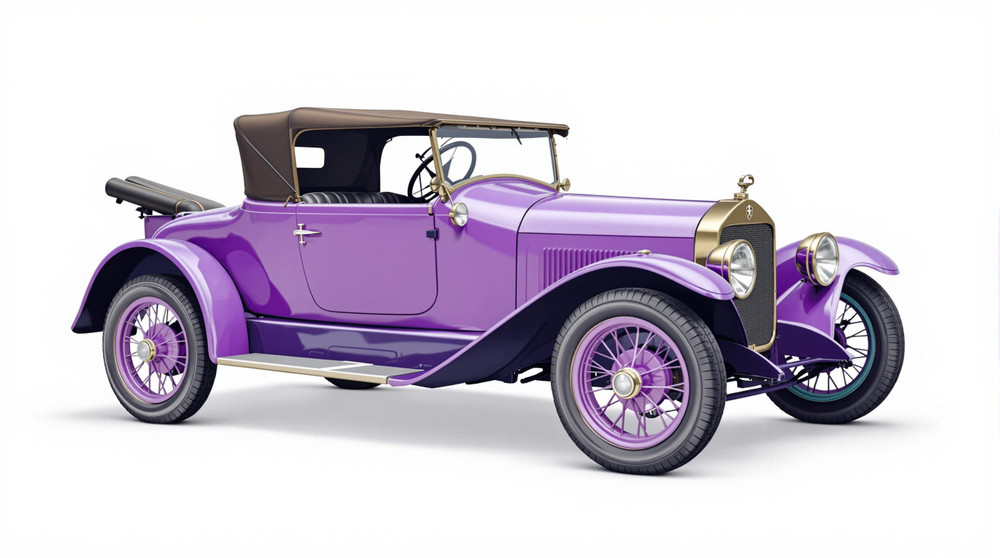
Image of 1922 Jordan Model F, Note: These illustrations use artistic license and may differ from actual historical models.
Performance Metrics
Fundamental Metrics
Emotional Appeal
MMP Rating
| Engine Specifications | |
|---|---|
| Engine Options: | Inline 4 |
| Displacement Range: | 3.0L |
| Horsepower Range: | Estimated 40-50 HP |
| Torque: | Not available |
| Compression Ratio: | Not available |
| Ignition System: | Battery and coil |
| Cooling System: | Water-cooled |
| Performance Specifications | |
| 0-60 Time: | Not available |
| 1/4 Mile Time: | Not available |
| Top Speed: | 60 mph |
| Transmission and Drive | |
| Drive Type: | Rear-wheel drive |
| Transmission Type: | 3-speed manual |
| Fuel and Efficiency | |
| Fuel System Type: | Carburetor |
| MPG: | Not available |
| Dimensions and Brakes | |
| Brakes: | Mechanical drum brakes |
| Wheelbase: | 125 inches |
| Weight: | Estimated 2,500 lbs |
Note: Specifications for classic cars are given to the best of our ability, considering the limited and variant data available.
1922 Jordan Model F: A Distinctive American Classic
The 1922 Jordan Model F was built for motorists who wanted more than basic transportation: it promised a measure of style, individuality, and open-road character rarely found in an ordinary family car of the period. It came from the Jordan Motor Car Company of Cleveland, Ohio, founded by Edward S. “Ned” Jordan in 1916. Jordan’s ambition was to make cars with the flair of a custom-bodied automobile while selling them as complete, factory-built products.
The Model F belongs to the company’s early-1920s range, when Jordan was establishing itself as a small but attention-getting American manufacturer. Its exact equipment could vary by body style and production specification, so surviving cars and period references do not always agree on every detail. One point is clear: the Model F carried the Jordan approach of combining conventional mechanical engineering with styling intended to stand out.
A particularly memorable chapter in Jordan history came through its advertising. The company’s famous “Somewhere West of Laramie” campaign celebrated freedom, fashion, and the open road. The line is most closely associated with the Jordan Playboy, a separate Jordan model, but it captures the adventurous image the company cultivated across its range.
Jordan Model F Design and Styling
The Model F has the upright, purposeful proportions of a car from the early 1920s, but it avoids looking purely utilitarian. Its long hood, exposed running boards, separate fenders, and tall radiator give it a formal profile. Depending on the body, the passenger compartment sits well back from the front axle, creating the impression of a substantial engine bay and a confident stance.
Details such as the lamps, windshield, hood louvers, and radiator treatment give each example much of its personality. Open versions look especially period-correct with a folded canvas top, while enclosed bodies have a more dignified, almost coachbuilt appearance. Jordan’s design philosophy favored visual presence rather than radical streamlining. This was a car meant to be noticed on a town street or country road.
Inside, expect the materials and fittings typical of a quality American car of its era: upholstered seating, a wood or wood-finished dashboard, metal controls, and a straightforward instrument panel. The cabin was not luxurious by modern standards, but its appeal comes from tangible, repairable materials and the craftsmanship visible in the trim. Condition matters greatly today. Original upholstery, instruments, and switchgear can be difficult to replace with parts that match the car’s period character.
Jordan offered its cars in a range of body and finish combinations, and color was part of the company’s appeal. Buyers could choose from period shades that included rich reds, blues, greens, and darker formal colors, with availability depending on the body and year. Exact Model F paint charts are not consistently documented, so a claimed original color should be checked against factory records or evidence beneath the car’s current finish.
Model F body availability also depended on the specific catalog offering and market. Touring, roadster, coupe, and sedan-style bodies were common choices across Jordan’s range, but not every body was necessarily offered on every chassis. Open touring and roadster configurations are often the most visually compelling today, while enclosed bodies offer greater protection and a more formal look. Confirming a particular car’s original body is important, since bodies could be changed or recreated over the decades.
Engineering and Historical Significance
The Model F was not a mass-market technology breakthrough. Its significance lies more in how Jordan presented an automobile: not simply as a mechanical appliance, but as an expression of taste and personality. That was a notable distinction in a period when many manufacturers concentrated on dependable, standardized transportation and conservative styling.
Jordan operated as a relatively small independent automaker in a rapidly consolidating industry. It competed against much larger companies by emphasizing distinctive design and persuasive marketing. The strategy helped the brand earn a reputation beyond its production scale, even though it could not ultimately match the manufacturing reach or financial resources of Detroit’s biggest firms.
Mechanically, the Model F followed familiar early-1920s practice: a front-mounted engine, rear-wheel drive, a manual transmission, and a separate chassis. Period descriptions and surviving-car listings commonly identify Model F examples as six-cylinder cars, often described at roughly 50 horsepower. Specifications can vary by configuration, and engine or chassis numbers should be checked before treating a particular figure as definitive. The car’s appeal is less about introducing a new engineering layout than about presenting established technology in a distinctive package.
Performance and Road Manners
A sound Model F should be thought of as a brisk touring car by 1922 standards, not a modern performance vehicle. Depending on engine condition, gearing, body weight, and road surface, a reasonable period-style estimate for top speed is roughly 50 to 60 mph. That is an estimate rather than a guaranteed factory figure for every Model F.
There is no dependable factory 0-to-60-mph figure to quote. Acceleration testing was not routinely reported in the modern format, and a century of changes to engines, tires, and gearing makes a present-day number especially unreliable. In practical terms, expect leisurely acceleration by current standards, with the driver needing to plan overtakes and hills well ahead.
The driving experience is hands-on. The driver works a manual gearbox, manages the controls with more attention than a modern car demands, and feels the road through a comparatively simple suspension system. On broken surfaces, the car can pitch and bounce, particularly with an open body and period tires. On a winding road, its steering and brakes call for a measured approach rather than quick corrections or late braking.
Sound is part of the attraction. A healthy six-cylinder engine should produce a steady, mechanical note rather than the muted quiet of a modern car. Expect wind around the windshield, tire noise, and the occasional rattle from vintage fittings. The result is engaging and direct, but it rewards smooth inputs and moderate speeds.
Owning a 1922 Jordan Model F
Today, the Model F is best suited to touring events, local shows, historic motoring gatherings, and careful weekend drives. It can be driven on public roads when properly maintained and registered, but it is not an ideal modern daily driver. Traffic speeds, limited braking performance, period lighting, and the lack of contemporary safety equipment all call for sensible route planning.
Routine service follows familiar vintage-car principles: regular lubrication, attention to ignition and fuel systems, careful cooling-system checks, and frequent inspection of tires, steering, and brakes. Repairs can be straightforward for an owner comfortable with prewar machinery, since many systems are mechanical and accessible. The challenge is often not complexity but parts. Jordan-specific trim, body panels, and certain engine components may require specialist sourcing, careful repair, or fabrication.
Reliability depends heavily on the quality of restoration and ongoing maintenance. A well-sorted car can be enjoyable on short tours, but a recently purchased example should receive a thorough mechanical inspection before a long drive. The cooling system, fuel lines, wheel bearings, brake condition, and tire age deserve particular attention.
Jordan Model F Facts and Myths
The Model F’s most useful bit of trivia is its connection to an unusually strong brand identity. Jordan understood that a car could be sold through an idea as well as a specification sheet. The company’s celebrated advertising helped make Jordan a recognizable name even though it was a much smaller producer than Ford, General Motors, or Studebaker.
There is no widely recognized Model F speed or endurance record, and it is not chiefly remembered as a competition car. Nor is there a well-established celebrity-owner story that defines the model. Its historical interest comes instead from its place in the independent American automobile industry and from the company’s distinctive approach to styling and promotion.
Common criticisms are much the same as those aimed at many cars of its era. Braking and acceleration are modest by modern standards, weather protection varies by body style, and parts availability can be frustrating. The Model F also lacks the instant name recognition of some better-known vintage marques. For enthusiasts, those drawbacks are balanced by its individuality and by the pleasure of driving a less familiar piece of American automotive history.
Collector Value and Rarity
There is no reliable, widely published production total for the 1922 Model F alone. Jordan produced cars in comparatively small numbers, and model-by-model figures are difficult to establish from readily available records. A reasonable working estimate is that Model F production was in the hundreds to low thousands, rather than the tens of thousands. That is a best-guess range, not a confirmed factory count.
Surviving examples are uncommon, and cars offered for sale may appear only occasionally. As a broad U.S. market estimate in 2026, a project or incomplete car might fall around $10,000 to $20,000, while a usable, driver-quality example could be roughly $25,000 to $45,000. A highly restored, documented, or especially attractive example may reach $50,000 to $75,000 or more. Body style, originality, mechanical condition, provenance, and the quality of restoration can move the price substantially.
Values for uncommon prewar cars tend to be uneven rather than steadily rising. Well-documented, properly restored examples can hold collector interest, but the buyer pool is narrower than it is for famous mass-market classics. That means condition and presentation matter more than a simple claim of rarity. Over the long term, the best examples may appreciate, but ownership should be driven by enthusiasm rather than expectations of a guaranteed investment return.
Why the 1922 Jordan Model F Still Matters
The Jordan Model F offers a snapshot of an ambitious moment in American motoring. It combined familiar early-1920s engineering with the styling, color, and promotional confidence of a company determined to look different. It is not remembered for setting a speed record or inventing a major new technology. Its distinction is more human: Jordan treated the automobile as a personal statement at a time when cars were becoming everyday necessities.
For collectors, that makes the Model F more than an uncommon old car. It is a reminder that the American automobile story was shaped not only by giants, but also by independent makers willing to put character on the road.
1922 Jordan Model F Catalog of Parts
 1922 Jordan Model F Accessory Floor Mat - 12"X17"-AC 50Accessory Floor Mat - made of high quality black rubber with molded original emblem. Also designed to be sewn into new carpets. 12"X17", Each
Why Choose Metro?
For over 100 years, Metro Moulded Parts has been the pinnacle of quality in classic car restoration parts. Our commitment to precision and authenticity in every component ensures a perfect fit and an OEM-level appearance.
- Expert Craftsmanship & Quality: Each part is a testament to our dedication to reliability and perfection, crafted from original designs and thoroughly tested.
- Advanced Technology: We use cutting-edge techniques to create flawless, long-lasting parts that surpass others in performance.
- SuperSoft Sponge – The Ultimate Door Seal: Not only are our door seals 30% softer than competitors', but they're also guaranteed to never leak. They effectively reduce wind and road noise, enhancing your classic car's comfort and driving experience.
- Proudly American: Our parts are a product of American craftsmanship, made in the USA with a spirit of excellence and heritage.
- Unrivaled Warranty: We back our products with a 30-year industry-leading warranty, a testament to our confidence in their quality.
Join us in preserving the legacy of classic cars with parts that are crafted for perfection, not just made.