
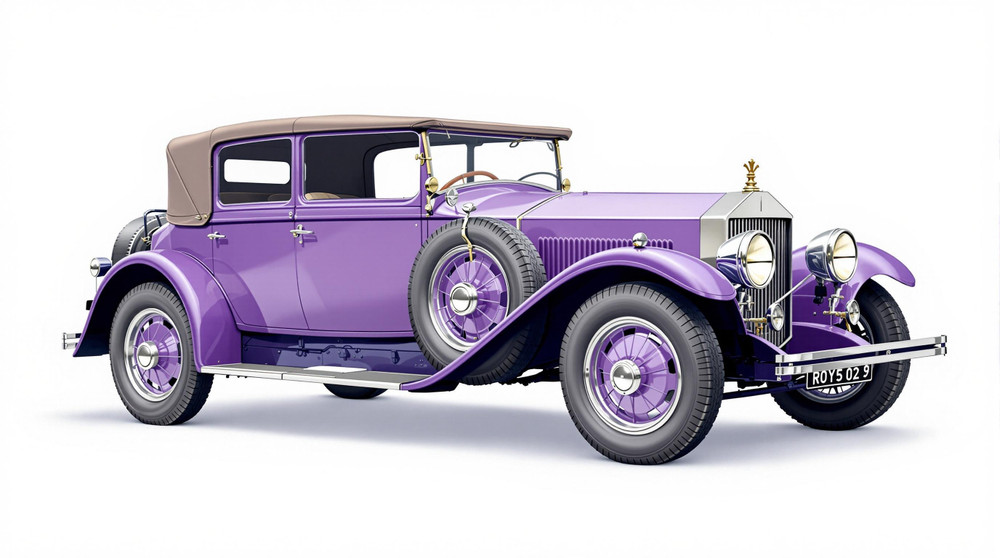
Image of 1922 Rolls Royce Silver Ghost, Note: These illustrations use artistic license and may differ from actual historical models.
Performance Metrics
Fundamental Metrics
Emotional Appeal
MMP Rating
| Engine Specifications | |
|---|---|
| Engine Options: | 7.4L I6 |
| Displacement Range: | 7,428 cc |
| Horsepower Range: | 40-50 HP |
| Torque: | Not available |
| Compression Ratio: | Not available |
| Ignition System: | Magneto |
| Cooling System: | Water-cooled |
| Performance Specifications | |
| 0-60 Time: | Not available |
| 1/4 Mile Time: | Not available |
| Top Speed: | 60-70 mph |
| Transmission and Drive | |
| Drive Type: | Rear-wheel drive |
| Transmission Type: | 4-speed manual |
| Fuel and Efficiency | |
| Fuel System Type: | Carburetor |
| MPG: | Not available |
| Dimensions and Brakes | |
| Brakes: | Drum brakes |
| Wheelbase: | 143.5 inches |
| Weight: | 3,175 lbs |
Note: Specifications for classic cars are given to the best of our ability, considering the limited and variant data available.
1922 Rolls-Royce Silver Ghost: A Guide to the “Best Car in the World”
The 1922 Rolls-Royce Silver Ghost was less a finished car than a carefully engineered foundation for one: a powerful, exceptionally smooth chassis that a coachbuilder could transform into a touring car, limousine, or grand town carriage. Built by Britain’s Rolls-Royce, it belonged to a celebrated generation of cars whose reputation for refinement and reliability helped establish the company’s enduring prestige.
Strictly speaking, “Silver Ghost” began as the nickname of a particular 1907 Rolls-Royce 40/50 hp, chassis number 60551, which had a silver-painted body and bright silver-plated fittings. The name eventually came to describe the entire 40/50 hp model series. By 1922, the Ghost had already earned international respect through long-distance reliability trials and demanding rallies. One notable early feat was a 15,000-mile trial in 1907, completed with remarkably few mechanical problems for the era.
Coachbuilt Style and Silver Ghost Craftsmanship
A 1922 Silver Ghost’s appearance depended heavily on its coachwork. Rolls-Royce supplied the rolling chassis, including the engine, transmission, axles, and controls. Specialist firms such as Barker, Park Ward, Hooper, and H.J. Mulliner then built the body to the owner’s requirements. The result could be a stately limousine with a formal, upright profile or an open tourer with sweeping fenders, a long bonnet, and a more adventurous stance.
Touring bodies are among the most evocative and recognizable Silver Ghost configurations. A well-proportioned open tourer shows off the car’s long hood and imposing radiator, while a limousine emphasizes its role as luxurious transport. Landaulets and coupés were also available. There was no single standard body style, and surviving cars may have been rebodied or modified during their long lives, so provenance matters as much as appearance to collectors.
The interior was tailored rather than mass-produced. Depending on the commission, owners could expect fine leather upholstery, polished wood trim, thick carpets, and carefully finished metal fittings. A chauffeur-oriented limousine might include a partition and more formal rear seating, while a touring car prioritized open-air views and flexible seating. Paint colors were likewise a matter of choice, not a fixed factory palette. Dark blue, green, maroon, black, and cream are all period-appropriate shades, but the original specification varied from car to car.
Engineering Ahead of Its Era
The Silver Ghost’s central engineering feature was its 7,428 cc, six-cylinder engine, arranged in two groups of three cylinders. Its 40/50 hp designation reflected the period’s tax-rating convention, rather than a straightforward modern horsepower figure. The engine’s generous capacity and measured tuning favored smooth, flexible power instead of high engine speeds. A four-speed manual gearbox sent drive to the rear wheels.
For its time, the Ghost was notable for its unusually composed engine, strong chassis, and attention to mechanical detail. The controls and driving position are entirely of their era, but the car’s power delivery and refinement helped distinguish it from many contemporaries. Braking equipment and details could vary with year and specification; later Ghosts could have four-wheel braking, while earlier arrangements were less comprehensive. It is important to check an individual car rather than assume every 1922 example has identical equipment.
How a Silver Ghost Drives
Exact performance figures depend on body weight, gearing, condition, and road surface. A healthy 1922 Silver Ghost is commonly described as capable of roughly 60 to 70 mph, though that is not a promise that every example should be driven at those speeds today. There is no consistent factory 0-to-60 mph figure for the model. As a period estimate, acceleration to 60 mph could take around 30 to 40 seconds or more, particularly with a heavy limousine body.
Behind the wheel, the engine’s character is more about steady momentum than urgency. The six-cylinder motor produces a subdued mechanical murmur, and the long chassis smooths out much of the roughness of early roads. On bumps, the car feels substantial and deliberate rather than nimble. On winding roads, its size, period steering, and considerable mass call for anticipation and a light, practiced touch. The driver must coordinate a manual gearbox and older-style controls, while passengers enjoy the stately pace and broad, cushioned ride.
That experience is part of the appeal, but it also sets expectations. A Silver Ghost is not a modern luxury car in vintage clothing. It asks for thoughtful driving, generous stopping distance, and a willingness to let the engine work at its own unhurried rhythm.
Why the Silver Ghost Matters
The Silver Ghost helped shape the public image of Rolls-Royce as a maker of exceptionally refined, dependable motor cars. Its reputation was built through engineering and endurance, not just polished coachwork. The 40/50 hp’s long production run also gave the company time to refine a successful basic design while accommodating a broad range of customer needs.
Compared with many contemporary luxury cars, the Ghost stood out for its smooth six-cylinder engine, robust construction, and bespoke bodywork. Its influence is less about one feature copied by every rival and more about the standard it set for quietness, reliability, and personalized luxury. The idea of pairing a carefully developed chassis with coachbuilt bodywork became a defining part of high-end motoring for decades.
Ownership, Maintenance, and Reliability
In 1922, a Silver Ghost could serve as private transport, a chauffeur-driven town car, or a touring machine. Today, most examples are used for preservation, touring events, concours displays, and historic motoring gatherings. Regular road use is possible, but it requires specialist knowledge and careful preparation rather than a quick trip to an ordinary repair shop.
The Ghost’s engineering has a reputation for durability, but age brings its own demands. Owners need to monitor lubrication, cooling, ignition, fuel delivery, brakes, tires, and the condition of the chassis and body. Parts and expertise are available through the classic Rolls-Royce community, though sourcing correct components can be expensive. Repairs are not generally easy for an average owner: the car is mechanically complex by vintage standards, and its size, coachwork, and individual specifications reward experienced hands.
Silver Ghost Facts and Common Criticisms
The name “Silver Ghost” did not originally identify a separate model. It referred to a single 40/50 hp car before becoming the familiar name for the series. The model’s reputation was also strengthened by competition and trials, including Rolls-Royce’s success in the 1913 Austrian Alpine Trial. During the First World War, Silver Ghost chassis were adapted for military duties, including staff-car service.
There is no single top-speed or endurance record that defines every 1922 example. The car’s claim to fame is its broader record of reliability and refinement. Its long production history is another distinction: approximately 7,874 Silver Ghosts were built in total, with production split between Britain and Rolls-Royce’s American operation in Springfield, Massachusetts. That figure covers the full model run, not just the 1922 model year.
Common criticisms are practical ones. The car is large, heavy, slow to accelerate by modern standards, and demanding to maintain. Braking and handling require more planning than in a modern vehicle, and a chauffeur-style body can make narrow roads and tight parking particularly awkward. For collectors, originality can also be complicated by decades of repairs, restorations, and body changes.
Collector Values and Market Outlook
Silver Ghosts are rare, but values vary enormously according to condition, coachwork, history, originality, and documentation. As a broad current-market estimate, a driver-quality or less fully restored example might fall around US$300,000 to US$700,000. A high-quality restoration or particularly desirable configuration could reach roughly US$700,000 to US$1.5 million or more. Exceptional cars with significant provenance may exceed that range, while cars needing major work can cost substantially less.
These are estimates rather than fixed price guides. A genuine, well-documented chassis with desirable original coachwork is a different proposition from a car with extensive alterations or uncertain history. The market for top-tier prewar cars remains supported by the Silver Ghost’s name and importance, but prices can fluctuate with condition, restoration costs, and broader collector demand. Over the long term, outstanding examples have generally held strong interest, while not every car automatically appreciates once the cost of ownership is considered.
A Lasting Rolls-Royce Benchmark
The 1922 Rolls-Royce Silver Ghost combined a smooth, large-capacity engine and sturdy chassis with the individuality of bespoke coachbuilding. It was not fast by modern standards, nor was it simple to own, but its long-running reputation for refinement and reliability set it apart in its own time. More than a century later, a Silver Ghost still makes a powerful statement: this was a car built not merely to travel, but to make every mile feel deliberate and distinguished.
1922 Rolls Royce Silver Ghost Catalog of Parts
 1922 ROLLS ROYCE SILVER GHOST Heel Pad. Initials "HJM"-RM 16Heel Pad. Initials "HJM". Made of high quality black rubber. 8" X 16". Each
Why Choose Metro?
For over 100 years, Metro Moulded Parts has been the pinnacle of quality in classic car restoration parts. Our commitment to precision and authenticity in every component ensures a perfect fit and an OEM-level appearance.
- Expert Craftsmanship & Quality: Each part is a testament to our dedication to reliability and perfection, crafted from original designs and thoroughly tested.
- Advanced Technology: We use cutting-edge techniques to create flawless, long-lasting parts that surpass others in performance.
- SuperSoft Sponge – The Ultimate Door Seal: Not only are our door seals 30% softer than competitors', but they're also guaranteed to never leak. They effectively reduce wind and road noise, enhancing your classic car's comfort and driving experience.
- Proudly American: Our parts are a product of American craftsmanship, made in the USA with a spirit of excellence and heritage.
- Unrivaled Warranty: We back our products with a 30-year industry-leading warranty, a testament to our confidence in their quality.
Join us in preserving the legacy of classic cars with parts that are crafted for perfection, not just made.