
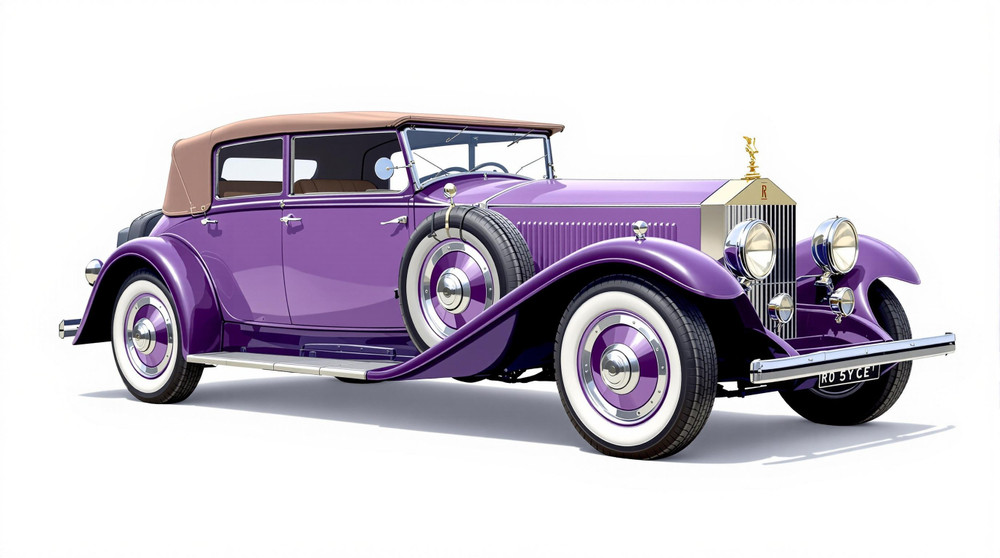
Image of 1929 Rolls Royce Phantom I, Note: These illustrations use artistic license and may differ from actual historical models.
Performance Metrics
Fundamental Metrics
Emotional Appeal
MMP Rating
| Engine Specifications | |
|---|---|
| Engine Options: | 7.7L I6 |
| Displacement Range: | 7668 cc |
| Horsepower Range: | 100-120 HP |
| Torque: | Not available |
| Compression Ratio: | Not available |
| Ignition System: | Coil ignition |
| Cooling System: | Water-cooled |
| Performance Specifications | |
| 0-60 Time: | Not available |
| 1/4 Mile Time: | Not available |
| Top Speed: | 80-85 mph |
| Transmission and Drive | |
| Drive Type: | Rear-wheel drive |
| Transmission Type: | 4-speed manual |
| Fuel and Efficiency | |
| Fuel System Type: | Carburetor |
| MPG: | Not available |
| Dimensions and Brakes | |
| Brakes: | 4-wheel drum brakes |
| Wheelbase: | 143.5 in (3645 mm) |
| Weight: | 5000 lbs |
Note: Specifications for classic cars are given to the best of our ability, considering the limited and variant data available.
1929 Rolls-Royce Phantom I: A New Standard of Luxury
The 1929 Rolls-Royce Phantom I was built to make a long journey feel almost effortless. Known when introduced as the “New Phantom,” it succeeded the celebrated Silver Ghost and carried Rolls-Royce into a new era of quieter, more powerful motoring. The car was produced by Rolls-Royce in Britain and, in a separate version, at the company’s Springfield, Massachusetts factory in the United States.
“Phantom I” became the familiar name later, after the Phantom II arrived. Its significance is clear: Rolls-Royce kept the refinement and careful engineering that had made the Silver Ghost famous, while developing a larger engine and chassis suited to increasingly luxurious bodies. One especially eye-catching example is the Phantom I with the Jonckheere Coupe body, nicknamed the “Round Door Rolls” for its unusual circular doors. It shows just how far owners and coachbuilders could take the Phantom’s design.
Coachbuilt Styling and Bespoke Interiors
The Phantom I was sold as a rolling chassis, not as a complete, uniform car. Rolls-Royce supplied the mechanical foundation, then independent coachbuilders created the body to suit the buyer. The result could be a formal limousine, an open touring car, a town car, a landaulet or a sporting coupe. That coachbuilt approach means two 1929 Phantom Is can look remarkably different even when they share the same engineering.
Common details include a tall, upright radiator grille, long bonnet, separate sweeping front wings, running boards and large headlamps. The Spirit of Ecstasy mascot usually crowned the radiator, while polished brightwork and carefully finished paint reinforced the car’s formal presence. The body’s proportions depended on its purpose: a chauffeur-driven limousine emphasized a spacious rear cabin, while an open tourer displayed the long hood and flowing fenders.
Rolls-Royce did not restrict customers to a short, standardized paint chart. Buyers could commission colors and finishes through their coachbuilder, so restrained dark blues, greens, maroons and black were popular choices, alongside more individual combinations. Interiors were similarly personalized. Fine leather, polished wood trim, wool upholstery, thick carpeting and carefully fitted cabinetry could transform the rear compartment into a private lounge. The exact materials and fittings varied by coachbuilder and customer specification.
There was no single body style that defined every Phantom I. Formal limousines and town cars suited wealthy owners who traveled with a chauffeur, while touring bodies offered more open-air motoring. In the United States, Brewster was a prominent coachbuilder; in Britain, firms such as Barker, Park Ward, Hooper and H. J. Mulliner created bodies for Rolls-Royce chassis.
Engineering That Set the Phantom Apart
The Phantom I’s central engineering feature was its 7,668 cc (7.7-liter) inline-six engine with overhead valves. It was a substantial development over the Silver Ghost’s powerplant, designed to move a heavy luxury car with greater reserve. Twin ignition, with two spark plugs per cylinder, was part of the engine’s equipment and helped support smooth, dependable running.
A four-speed manual gearbox sent power to the rear wheels. The chassis was also designed to accommodate a wide range of coachbuilt bodies, and four-wheel brakes with servo assistance helped bring the substantial car to a stop. These features did not make it a sports car. They made it a more capable and composed luxury automobile at a time when many vehicles were still relatively basic in their braking and power delivery.
The Phantom I’s influence came less from a single mass-market innovation than from the way it combined engineering, craftsmanship and customization. It demonstrated that a high-end automobile could be specified around its owner rather than delivered in one fixed configuration. That coachbuilt ideal became a lasting part of Rolls-Royce identity and helped establish the Phantom name as a symbol of bespoke luxury.
Speed, Ride and Driving Feel
Performance figures for a 1929 Phantom I need context. Body weight, axle ratio, road conditions and mechanical condition all affect the result, and period testing did not use today’s consistent acceleration standards. A well-maintained example might reach roughly 75 to 85 mph, depending on its body and gearing. A modern-style 0-to-60 mph time is rarely documented; a broad estimate of about 25 to 35 seconds is more realistic than a single precise figure.
On the road, the Phantom I is about measured progress rather than quick acceleration. The large six-cylinder engine delivers its power smoothly, and the four-speed gearbox rewards deliberate shifts. Steering is heavy by modern standards, especially at low speeds, and the driver must anticipate the car’s size and braking distance. Narrow country lanes, steep gradients and tight corners require patience and planning.
Its substantial chassis and long wheelbase can soften the effect of ordinary road imperfections, although the ride depends greatly on the suspension’s condition and the weight of the body. On a winding road, it feels dignified rather than nimble. The engine’s sound is typically a subdued mechanical murmur rather than a dramatic roar, with the experience shaped by the cabin, body style and upkeep. A chauffeur-driven saloon offers quiet comfort for passengers; an open tourer puts more of the engine and road sounds in the driver’s ears.
Owning and Maintaining a Phantom I
Today, a Phantom I is best suited to touring, concours events, private collections and occasional ceremonial use. It is generally not a sensible daily driver. Its size, age, braking distances and slower pace make it demanding in modern traffic, while the value and rarity of many examples encourage careful, limited use.
Maintenance calls for specialist knowledge, appropriate parts and regular attention. The car is mechanical rather than electronic, which can make some repairs conceptually straightforward, but that does not make it easy for an average owner to maintain. Parts may need to be sourced through specialist suppliers or made to order, and coachbuilt bodywork, trim and old mechanical components can require expert restoration. A pre-purchase inspection by a Rolls-Royce specialist is essential. Good records, correct servicing and careful storage are particularly important.
Reliability depends on condition and maintenance, not simply on the Rolls-Royce badge. A well-restored Phantom I can be a dependable touring car when properly prepared, but neglect, age-related wear and infrequent use can create expensive problems. Prospective owners should budget for ongoing care as well as the purchase price.
Phantom I Facts and Famous Oddities
The Phantom I was built in Britain and in the United States, where Rolls-Royce operated its Springfield factory. Production estimates commonly put total output at roughly 3,500 cars, with figures often cited as about 2,269 British-built examples and approximately 1,240 American-built examples. Counts can vary slightly among sources, and surviving cars are fewer still.
The Jonckheere Coupe is one of the model’s most memorable curiosities. Its dramatic coachwork includes distinctive rounded doors and a striking, almost theatrical profile. The car is a reminder that a Phantom chassis could become far more than a conventional limousine when an owner commissioned an ambitious design.
Phantom Is were associated with wealthy industrialists, public figures and royalty, but their individualized bodies make it difficult to treat the model as one uniform celebrity car. They were built for private travel and display, not for racing or mass-market record setting. A frequent criticism today is that the cars are extremely large, slow to maneuver and costly to restore. Those drawbacks are part of the ownership reality, even if they are also inseparable from the car’s imposing character.
1929 Phantom I Values and Availability
Values vary widely according to originality, mechanical condition, restoration quality, provenance and, especially, the desirability of the coachwork. As a broad guide, a project or car requiring substantial work might be valued around $75,000 to $175,000. A sound, usable example could fall roughly between $200,000 and $500,000, while exceptional cars with rare bodies, notable history or outstanding restoration may exceed $1 million. These are indicative U.S.-dollar ranges, not a formal appraisal, and individual auction results can differ considerably.
With production in the low thousands across the Phantom I run, the model is rare by ordinary standards, but examples do appear through specialist dealers and major classic-car auctions. The market is selective: a well-documented car in strong condition is generally more attractive than a less complete example with expensive restoration needs. Over the long term, exceptional Phantom Is have the ingredients to hold collector interest, but values are not guaranteed to rise steadily. Restoration costs, economic conditions and the quality of a particular car all influence its price.
Why the 1929 Rolls-Royce Phantom I Matters
The 1929 Rolls-Royce Phantom I brought together a powerful 7.7-liter engine, a substantial chassis and the freedom of bespoke coachbuilding. It was built for smooth, dignified travel, not for speed records or easy everyday use, and its character changes dramatically with each body and specification.
Nearly a century later, the Phantom I remains compelling because it represents an era when luxury cars were commissioned as individual creations. Its engineering gave those creations a formidable foundation, while its coachbuilt variety ensured that no two stories had to look exactly alike.
1929 Rolls Royce Phantom I Catalog of Parts
 1929 ROLLS ROYCE PHANTOM I Heel Pad. Initials "HJM"-RM 16Heel Pad. Initials "HJM". Made of high quality black rubber. 8" X 16". Each
Why Choose Metro?
For over 100 years, Metro Moulded Parts has been the pinnacle of quality in classic car restoration parts. Our commitment to precision and authenticity in every component ensures a perfect fit and an OEM-level appearance.
- Expert Craftsmanship & Quality: Each part is a testament to our dedication to reliability and perfection, crafted from original designs and thoroughly tested.
- Advanced Technology: We use cutting-edge techniques to create flawless, long-lasting parts that surpass others in performance.
- SuperSoft Sponge – The Ultimate Door Seal: Not only are our door seals 30% softer than competitors', but they're also guaranteed to never leak. They effectively reduce wind and road noise, enhancing your classic car's comfort and driving experience.
- Proudly American: Our parts are a product of American craftsmanship, made in the USA with a spirit of excellence and heritage.
- Unrivaled Warranty: We back our products with a 30-year industry-leading warranty, a testament to our confidence in their quality.
Join us in preserving the legacy of classic cars with parts that are crafted for perfection, not just made.