
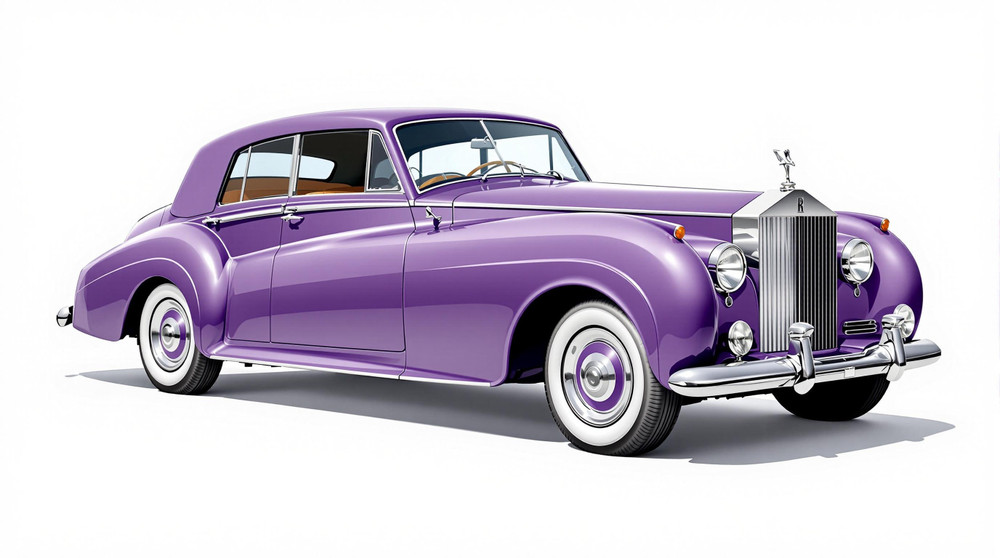
Image of 1956 Rolls-Royce Silver Wraith, Note: These illustrations use artistic license and may differ from actual historical models.
Performance Metrics
Fundamental Metrics
Emotional Appeal
MMP Rating
| Engine Specifications | |
|---|---|
| Engine: | Inline 6-cylinder engine |
| Displacement: | 4.9L |
| Horsepower: | Estimated 130-150 HP |
| Torque: | Not specified for this model |
| Compression Ratio: | Not specified for this model |
| Ignition System: | Coil ignition |
| Cooling System: | Water-cooled |
| Performance Specifications | |
| 0-60 Time: | Not specified for this model |
| 1/4 Mile Time: | Not specified for this model |
| Top Speed: | 100 mph |
| Transmission and Drive | |
| Drive Type: | Rear-wheel drive |
| Transmission Type: | 4-speed automatic |
| Fuel and Efficiency | |
| Fuel System Type: | Carburetor |
| MPG: | Not specified for this model |
| Dimensions and Brakes | |
| Brakes: | Drum brakes |
| Wheelbase: | 133 inches |
| Weight: | 4,600 lbs |
Note: Specifications for classic cars are given to the best of our ability, considering the limited and variant data available.
1956 Rolls-Royce Silver Wraith: A Bespoke British Classic
The 1956 Rolls-Royce Silver Wraith was less a finished car than an invitation to create one. Rolls-Royce supplied the chassis and mechanicals, then independent coachbuilders shaped them into everything from formal limousines to elegant touring saloons. The result was a postwar luxury car built for owners who wanted something far more personal than a standard production model.
Made by Rolls-Royce at its Crewe factory in England, the Silver Wraith was introduced in 1946 as the company’s first new postwar model. It remained in production until 1959, overlapping with the more standardized Silver Cloud, which arrived in 1955. The Silver Wraith continued to serve buyers seeking a larger, coachbuilt car with the stature of a traditional chauffeur-driven Rolls-Royce.
A detail that helps explain its appeal is that two Silver Wraiths from the same year can look strikingly different. Their bodies were crafted by specialist firms to individual commissions, so the name identifies the chassis and marque, not one single body shape.
Coachbuilt Style and Hand-Finished Luxury
The Silver Wraith’s exterior began with the familiar Rolls-Royce visual language: a tall, upright grille, a long bonnet, flowing front wings and a dignified stance. The radiator shell and Spirit of Ecstasy ornament gave the car an unmistakable presence, while the coachwork behind them could be tailored to suit its owner. Some bodies looked stately and restrained; others featured sweeping fenders, formal rear compartments and more decorative details.
Inside, the emphasis was on craftsmanship rather than mass-produced uniformity. Depending on the commission, cabins could include leather upholstery, polished wood veneers, wool carpeting, folding occasional seats and separate accommodations for chauffeur and passengers. Materials and fittings varied by coachbuilder and client, but the goal was consistent: quiet, comfortable travel with a high degree of personal attention.
There was no single factory color chart that defined the Silver Wraith’s appearance. Owners could specify paint and trim combinations through the coachbuilder, with dark blues, black, deep green and burgundy among the traditional choices. Two-tone finishes were also possible. A restrained dark exterior with a contrasting roof or discreet pinstriping suited the formal limousine body especially well.
Available body styles included saloons, limousines, touring bodies, drophead coupes and other special commissions. Hooper, Park Ward, H.J. Mulliner, Freestone & Webb and James Young were among the respected coachbuilders associated with Rolls-Royce bodies. Formal limousines and elegant saloons were especially popular, while the long-wheelbase cars offered extra rear passenger space and a more imposing profile.
Engineering Behind the Prestige
The Silver Wraith’s engineering reflected Rolls-Royce’s traditional priorities: smoothness, durability and refinement over headline-grabbing power figures. A 1956 example typically used the 4,887 cc inline-six, an enlarged development of the company’s prewar six-cylinder design. It used an overhead-inlet, side-exhaust valve arrangement, often called an F-head layout. Rolls-Royce did not routinely publish an official horsepower figure, but period estimates commonly place output in the region of 150 horsepower, depending on specification.
A four-speed manual gearbox was standard on many cars, and an automatic transmission became available as an option. The Silver Wraith also benefited from independent front suspension, which helped it ride more smoothly than a traditional solid-front-axle design. Power assistance for the brakes and steering helped manage the car’s considerable size, though the precise equipment could vary by year and specification.
The Silver Wraith was not a mass-market technology showcase. Its significance lay in how it combined modern chassis engineering with the older, highly individualized coachbuilding tradition. At a time when the industry was moving toward standardized bodies and higher-volume production, Rolls-Royce kept a place open for bespoke construction.
Why the Silver Wraith Mattered
As the first postwar Rolls-Royce model, the Silver Wraith helped re-establish the marque’s position in a changing world. It preserved the idea that a luxury car could be commissioned around its owner, rather than selected from a small set of factory configurations. The coachbuilt approach also supported specialist British firms and maintained skills in body design, woodwork and hand finishing.
The Silver Wraith stood apart from contemporaries such as the Bentley Mark VI and later Silver Cloud because its body was usually supplied by an independent coachbuilder. That made it more varied, more exclusive and often more formal in character. The model’s eventual successor in the top-level coachbuilt role was the Phantom V, while the Silver Cloud represented the growing appeal of a more integrated, factory-built luxury car.
Its influence is less about a single styling feature than about the survival of bespoke automotive design into the postwar era. Today, a Silver Wraith’s coachwork is central to its identity and value. The chassis tells part of the story; the body tells the rest.
Performance and Road Manners
Performance figures differ with engine tune, body style, gearing and the weight of the coachwork. As a useful general guide, a 1956 Silver Wraith could reach roughly 90 to 100 mph, while a 0-to-60 mph run might take around 16 to 20 seconds. These are estimates rather than factory guarantees, and a heavy limousine would generally be slower than a lighter-bodied car.
On the road, the Silver Wraith rewards an unhurried driving style. Its engine delivers power smoothly, while the long wheelbase and substantial mass help it settle into a composed cruise. Independent front suspension softens many road imperfections, though the exact ride depends on the body, suspension condition, tires and maintenance history. On winding roads, the car feels large and deliberate rather than agile. A driver needs to plan corners, allow room for the bodywork and resist the temptation to hustle it like a sports saloon.
The six-cylinder engine is known more for its cultured sound than for dramatic noise. From the driver’s seat, the experience is a blend of muted mechanical rhythm, a broad bonnet stretching ahead and a measured, almost ceremonial progress through traffic. Steering and braking effort can feel heavier than in a modern car, particularly at low speeds, so the driver remains actively involved.
Owning and Maintaining a Silver Wraith
Most Silver Wraiths today are used for classic-car touring, concours events, weddings, film work and private collections. Some are still driven regularly, but daily use is uncommon. Their size, age, fuel consumption, bespoke parts and limited access to parking make them better suited to planned outings than routine commuting.
Maintenance is manageable for a committed owner, but it is not a casual do-it-yourself project for most people. The basic mechanical systems are understandable to a specialist familiar with period Rolls-Royces, yet coachbuilt bodies can contain unique fittings, trim and structural details. Parts availability varies: routine service items may be obtainable, while body-specific components can require specialist repair or careful fabrication. A pre-purchase inspection should include the chassis, engine, gearbox, brakes, cooling system, electrical equipment, woodwork and the condition of the coachwork.
Reliability depends heavily on upkeep. A well-maintained car can cover touring distances confidently, but neglected examples may bring expensive surprises. Buyers should budget for age-related work and seek records from marque specialists, rather than assuming that a prestigious badge guarantees sound mechanical condition.
Silver Wraith Facts and Common Criticisms
Rolls-Royce built approximately 1,883 Silver Wraith chassis over the model’s full production run from 1946 to 1959. That figure covers all years, not just 1956, and the number of surviving cars in any particular body style is smaller. The 1956 production total is not commonly stated as a single definitive figure, so it is safer to judge an individual car by its chassis records and coachbuilder history.
Silver Wraiths served owners who wanted formal transport, including government, diplomatic and ceremonial clients. The model is associated with the wider tradition of official Rolls-Royce limousines, although individual state-car claims should always be checked against chassis documentation. There is no widely recognized Silver Wraith speed or endurance record that defines the model. Its distinction is its bespoke construction and long service as a prestigious chauffeur-driven car.
Common criticisms are practical ones: the car is large, slow by modern standards, thirsty and expensive to restore. Coachbuilt variations also make some repairs more complicated than they would be on a standardized production car. Enthusiasts generally see those same characteristics as part of its appeal, but prospective owners should go in with realistic expectations.
Collector Values and Market Outlook
Collector values vary widely because “Silver Wraith” covers many different bodies and conditions. As a broad 2026 estimate, a project or incomplete car might sell for around $30,000 to $70,000. A sound, usable example may fall roughly between $80,000 and $250,000, while a highly restored, rare or exceptionally documented car can exceed $300,000. Outstanding coachwork, provenance and concours-level condition may push a particular example higher. These are guide ranges, not formal appraisals, and regional markets can differ substantially.
The Silver Wraith is uncommon rather than impossibly rare. With about 1,883 chassis built across its entire run, it appears on the market less often than a standard-production luxury car, but examples do surface through specialist dealers and auctions. Buyers should place particular importance on originality, coachbuilder attribution, restoration quality and documented history.
Values have generally been selective rather than uniformly rising. The strongest cars, especially those with desirable bodies and well-supported provenance, tend to attract the most interest. Lesser examples can be costly to bring up to standard, which limits their value. In real, inflation-adjusted terms, the market has not rewarded every Silver Wraith equally, so condition and specification matter more than simply owning the model name.
A Bespoke Classic with Lasting Presence
The 1956 Rolls-Royce Silver Wraith brings together postwar engineering, traditional coachbuilding and a level of personalization that is rare in modern cars. Its smooth six-cylinder engine and composed ride made it a distinguished long-distance machine, while its individually commissioned bodywork ensured that no two examples needed to look alike.
It is not the easiest classic to own, nor was it built to be hurried. But for collectors who value craftsmanship, history and unmistakable presence, the Silver Wraith remains a remarkable reminder that a Rolls-Royce could be more than a luxury car: it could be a one-off expression of its owner’s taste.
1956 Rolls-Royce Silver Wraith Catalog of Parts
 1956 Rolls-Royce Silver Wraith Heel Pad. Initials "HJM"-RM 16Heel Pad. Initials "HJM". Made of high quality black rubber. 8" X 16". Each
Why Choose Metro?
For over 100 years, Metro Moulded Parts has been the pinnacle of quality in classic car restoration parts. Our commitment to precision and authenticity in every component ensures a perfect fit and an OEM-level appearance.
- Expert Craftsmanship & Quality: Each part is a testament to our dedication to reliability and perfection, crafted from original designs and thoroughly tested.
- Advanced Technology: We use cutting-edge techniques to create flawless, long-lasting parts that surpass others in performance.
- SuperSoft Sponge – The Ultimate Door Seal: Not only are our door seals 30% softer than competitors', but they're also guaranteed to never leak. They effectively reduce wind and road noise, enhancing your classic car's comfort and driving experience.
- Proudly American: Our parts are a product of American craftsmanship, made in the USA with a spirit of excellence and heritage.
- Unrivaled Warranty: We back our products with a 30-year industry-leading warranty, a testament to our confidence in their quality.
Join us in preserving the legacy of classic cars with parts that are crafted for perfection, not just made.