
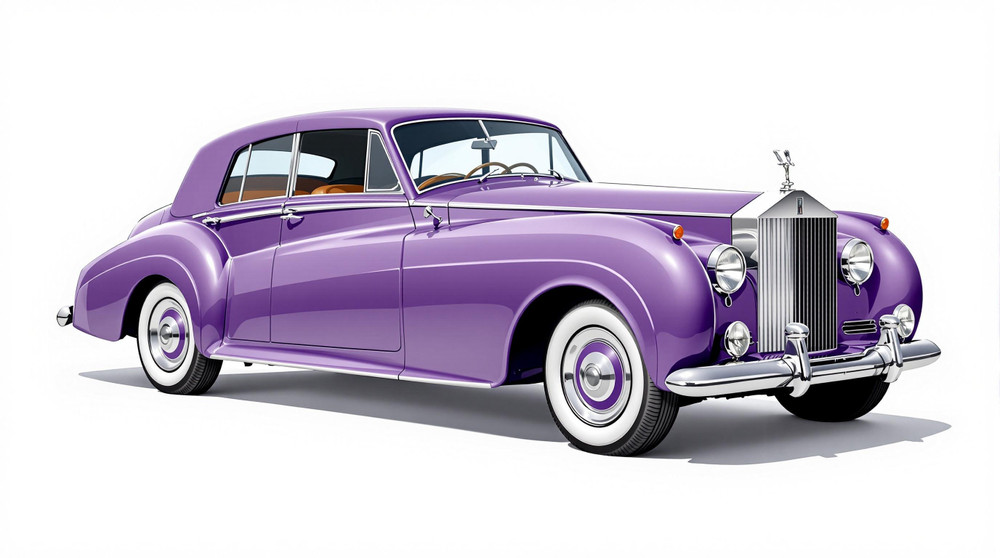
Image of 1957 Rolls-Royce Silver Wraith, Note: These illustrations use artistic license and may differ from actual historical models.
Performance Metrics
Fundamental Metrics
Emotional Appeal
MMP Rating
| Engine Specifications | |
|---|---|
| Engine: | Inline 6-cylinder engine |
| Displacement: | 4.9L |
| Horsepower: | Estimated 178-200 HP |
| Torque: | Not available |
| Compression Ratio: | Not available |
| Ignition System: | Coil ignition |
| Cooling System: | Water-cooled |
| Performance Specifications | |
| 0-60 Time: | Not available |
| 1/4 Mile Time: | Not available |
| Top Speed: | 100 mph |
| Transmission and Drive | |
| Drive Type: | Rear-wheel drive |
| Transmission Type: | 4-speed automatic |
| Fuel and Efficiency | |
| Fuel System Type: | Carburetor |
| MPG: | Not available |
| Dimensions and Brakes | |
| Brakes: | Drum brakes |
| Wheelbase: | 133 inches |
| Weight: | 4,600 lbs |
Note: Specifications for classic cars are given to the best of our ability, considering the limited and variant data available.
1957 Rolls-Royce Silver Wraith: A Coachbuilt Classic
The 1957 Rolls-Royce Silver Wraith was less a single finished car than a luxurious chassis waiting for its owner’s chosen coachwork. Built by Rolls-Royce in Crewe, England, it belonged to the marque’s first postwar generation and carried forward a grand tradition: Rolls-Royce supplied the engineering, while specialist coachbuilders created the body. The result could be a formal limousine, an elegant saloon or a highly individual commission.
The Silver Wraith was introduced in 1946, when Britain’s motor industry was rebuilding after World War II. By 1957, it had become a favorite among wealthy private clients and official users who wanted a dignified, hand-finished car. One detail sets it apart from many later luxury cars: the body was not a standard factory shell, but a separate creation mounted on a robust chassis. Two Silver Wraiths of the same year could therefore look strikingly different.
Coachbuilt Styling and Bespoke Interiors
From the outside, the Silver Wraith has the unmistakable presence of a postwar Rolls-Royce. Its long bonnet, upright radiator grille, commanding Spirit of Ecstasy mascot and sweeping front wings give it a formal, almost architectural appearance. The proportions vary with the body, but the long-wheelbase versions are especially imposing, with generous rear doors and space for chauffeur-driven passengers. Chrome trim was elegant rather than excessive, and the craftsmanship of the bodywork mattered as much as the famous grille.
Rolls-Royce did not offer a single fixed body design. Coachbuilders including H.J. Mulliner, Hooper, Park Ward, James Young and Freestone & Webb produced bodies for Silver Wraith chassis. Available styles included formal limousines, touring limousines, saloons and landaulettes, some with a folding rear roof section. The long-wheelbase limousine is the car’s most iconic form, particularly for ceremonial and chauffeur use, although individual commissions could be more sporting or personal in character.
Inside, the emphasis was on quiet comfort and careful finishing. Buyers could specify rich leather upholstery, polished wood veneers, deep carpets and tailored trim. The exact materials and layout depended on the coachbuilder and customer, so a surviving car’s cabin may be entirely unique. There was no universal factory paint palette for these coachbuilt bodies. Owners could choose from a broad range of colors, including dark blue, black, maroon, cream and silver, as well as contrasting two-tone schemes. Conservative combinations suited the car’s formal role, while bespoke colors made some examples distinctly personal.
Engineering for Refined Motoring
Under the bonnet, late Silver Wraiths used Rolls-Royce’s 4,887 cc inline-six engine. The engine’s measured delivery suited a heavy luxury car: it was designed to move the car smoothly and quietly, rather than advertise its performance with a dramatic surge. Rolls-Royce traditionally avoided publishing headline horsepower figures, so modern power estimates should be treated as approximations rather than official specifications.
The Silver Wraith used a separate chassis, independent front suspension and a live rear axle. Four-wheel drum brakes with mechanical servo assistance helped manage the car’s considerable mass. A four-speed manual gearbox was available, and a General Motors Hydra-Matic automatic transmission could also be specified. In an era when many cars still relied on simpler suspension and transmission designs, these features helped make the Wraith a sophisticated long-distance machine.
Postwar Significance and Lasting Influence
The Silver Wraith represented a bridge between traditional coachbuilt luxury and the more standardized postwar automobile. Its body-on-chassis construction gave customers unusual freedom, while Rolls-Royce supplied an engineered foundation intended to last. That division of labor allowed coachbuilders to respond to individual tastes and to create bodies suited to different roles, from private motoring to ceremonial service.
What distinguished the Silver Wraith from many contemporaries was not one isolated technical breakthrough. It was the combination of a refined six-cylinder engine, a carefully developed chassis, extensive customization and the company’s focus on low-effort, quiet travel. The model also preserved the prestige of bespoke coachbuilding at a time when mass production was becoming the dominant approach. Its influence is most visible in the idea that a luxury car could be commissioned as a personal object, not simply selected from a standard catalogue.
Performance and Road Manners
Performance figures vary with the body style, gearing and condition of an individual car. A healthy 1957 Silver Wraith is generally estimated to reach about 95 to 100 mph, with a 0-to-60 mph time in the region of 15 to 18 seconds. Those are approximate figures, not factory promises, and a heavy limousine will not accelerate like a lighter-bodied saloon.
On the road, the Silver Wraith favors a steady pace. Its suspension filters ordinary bumps and broken pavement with the relaxed movement expected of a large luxury car, while the long wheelbase helps it feel composed on open roads. Tight, winding routes call for patience: the car is large, its steering is not light by modern standards, and its weight requires thoughtful braking. Crosswinds can also be noticeable, particularly with tall limousine bodies.
The driving experience is defined by restraint. The six-cylinder engine works with a subdued, even sound, and the cabin is intended to keep road and mechanical noise at a distance. The driver sits behind a large steering wheel and controls a substantial machine through traditional mechanical inputs. It is not a car that hides its size from its driver, but on a flowing road it can feel remarkably calm and deliberate.
Living With a Silver Wraith
Today, most Silver Wraiths are used as show cars, collection pieces, occasional touring cars or chauffeur-driven wedding and ceremonial vehicles. A well-maintained example can still cover road miles, but it is rarely a sensible daily driver. Its age, size, fuel consumption and specialist maintenance needs make regular modern traffic a demanding environment.
Maintenance is a matter for experienced hands. Routine servicing is manageable for a skilled owner, but complex repairs, coachwork restoration and parts sourcing can require marque specialists. The car’s traditional engineering is understandable compared with many modern vehicles, yet that does not make a Rolls-Royce inexpensive or easy to repair. A neglected example can quickly become costly, especially if its body, interior or bespoke components need major work. Pre-purchase inspections should include the chassis, engine, gearbox, braking system, electrical equipment and coachwork, along with a careful review of the car’s history.
Silver Wraith Facts and Common Criticisms
The Silver Wraith was Rolls-Royce’s first new postwar model, and its production continued from 1946 until 1959. It was supplied as a chassis, so the finished car’s identity often reflects the coachbuilder as much as the manufacturer. That makes body style and provenance especially important when researching a particular example.
Silver Wraiths served private owners and official users, including heads of state and other dignitaries. Their formal appearance made them natural choices for ceremonial duties, though specific claims about royal or celebrity ownership should always be checked against documentation for the individual car. The model was not built to set speed records or compete in racing. Its achievement was delivering dignified, bespoke transport with the engineering to support it.
Common criticisms are practical rather than mysterious: the car is heavy, thirsty by modern standards, slower to accelerate than contemporary performance cars and expensive to maintain. Its brakes and handling also require more anticipation than a modern driver may expect. In return, it offers a level of presence and individuality that mass-produced luxury cars rarely match.
Collector Values and Rarity
Rolls-Royce built approximately 1,883 Silver Wraiths across the model’s entire 1946–1959 production run. A precise total for the 1957 model year is not consistently available, but a reasonable estimate is that only a low number of hundreds were built that year. The coachbuilt nature of the model means that surviving examples vary widely in style, specification and condition.
As a broad current-market guide, a Silver Wraith needing substantial restoration might sell for around US$40,000 to US$70,000. A sound, presentable car could fall roughly between US$70,000 and US$150,000, while a high-quality restoration, exceptional coachwork or important documented provenance can push a car beyond US$200,000. These are estimates, not appraisals: body style, originality, restoration quality and history can shift the price considerably.
Values have been selective rather than uniformly rising. The best-restored and most historically important cars attract strong interest, while ordinary examples can be held back by the cost of upkeep and a relatively small pool of buyers. In recent years, the broader market for large postwar luxury cars has tended to reward condition and provenance more than simply age or rarity. Buyers should treat a Silver Wraith as a significant classic to enjoy, not as a guaranteed investment.
A Lasting Expression of Rolls-Royce Luxury
The 1957 Rolls-Royce Silver Wraith combined a refined six-cylinder engine and capable chassis with the freedom of bespoke coachwork. Its formal lines, handcrafted cabin and chauffeur-friendly proportions made it a fitting choice for private owners and official occasions alike. More than a luxury car, it was a commission shaped by its first owner and coachbuilder. That individuality, carried by the quiet authority of the Rolls-Royce name, is what keeps the Silver Wraith compelling today.
1957 Rolls-Royce Silver Wraith Catalog of Parts
 1957 Rolls-Royce Silver Wraith Heel Pad. Initials "HJM"-RM 16Heel Pad. Initials "HJM". Made of high quality black rubber. 8" X 16". Each
Why Choose Metro?
For over 100 years, Metro Moulded Parts has been the pinnacle of quality in classic car restoration parts. Our commitment to precision and authenticity in every component ensures a perfect fit and an OEM-level appearance.
- Expert Craftsmanship & Quality: Each part is a testament to our dedication to reliability and perfection, crafted from original designs and thoroughly tested.
- Advanced Technology: We use cutting-edge techniques to create flawless, long-lasting parts that surpass others in performance.
- SuperSoft Sponge – The Ultimate Door Seal: Not only are our door seals 30% softer than competitors', but they're also guaranteed to never leak. They effectively reduce wind and road noise, enhancing your classic car's comfort and driving experience.
- Proudly American: Our parts are a product of American craftsmanship, made in the USA with a spirit of excellence and heritage.
- Unrivaled Warranty: We back our products with a 30-year industry-leading warranty, a testament to our confidence in their quality.
Join us in preserving the legacy of classic cars with parts that are crafted for perfection, not just made.