
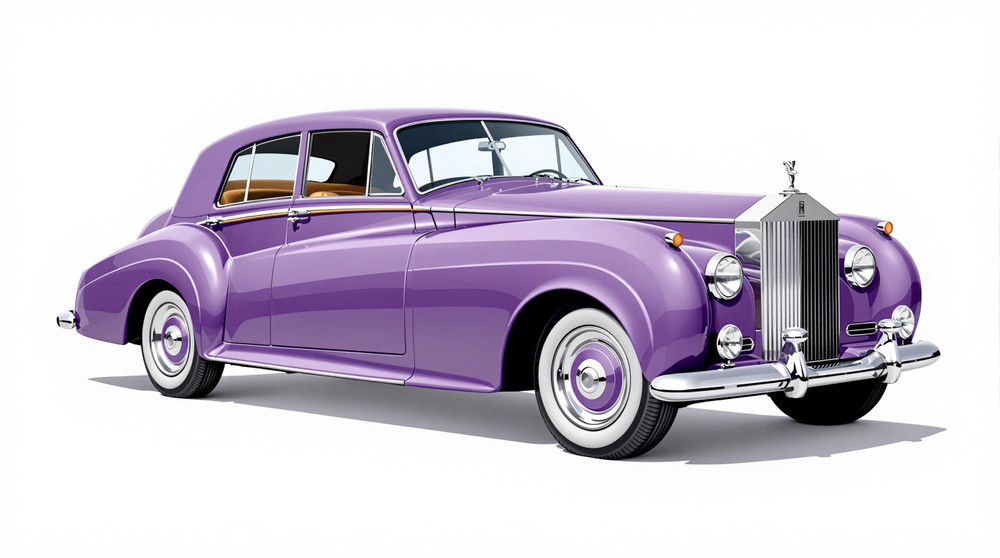
Image of 1958 Rolls-Royce Silver Cloud, Note: These illustrations use artistic license and may differ from actual historical models.
Performance Metrics
Fundamental Metrics
Emotional Appeal
MMP Rating
| Engine Specifications | |
|---|---|
| Engine: | 6.2L V8 |
| Displacement: | 6,230 cc |
| Horsepower: | 178-230 hp |
| Torque: | Estimated 300-340 lb-ft |
| Compression Ratio: | 8:1 |
| Ignition System: | Coil ignition |
| Cooling System: | Water-cooled |
| Performance Specifications | |
| 0-60 Time: | 13.5 seconds |
| 1/4 Mile Time: | Estimated 19 seconds |
| Top Speed: | 114 mph |
| Transmission and Drive | |
| Drive Type: | Rear-wheel drive |
| Transmission Type: | 4-speed automatic |
| Fuel and Efficiency | |
| Fuel System Type: | Twin SU carburetors |
| MPG: | Estimated 10-12 mpg |
| Dimensions and Brakes | |
| Brakes: | Drum brakes |
| Wheelbase: | 123 inches |
| Weight: | 4,700 lbs |
Note: Specifications for classic cars are given to the best of our ability, considering the limited and variant data available.
1958 Rolls-Royce Silver Cloud: Quiet Authority in Motion
The 1958 Rolls-Royce Silver Cloud did not need a dramatic grille or a thunderous engine to command attention. Its long bonnet, upright radiator and unhurried presence made the point before the engine had even started. Built by Rolls-Royce at Crewe, England, the Silver Cloud was the company’s flagship luxury saloon of the 1950s, combining traditional craftsmanship with a more standardized approach to coachwork.
Introduced in 1955, the Silver Cloud replaced the Silver Dawn and remained in production until 1959, when the V8-powered Silver Cloud II arrived. A 1958 example belongs to the first-generation Silver Cloud, often called the Silver Cloud I. One intriguing detail is that beneath its stately appearance sat a separate chassis, allowing specialist coachbuilders to create individual bodies alongside Rolls-Royce’s own steel saloon.
Silver Cloud Styling and Craftsmanship
The Silver Cloud’s proportions are classic Rolls-Royce: a tall, finely detailed radiator grille, a long bonnet, swept front wings and a spacious passenger compartment set well back from the nose. The Spirit of Ecstasy mascot crowns the grille, while restrained chrome trim and elegant wheel covers add polish without making the design look busy. At the rear, a formal boot and upright lamps complete the car’s dignified profile.
Inside, the atmosphere is quiet and deliberately understated. Depending on the original specification, occupants could find supple leather upholstery, polished walnut veneer, deep carpeting and carefully finished metal fittings. The broad seats, generous headroom and carefully arranged controls made the cabin feel more like a private drawing room than a conventional car interior. Individual cars vary, especially those with coachbuilt bodies, so materials and trim should always be checked against the car’s history.
Factory saloons were available in a wide range of paint colors, and two-tone finishes were a popular way to emphasize the Silver Cloud’s long, flowing lines. Combinations of grey and silver, cream and darker shades, or black with a contrasting upper body are often seen. Buyers could also specify more personal colors, particularly when ordering a coachbuilt car.
Body Styles and Bespoke Options
The most familiar and widely produced version is the four-door standard steel saloon. Rolls-Royce also offered a long-wheelbase saloon, which provided extra rear-seat space, while supplying chassis for independent coachbuilders. Firms including H.J. Mulliner, Park Ward, James Young and Hooper produced distinctive bodies, such as formal limousines, two-door coupés and drophead coupés.
Those coachbuilt versions are among the Silver Cloud’s most striking and collectible forms, but the standard saloon is the model most people picture when they hear the name. It offered the classic Silver Cloud outline in a more consistent factory-built package, while still retaining the separate chassis that made alternative body designs possible.
Engineering That Changed the Luxury Saloon
The Silver Cloud was not a radical break with Rolls-Royce tradition. Its importance lies in how it balanced established engineering and hand-finished luxury with a more modern, standardized saloon body. The result looked unmistakably like a Rolls-Royce but was more cohesive and contemporary than the heavily coachbuilt cars that had defined the marque’s earlier years.
Power came from a 4,887 cc inline six-cylinder engine, with an aluminum-alloy cylinder head and twin carburetors. A four-speed automatic transmission, power-assisted steering and independent front suspension helped make the car easier and more relaxing to drive than its size suggested. The body sat on a substantial separate chassis, and the suspension paired coil springs at the front with leaf springs at the rear. Four-wheel drum brakes, assisted by Rolls-Royce’s servo system, provided the stopping power of the period.
In the wider luxury-car market, the Silver Cloud stood apart through its combination of near-silent refinement, careful finish and formal road presence. Its influence was less about introducing a single revolutionary gadget and more about setting a standard for how a luxury saloon could feel: composed, discreet and tailored to its owner.
Performance and Road Manners
Period performance figures vary with body style, specification and test conditions. A standard Silver Cloud I is commonly quoted at around 13 to 14 seconds for 0 to 60 mph, with a top speed in the region of 100 to 102 mph. Those figures were respectable for a large luxury car of the late 1950s, but acceleration was never its defining feature. The six-cylinder engine delivered smooth, steady power rather than a sports-car rush.
On the road, the car’s great talent is its ability to absorb uneven surfaces. The suspension softens bumps and broken pavement, while the long wheelbase helps the saloon settle into a calm, unhurried rhythm. On a winding road, its weight and size become more apparent: it prefers measured steering inputs and a flowing line to rapid direction changes. Power steering reduces effort at low speeds, though parking a large Silver Cloud still takes care.
From behind the wheel, the engine is typically heard as a subdued, even hum rather than a pronounced roar. The automatic transmission encourages smooth progress, and the driver’s main task is to guide the car with restraint. A healthy example should feel composed and quiet, though modern traffic can make its modest acceleration and drum brakes feel less effortless than they did in period.
What Ownership Is Really Like
A Silver Cloud can be driven on the road, but today it is more commonly used for weekend outings, classic-car tours, weddings and shows than as a daily commuter. Its comfort suits long, leisurely journeys, while its age, fuel consumption and size make regular city use less practical. It is not a racing car, and its traditional construction rewards a relaxed driving style.
Maintenance is a specialist undertaking rather than a casual weekend job for most owners. The engine and chassis are robust when properly cared for, but age brings familiar concerns: corrosion in the body and chassis, cooling-system condition, carburetor tuning, transmission behavior, brake components and worn suspension parts. A pre-purchase inspection by a Rolls-Royce specialist is essential, as neglected repairs can quickly become expensive.
Routine servicing is manageable for an experienced home mechanic with the correct workshop information, tools and space. However, restoration work, complex mechanical repairs and coachwork are best left to specialists. Parts and expertise remain available through the classic Rolls-Royce community, but availability does not make every repair inexpensive. Service history and evidence of careful upkeep are especially valuable.
Silver Cloud Facts and Common Criticisms
Across its 1955 to 1959 production run, approximately 2,238 Silver Cloud I cars were built. That figure covers a mix of factory saloons and special-bodied cars, making it a useful guide to overall rarity rather than a count of identical 1958 saloons. Coachbuilt examples are less common than standard saloons, and their rarity and desirability depend heavily on the coachbuilder, body style and documented history.
The Silver Cloud was a luxury road car, not a record-setting speed or endurance machine. Its notable achievement was cultural as much as mechanical: it became one of the defining images of mid-century Rolls-Royce motoring and appeared in formal and ceremonial settings around the world. Individual cars have also attracted collectors and public figures, though celebrity associations should be verified with documentation rather than repeated as folklore.
Common criticisms are straightforward. The car is heavy, thirsty by modern standards and not especially quick. Drum brakes require more anticipation than modern disc brakes, and the large body can feel cumbersome in tight spaces. Owners also need to accept substantial maintenance costs. In return, a well-sorted Silver Cloud delivers a kind of quiet, spacious comfort that is difficult to reproduce in a modern car.
Collector Value and Availability
As a broad 2026 market estimate, a Silver Cloud I saloon in driver-quality condition might sell for roughly US$50,000 to US$100,000. A well-maintained or carefully restored standard saloon could bring about US$100,000 to US$200,000, with exceptional examples sometimes exceeding that range. Coachbuilt coupés and drophead coupés can command substantially more, potentially several hundred thousand dollars, depending on the maker, condition, provenance and originality.
These are guide ranges, not guaranteed sale prices. Rust, incomplete restoration work or uncertain history can reduce a car’s value sharply, while excellent documentation and high-quality restoration can support a premium. Standard saloons appear on the market more often than rare coachbuilt versions, but the Silver Cloud is not an everyday find. Buyers should compare recent sales of the same body style and condition rather than relying on a single headline auction result.
Values have generally been supported by the Silver Cloud’s enduring recognition and limited supply, but the market is selective. Exceptional, original or correctly restored cars remain desirable, while cars needing major work can be difficult to sell at strong prices. This is a car to buy for its character and craftsmanship first, with appreciation treated as a possible bonus rather than a promise.
Why the 1958 Silver Cloud Still Matters
The 1958 Rolls-Royce Silver Cloud brings together the details that made the marque famous: a graceful formal shape, a finely appointed cabin, smooth six-cylinder power and a ride tuned for calm travel. Its separate chassis and coachbuilt alternatives also preserve a direct link to an earlier era of bespoke automobile construction.
It is not the fastest or simplest classic to own, but it remains one of the clearest expressions of postwar British luxury. A Silver Cloud does not rush to impress. It glides into view, settles onto the road and reminds everyone that, in the right car, quiet confidence can be more memorable than speed.
1958 Rolls-Royce Silver Cloud Catalog of Parts
 1958 Rolls-Royce Silver Cloud Heel Pad. Initials "HJM"-RM 16Heel Pad. Initials "HJM". Made of high quality black rubber. 8" X 16". Each
Why Choose Metro?
For over 100 years, Metro Moulded Parts has been the pinnacle of quality in classic car restoration parts. Our commitment to precision and authenticity in every component ensures a perfect fit and an OEM-level appearance.
- Expert Craftsmanship & Quality: Each part is a testament to our dedication to reliability and perfection, crafted from original designs and thoroughly tested.
- Advanced Technology: We use cutting-edge techniques to create flawless, long-lasting parts that surpass others in performance.
- SuperSoft Sponge – The Ultimate Door Seal: Not only are our door seals 30% softer than competitors', but they're also guaranteed to never leak. They effectively reduce wind and road noise, enhancing your classic car's comfort and driving experience.
- Proudly American: Our parts are a product of American craftsmanship, made in the USA with a spirit of excellence and heritage.
- Unrivaled Warranty: We back our products with a 30-year industry-leading warranty, a testament to our confidence in their quality.
Join us in preserving the legacy of classic cars with parts that are crafted for perfection, not just made.