
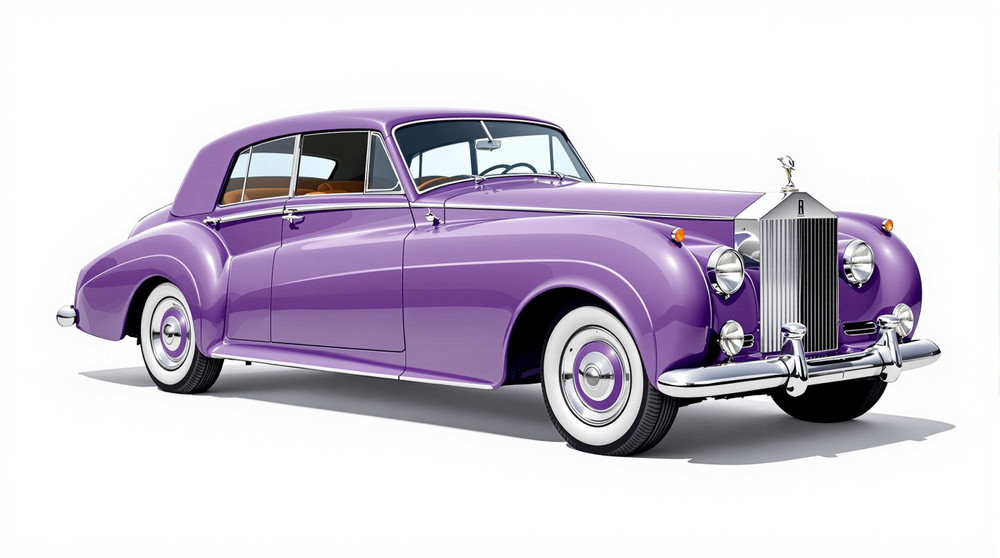
Image of 1958 Rolls-Royce Silver Wraith, Note: These illustrations use artistic license and may differ from actual historical models.
Performance Metrics
Fundamental Metrics
Emotional Appeal
MMP Rating
| Engine Specifications | |
|---|---|
| Engine: | 6-cylinder in-line engine |
| Displacement: | 4887 cc |
| Horsepower: | Estimated 130-150 hp |
| Torque: | Not available |
| Compression Ratio: | Not available |
| Ignition System: | Coil ignition |
| Cooling System: | Water-cooled |
| Performance Specifications | |
| 0-60 Time: | Not available |
| 1/4 Mile Time: | Not available |
| Top Speed: | 100 mph |
| Transmission and Drive | |
| Drive Type: | Rear-wheel drive |
| Transmission Type: | 4-speed automatic |
| Fuel and Efficiency | |
| Fuel System Type: | Carburetor |
| MPG: | Not available |
| Dimensions and Brakes | |
| Brakes: | Drum brakes |
| Wheelbase: | 123 inches |
| Weight: | 4300 lbs |
Note: Specifications for classic cars are given to the best of our ability, considering the limited and variant data available.
1958 Rolls-Royce Silver Wraith: A Hand-Built British Flagship
The 1958 Rolls-Royce Silver Wraith was less a single factory-built car than a meeting of two crafts: Rolls-Royce engineering and the work of a specialist coachbuilder. Rolls-Royce supplied the rolling chassis, engine, and mechanical components, while firms such as H.J. Mulliner, Hooper, Park Ward, and James Young created the body to suit the buyer. The result was a stately, individually tailored automobile from the final years of Britain’s great coachbuilt era.
The Silver Wraith had debuted in 1946 as Rolls-Royce’s postwar flagship. By 1958, the model was nearing the end of its run, which concluded in 1959. Its significance lies in that transition: it preserved the tradition of bespoke, body-on-chassis motoring even as the industry moved toward more standardized production. A Silver Wraith’s chassis and body could come from different makers, so two cars built in the same year might look strikingly different.
A memorable detail is that buyers did not simply choose a trim package from a factory catalog. They commissioned a body, often specifying the layout, fittings, upholstery, and finish. The coachbuilder’s name is therefore an essential part of a Silver Wraith’s identity, not just a footnote in its history.
Coachbuilt Styling and Sumptuous Interiors
The Silver Wraith’s long, separate chassis gave coachbuilders considerable freedom. Most bodies emphasized formality and presence: a tall radiator grille, upright bonnet, sweeping front wings, and a spacious passenger compartment. The famous Rolls-Royce grille and Spirit of Ecstasy mascot provided a recognizable front end, while the shape of the doors, roofline, rear quarters, and windows varied from one coachbuilt design to another.
Formal four-door saloons were among the most familiar configurations, but buyers could also order limousine-style bodies with extra rear-seat space, division windows separating the chauffeur from passengers, and other bespoke arrangements. Touring limousines and occasional specialist designs added further variety. Long-wheelbase chassis were especially well suited to chauffeur-driven use, where rear legroom and quiet comfort mattered more than a sporting profile.
Inside, the emphasis was on craftsmanship rather than standardized luxury. Depending on the body and specification, an owner might find rich leather upholstery, polished wood veneers, thick carpets, deep, carefully padded seats, and finely finished metal fittings. Rear-cabin details could be tailored for business or formal travel, including occasional seating, writing surfaces, fitted cabinetry, or a glass division. Materials and layouts varied, so the condition and originality of a particular car’s interior can be as important as its exterior.
Paint was similarly personal. Dark formal shades such as black, deep blue, and maroon suited chauffeur-driven limousines, while two-tone combinations and lighter colors were also available to order. There was no single universal “Silver Wraith palette” in the modern sense. Its bespoke nature meant the buyer’s preferences and the coachbuilder’s design often determined the final appearance.
Engineering Behind the Quiet Prestige
Under the bonnet sat Rolls-Royce’s 4,887 cc, overhead-valve straight-six engine. The company did not generally promote a headline horsepower figure, preferring to describe power as adequate for its purpose. In practice, the engine was tuned to move a large, often heavy car smoothly and quietly rather than deliver sports-car acceleration.
The Silver Wraith used a separate chassis, independent front suspension with coil springs, and a live rear axle supported by leaf springs. Hydraulic dampers helped control body movement, while drum brakes handled stopping duties. A four-speed manual gearbox was available, and many later cars were fitted with the four-speed General Motors Hydra-Matic automatic transmission, which suited the car’s relaxed, chauffeur-friendly character.
These were sophisticated provisions for a luxury car of its period, but the Silver Wraith was not built around a single headline technology. Its innovation was in the integration of a refined powertrain, quiet running, flexible chassis, and coachbuilt bodywork. It offered an owner the engineering and prestige of Rolls-Royce with a level of physical customization that mass-produced luxury cars could not match.
What Set the Silver Wraith Apart
In the 1950s, the Silver Wraith occupied a rarefied position among luxury cars. Its rivals might offer impressive power, elaborate trim, or generous passenger space, but the Rolls-Royce combined all three with a bespoke construction process and an unusually strong emphasis on refinement. The chassis could be adapted to different body designs, allowing the same model name to cover everything from an imposing formal saloon to a spacious limousine.
That approach also makes the Silver Wraith valuable to automotive historians. It represents a period when a luxury car could be commissioned as an individual object, with the coachbuilder shaping its proportions and interior around a specific client. Although the industry later favored integrated, factory-built bodies, the Silver Wraith remains a vivid example of the craft and flexibility that preceded that shift.
Performance and the Chauffeur’s Ride
Performance figures depend on body style, gearing, condition, and the weight of the finished car. As a general guide, a 1958 Silver Wraith could reach roughly 95 to 100 mph, while 0-to-60 mph acceleration was likely in the region of 15 to 20 seconds. These are estimates rather than precise figures for every car, and a heavy limousine would be slower than a lighter saloon.
On the road, the Silver Wraith’s strength was composure. The straight-six delivered power progressively, and an automatic-equipped example could gather speed without demanding much effort from the driver. The suspension was designed to take the sting out of poor surfaces, making long journeys and chauffeur-driven travel its natural territory. Large bumps could still make the substantial body move, but the car was built to soften and settle that motion rather than feel taut or sporty.
On winding roads, the Silver Wraith rewards smooth inputs. Its size, weight, and relatively leisurely steering response call for anticipation, not quick corrections. The engine’s subdued note, the muted sounds of the cabin, and the effortless pace create a distinctive experience: the driver feels the car’s mass, while passengers are insulated from much of the work involved in moving it.
Living With a 1958 Silver Wraith
Today, most Silver Wraiths are used as collector cars, show vehicles, or special-occasion transport. Well-preserved examples may still cover touring distances, but they are rarely sensible daily drivers. Their size, fuel consumption, age, and specialist maintenance needs make regular modern traffic a demanding environment.
Routine servicing is manageable for an experienced classic-car workshop, but the Silver Wraith is not an easy car for the average owner to repair at home. Parts availability varies, and some components are specific to the chassis, coachbuilder, or individual body. Restoring woodwork, trim, body panels, or bespoke fittings can be especially time-consuming because there is no universal replacement solution for every coachbuilt car.
Reliability depends heavily on upkeep. A properly maintained engine and transmission can provide dependable service, but neglected lubrication, cooling, brakes, electrical systems, or suspension can turn a seemingly minor issue into an expensive project. Before buying, a specialist inspection should include the chassis, corrosion, engine condition, gearbox, brakes, and the quality of any restoration work. Documentation and a clear record of previous maintenance are particularly valuable.
Silver Wraith Facts and Common Criticisms
The Silver Wraith was produced from 1946 to 1959, with total production commonly cited at about 1,883 cars across the model’s run. That figure covers the whole production period, not just 1958, and individual-year totals are much smaller. The model is often divided into earlier and later mechanical series, but “Silver Wraith II” belongs to a much later Rolls-Royce model from the 1970s, not to the 1958 car.
One of the model’s most appealing pieces of trivia is that its appearance can tell a story about its construction. The coachbuilder’s signature details may be visible in the roofline, rear window, door shape, or cabin fittings. Two Silver Wraiths with the same model year and similar mechanical specification can therefore have very different character and collector appeal.
The Silver Wraith was not designed to set speed or endurance records. Its purpose was dignified, quiet transportation, often for owners who expected to be driven rather than to drive themselves. Its most notable public role was as a type of car associated with official, ceremonial, and diplomatic transport, though individual histories vary and should be verified through records.
Common criticisms are practical ones: the car is large, thirsty, slow by modern standards, and costly to restore. Coachbuilt uniqueness can also make repairs more complicated than on a standardized production car. For enthusiasts, those drawbacks are part of the bargain for owning a rare, handcrafted machine, but they should be understood before purchase.
Collector Value and Market Outlook
Values vary widely according to coachbuilder, body style, originality, mechanical condition, restoration quality, and documented history. As a broad current-market estimate, a usable but imperfect example might fall around $75,000 to $150,000. A sound, well-presented car could bring roughly $150,000 to $300,000, while an exceptional restoration, desirable coachbuilt body, or compelling provenance may push a car beyond $300,000. Rare or especially important examples can exceed that range, but those outcomes are not typical.
Availability is limited. With roughly 1,883 Silver Wraiths built over the entire production run, the model is scarce compared with mass-produced classics, and only a fraction appear on the market in any given year. Buyers should look beyond a striking photograph and investigate chassis records, coachbuilder history, restoration invoices, and the quality of the underlying structure.
Prices tend to reward quality and provenance more than simple age. Strong, correctly restored cars have generally held collector interest, while projects can be expensive to complete and may not return their restoration cost. The market can fluctuate, but the Silver Wraith’s scarcity, bespoke construction, and place in Rolls-Royce history give the best examples durable appeal.
Why the 1958 Silver Wraith Still Matters
The 1958 Rolls-Royce Silver Wraith united a refined straight-six, a traditional separate chassis, and bodywork shaped by some of Britain’s finest coachbuilders. It was not the fastest or easiest luxury car to own, but it offered something more personal: a hand-finished automobile whose form and cabin could reflect the wishes of its first owner.
As one of the final Silver Wraiths, a 1958 example stands at the close of a remarkable coachbuilt tradition. Its lasting appeal lies not only in the grille or the badge, but in the idea that a great car could be engineered by Rolls-Royce and then made unmistakably individual by hand.
1958 Rolls-Royce Silver Wraith Catalog of Parts
 1958 Rolls-Royce Silver Wraith Heel Pad. Initials "HJM"-RM 16Heel Pad. Initials "HJM". Made of high quality black rubber. 8" X 16". Each
Why Choose Metro?
For over 100 years, Metro Moulded Parts has been the pinnacle of quality in classic car restoration parts. Our commitment to precision and authenticity in every component ensures a perfect fit and an OEM-level appearance.
- Expert Craftsmanship & Quality: Each part is a testament to our dedication to reliability and perfection, crafted from original designs and thoroughly tested.
- Advanced Technology: We use cutting-edge techniques to create flawless, long-lasting parts that surpass others in performance.
- SuperSoft Sponge – The Ultimate Door Seal: Not only are our door seals 30% softer than competitors', but they're also guaranteed to never leak. They effectively reduce wind and road noise, enhancing your classic car's comfort and driving experience.
- Proudly American: Our parts are a product of American craftsmanship, made in the USA with a spirit of excellence and heritage.
- Unrivaled Warranty: We back our products with a 30-year industry-leading warranty, a testament to our confidence in their quality.
Join us in preserving the legacy of classic cars with parts that are crafted for perfection, not just made.