
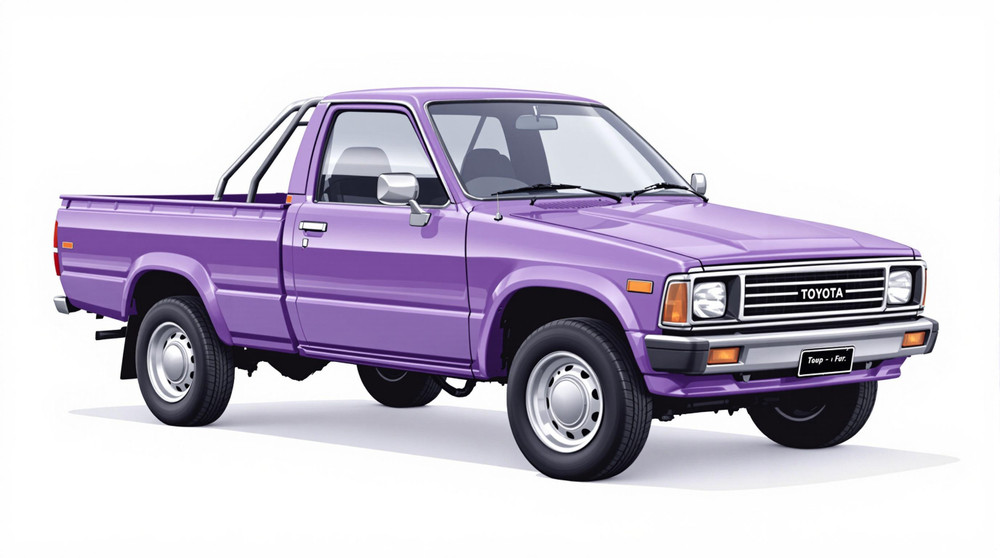
Image of 1981 Toyota Pickup, Note: These illustrations use artistic license and may differ from actual historical models.
Performance Metrics
Fundamental Metrics
Emotional Appeal
MMP Rating
| Engine Specifications | |
|---|---|
| Engine: | 2.4L 4-cylinder |
| Displacement: | 2366cc |
| Horsepower: | 96-100 hp |
| Torque: | 129 lb-ft |
| Compression Ratio: | 8.8:1 |
| Ignition System: | Electronic |
| Cooling System: | Liquid-cooled |
| Performance Specifications | |
| 0-60 Time: | 15 seconds |
| 1/4 Mile Time: | 20 seconds |
| Top Speed: | 100 mph |
| Transmission and Drive | |
| Drive Type: | Rear-wheel drive |
| Transmission Type: | 4-speed manual, 5-speed manual, 3-speed automatic |
| Fuel and Efficiency | |
| Fuel System Type: | Carburetor |
| MPG: | 20-25 mpg |
| Dimensions and Brakes | |
| Brakes: | Front disc, rear drum |
| Wheelbase: | 103.5 inches |
| Weight: | 3000 lbs |
Note: Specifications for classic cars are given to the best of our ability, considering the limited and variant data available.
1981 Toyota Pickup: The Compact Truck That Built a Reputation
The 1981 Toyota Pickup was small enough to thread through city traffic, tough enough for work, and simple enough for an owner to understand with a basic tool kit. Built by Toyota as part of the Hilux family, it arrived in the United States during a period when fuel-conscious buyers were taking compact trucks seriously. Its blend of utility, durability, and straightforward engineering helped establish the template for the modern small pickup.
Outside North America, Toyota called the truck the Hilux. In the United States, it was sold simply as the Toyota Pickup. The 1981 model belongs to the Hilux generation introduced in 1978, with a squared-off design that suited the decade. One notable development came that year: Toyota introduced the 2.4-liter 22R gasoline engine in the Pickup, an engine that would become one of the company’s best-known truck powerplants. Availability varied by market and production date, so some trucks may have different engines or specifications.
There was also a fascinating branch of the 1981 truck’s story. A company called Winnebago Industries converted some Toyota pickups into the Trekker, a compact, open-backed sport utility vehicle with a removable fiberglass rear section. The Trekker helped point the way toward Toyota’s first 4Runner, which arrived in 1984.
Square-Jawed Styling and Practical Details
The 1981 Toyota Pickup had the purposeful look of a working tool. Its upright hood, flat body sides, squared wheel openings, and simple grille gave it a clean, no-nonsense profile. Depending on trim and market, the front end wore round or rectangular headlights. Four-wheel-drive models sat higher and looked especially purposeful, with their taller stance and chunky tires.
Inside, the cabin was compact and built for use rather than luxury. Hard-wearing vinyl, durable plastics, simple door panels, and straightforward switches were typical. Higher-trim SR5 models could add more comfortable seating, upgraded trim, extra instrumentation, and sportier details. The dashboard was easy to read, and the controls were generally uncomplicated. In today’s terms, the cabin feels basic, but that simplicity is part of its appeal: there is little to distract from the job at hand.
Technology was modest by modern standards, but the truck offered useful engineering for its time. Buyers could choose manual transmissions, and four-wheel-drive models provided a transfer case for tackling slippery roads and rough terrain. Instrumentation and equipment depended on trim. An SR5 might include a tachometer and additional convenience features, while a base truck focused on essentials. There were no modern driver aids, touchscreens, or electronic traction systems. The driver did the work.
Toyota offered a range of exterior colors that changed by market and trim. White, red, blue, silver, and earth tones were among the period-appropriate choices, with two-tone paint especially associated with sporty SR5 models. Exact color names and combinations varied, so original paint codes are the best guide when identifying a specific truck.
Body and drivetrain choices gave the Pickup broad appeal. Buyers could find two-wheel-drive and four-wheel-drive trucks, along with different cab and bed configurations depending on market. The familiar regular-cab pickup was the core offering, with short- and long-bed versions available in various combinations. The short-bed four-wheel-drive truck is now among the most recognizable and sought-after configurations. The Trekker conversion is much rarer and should be treated as a separate specialty vehicle, not a standard Toyota body style.
Why the 1981 Pickup Mattered
The Toyota Pickup helped show American buyers that a compact truck did not have to be a disposable, bare-bones alternative to a full-size model. Its appeal came from a useful balance: manageable dimensions, relatively modest fuel consumption, practical cargo capacity, and a reputation for mechanical durability. That combination was particularly attractive after the fuel-price shocks of the 1970s, when drivers were paying closer attention to economy as well as utility.
Its engineering was conventional, and that was a strength. The Pickup did not rely on complicated electronics to make it capable. A sturdy chassis, straightforward mechanical systems, and available four-wheel drive made it useful on job sites, farms, trails, and everyday commutes. Toyota’s approach helped build the reputation that would support the brand’s later growth in North America and influenced the expectations buyers brought to compact trucks: they should be efficient, maneuverable, and dependable, not merely small.
It was not alone in the market. Domestic compact pickups and other imports also competed for buyers. Toyota stood out through its consistency and its growing reputation for quality. The legacy can be seen in later Toyota trucks, especially the Tacoma, which carried the compact-pickup idea into a larger, more modern era.
22R Power and Old-School Road Manners
The headline gasoline engine for many 1981 examples was the 2.4-liter 22R inline-four. Output was modest by current standards, with specifications varying by market, emissions equipment, and rating method. Some trucks from the period may instead have a 2.2-liter 20R or another market-specific engine. The 22R became famous less for outright speed than for its uncomplicated design and long service life when properly maintained.
Performance figures depend heavily on engine, transmission, axle gearing, body style, and vehicle condition. Period-style estimates put many versions in roughly the 14-to-18-second range for 0-to-60 mph acceleration, with top speed generally around 85 to 95 mph. Treat those as broad estimates rather than factory guarantees. A four-wheel-drive model with larger tires and lower gearing will feel different from a lighter two-wheel-drive truck, and decades of wear can change performance considerably.
On the road, the Pickup feels mechanical and direct. The four-cylinder engine works audibly when pushed, and acceleration is steady rather than brisk. A manual transmission makes the driver an active part of the experience: choose a gear, manage the engine’s modest power, and plan overtakes well in advance. At highway speeds, wind and tire noise are part of the soundtrack.
The ride is firm, particularly when the bed is empty. Leaf springs and a work-focused suspension can transmit sharp bumps into the cabin, while a load in the back often settles the truck down. On winding roads, it feels narrow and relatively nimble, but it is still a tall pickup with older steering and suspension design. Four-wheel-drive models with a solid front axle are especially capable at low speeds on rough ground, though they feel less polished on pavement than a modern SUV.
Living With a Classic Toyota Pickup
These trucks were designed to work, and surviving examples still serve as farm vehicles, shop runabouts, camping rigs, and daily drivers. Well-kept examples also appear at classic-truck meets and Toyota gatherings. Modified trucks, lifted 4x4s, and restoration projects have their own following, while original, uncut examples are increasingly attractive to collectors.
Maintenance is one of the Pickup’s strongest ownership points. The engine bay is relatively accessible, the mechanical systems are familiar to many independent mechanics, and routine jobs do not require specialized diagnostic equipment. Parts availability is generally good for common service items, although trim pieces, original interior components, and specific body parts can take more searching. Before buying, check the frame, cab corners, floor pans, bed, and suspension mounting points carefully. Rust is often a bigger threat than a worn engine.
Common service needs include cooling-system attention, carburetor work on carbureted examples, ignition and fuel-system maintenance, suspension bushings, and repairs to aging electrical connections. A truck that starts and drives well still deserves a close inspection. Long-term neglect, hard off-road use, and poorly executed modifications can turn an apparently inexpensive purchase into a major project.
Trivia, Trekker Lore, and Common Complaints
The Trekker is the standout curiosity of this model year. Built from Toyota pickups by Winnebago, it combined a Toyota cab and chassis with a fiberglass rear body and removable roof section. It was an unusual early step toward the compact SUV boom. Because it was a conversion rather than a mass-produced factory body style, surviving Trekkers are far less common than ordinary pickups.
The Toyota Pickup’s reputation for toughness grew over many years and across several Hilux generations. Later Hilux trucks became famous in televised durability challenges, but those tests did not feature the 1981 model. Likewise, the Toyota pickup driven by Marty McFly in the 1985 film Back to the Future was a later truck, not a 1981 example. These distinctions matter when researching a specific vehicle or evaluating claims about its history.
The truck has its critics. It is slow by modern traffic standards, the cabin is tight, and the ride can be choppy when unloaded. Older brakes and safety equipment also fall well short of current expectations. Rust, hard use, and decades of improvised repairs are frequent concerns. Its toughness is real, but it is not magic: maintenance and condition make all the difference.
Collector Values and Market Outlook
Prices vary sharply with rust, originality, drivetrain, trim, and restoration quality. As a broad 2026 U.S. market guide, a rough project may bring about $2,500 to $6,000. A usable driver in fair condition might fall around $6,000 to $12,000, while a clean, well-kept example can reach roughly $12,000 to $25,000. Excellent original trucks, desirable SR5s, and solid four-wheel-drive examples can sell for $25,000 to $40,000 or more. Exceptional restorations and rare Trekker conversions can exceed those ranges.
These figures are estimates, not a price guide for every region or vehicle. A clean frame and documented history can matter more than fresh paint, and a modified truck may appeal strongly to one buyer while reducing its value to someone seeking originality. Four-wheel-drive short-bed models tend to attract particular interest, but condition remains the deciding factor.
There is no simple, reliable public production figure for every 1981 Toyota Pickup configuration worldwide. The Hilux was sold across many markets, and surviving records do not always separate model-year totals by body, engine, and drivetrain. As a cautious order-of-magnitude estimate, U.S. production or sales for the model year may have been in the tens of thousands, perhaps roughly 50,000 to 100,000 trucks. That is a broad estimate, not an audited factory count. The Trekker was produced in much smaller numbers.
Values for clean examples have generally strengthened as the supply of rust-free, original compact pickups has shrunk. The trend is especially noticeable for 4x4s, SR5 models, and unusual vehicles such as the Trekker. Ordinary project trucks remain more affordable, but the best examples are no longer overlooked bargains.
A Small Truck With a Big Legacy
The 1981 Toyota Pickup combines straightforward engineering, useful proportions, and the early chapters of a durability story that would define Toyota trucks for generations. It is not fast or plush, and it asks its driver to accept the limits of an older vehicle. In return, it offers honest mechanical character, practical capability, and a design that still makes sense decades later.
Whether found as a hardworking 4x4, a carefully preserved SR5, or a rare Trekker conversion, the 1981 Toyota Pickup is more than a compact classic. It is one of the trucks that taught buyers how much usefulness could fit into a small package.
1981 Toyota Pickup Catalog of Parts
 1981 Toyota Pickup Molded Door Seals. Pair R&L-LM 134Molded Door Seals. Pair R&L
Why Choose Metro?
For over 100 years, Metro Moulded Parts has been the pinnacle of quality in classic car restoration parts. Our commitment to precision and authenticity in every component ensures a perfect fit and an OEM-level appearance.
- Expert Craftsmanship & Quality: Each part is a testament to our dedication to reliability and perfection, crafted from original designs and thoroughly tested.
- Advanced Technology: We use cutting-edge techniques to create flawless, long-lasting parts that surpass others in performance.
- SuperSoft Sponge – The Ultimate Door Seal: Not only are our door seals 30% softer than competitors', but they're also guaranteed to never leak. They effectively reduce wind and road noise, enhancing your classic car's comfort and driving experience.
- Proudly American: Our parts are a product of American craftsmanship, made in the USA with a spirit of excellence and heritage.
- Unrivaled Warranty: We back our products with a 30-year industry-leading warranty, a testament to our confidence in their quality.
Join us in preserving the legacy of classic cars with parts that are crafted for perfection, not just made.