

Image of 1916 Willys Knight, Note: These illustrations use artistic license and may differ from actual historical models.
Performance Metrics
Fundamental Metrics
Emotional Appeal
MMP Rating
| Engine Specifications | |
|---|---|
| Engine Options: | 4-cylinder Knight sleeve valve engine |
| Displacement Range: | 186 cubic inches |
| Horsepower Range: | Estimated 20-30 HP |
| Torque: | Not available |
| Compression Ratio: | Not available |
| Ignition System: | Battery and coil |
| Cooling System: | Water-cooled |
| Performance Specifications | |
| 0-60 Time: | Not available |
| 1/4 Mile Time: | Not available |
| Top Speed: | 40-50 mph |
| Transmission and Drive | |
| Drive Type: | Rear-wheel drive |
| Transmission Type: | 3-speed manual |
| Fuel and Efficiency | |
| Fuel System Type: | Gravity feed |
| MPG: | Not available |
| Dimensions and Brakes | |
| Brakes: | Mechanical drum brakes |
| Wheelbase: | 112 inches |
| Weight: | 2,800 lbs |
Note: Specifications for classic cars are given to the best of our ability, considering the limited and variant data available.
1916 Willys-Knight: A Different Kind of Luxury Car
The 1916 Willys-Knight made its case for refinement with an engine that had no conventional poppet valves. Built by Willys-Overland in Toledo, Ohio, it used a sleeve-valve design intended to run more quietly and smoothly than the engines in many rival cars. That unusual engineering gave the Willys-Knight a distinctive character, and made it one of the more intriguing American automobiles of the prewar era.
“Willys-Knight” covered a range of cars rather than one fixed specification. The 1916 lineup included four-cylinder models such as the Model 20 and, depending on the model and catalog, six-cylinder offerings such as the Model 88. Equipment, dimensions, bodywork, and performance therefore varied. The common thread was the Knight engine, developed by Charles Yale Knight and licensed to manufacturers including Willys-Overland.
The timing was significant. American carmakers were moving from early brass-era machines toward more powerful, enclosed, and comfortable automobiles. Willys-Overland had become a major manufacturer, and its Knight-powered cars offered a more upscale alternative to the company’s simpler, mass-market vehicles. Their selling point was not just size or horsepower: it was the promise of a quieter, more polished drive.
A detail that still surprises many enthusiasts is how the engine achieved that quietness. Instead of opening and closing ordinary valves, sliding sleeves around the pistons controlled the intake and exhaust ports. It was a sophisticated solution, but one that demanded careful lubrication and specialist knowledge.
Styling, Cabin, and Period Options
From the outside, a 1916 Willys-Knight has the upright, formal proportions of an early touring car. A tall radiator and bonnet lead the eye toward a long passenger compartment, while separate fenders, running boards, and large spoked wheels give the car its unmistakably prewar stance. Brass or bright-metal fittings, lamps, and trim could vary with model, equipment, and owner specification. The overall look is substantial without the later streamlining of the 1920s.
Open touring bodies were among the most characteristic choices. They offered room for several passengers and made the car feel suited to country outings and long-distance travel. Roadsters, coupes, and more enclosed sedan-style bodies were also available across the Willys-Knight range, though availability depended on the particular model and year. An enclosed body brought welcome protection from weather, while the touring car remains the most instantly recognizable form today.
The cabin was built for comfort by the standards of the day, with upholstered seating, a high driving position, and substantial wood and metal fittings. Materials and finish differed between body styles and price levels. Leather was common in open cars, while enclosed bodies could use cloth or other upholstery. These were hand-finished automobiles, but they should not be mistaken for modern luxury interiors: exposed controls, a large steering wheel, and a working view of the chassis were all part of the experience.
Factory paint choices could vary, and surviving cars may have been repainted or restored in colors not offered originally. Dark greens, maroons, blues, and black are plausible period choices, but a specific car’s original color is best confirmed through paint traces, factory records, or restoration documentation. Deep, subdued shades suit the car’s formal lines particularly well.
Sleeve-Valve Engineering and Historical Importance
The Willys-Knight’s defining innovation was its Knight sleeve-valve engine. In a conventional engine, poppet valves open and close in the cylinder head. In the Knight system, moving sleeves in the cylinders uncovered ports for the fuel-air mixture and exhaust. With fewer familiar valve-train noises, the engine could sound notably smooth and subdued for its era.
That quiet operation helped distinguish the Willys-Knight from many contemporary cars, whose mechanical clatter was part of everyday motoring. The design also had trade-offs. Sleeve-valve engines needed dependable lubrication, could consume more oil than owners expected, and were more complicated to maintain than a straightforward side-valve engine. Their appeal was real, but so was the upkeep required to preserve their best qualities.
The Willys-Knight did not single-handedly transform automotive engineering, and sleeve valves never displaced conventional valves across the industry. Its importance lies in showing how seriously early manufacturers pursued smoothness and refinement. The car brought an unconventional engine design to a sizable American maker’s lineup and helped establish a distinctive identity for Willys-Knight vehicles.
Speed, Road Manners, and the Driving Experience
Performance depends on which 1916 model is being discussed, its condition, gearing, body style, and the quality of its restoration. Period specifications and modern reference sources do not always describe the range consistently. As a practical guide, a healthy example might manage roughly 45 to 55 mph, with some cars potentially reaching around 60 mph under favorable conditions. These are indicative figures, not a guarantee for every car.
A trustworthy factory 0-to-60-mph time is not generally available. More importantly, many surviving examples are not driven as though they were modern cars, and a century-old automobile may have gearing, brakes, tires, and engine condition that make a hard acceleration test unwise. Expect leisurely acceleration by today’s standards, especially in a heavier enclosed body. The car is best enjoyed at touring speeds rather than pushed to its limit.
On a smooth road, the engine’s subdued note and steady power delivery are central to the appeal. The ride is shaped by the car’s substantial chassis, period suspension, and tall, narrow tires. It can feel composed over ordinary road imperfections, but large potholes and rough surfaces call for caution. Steering is comparatively heavy and direct, and winding roads require planning: the car has a high center of gravity, relatively modest brakes by modern standards, and no modern safety aids.
Behind the wheel, the driver is actively involved. Starting, shifting, braking, and managing the controls demand more attention than in a contemporary car. When the engine is well adjusted, the result is less a burst of speed than a smooth, measured progress with remarkably little mechanical clatter for a car of its age.
Owning and Maintaining a Willys-Knight
Today, a 1916 Willys-Knight is primarily a touring, collection, or show car. Some owners take their cars on vintage motoring events and local tours, but regular modern commuting is impractical. Traffic speed, limited braking performance, fragile original components, and the difficulty of finding suitable parts make frequent everyday use a challenge.
Maintenance is manageable for an experienced veteran-car owner, but this is not the easiest early automobile for a beginner to keep on the road. The sleeve-valve engine needs appropriate oiling and careful attention to wear. Ignition, cooling, fuel delivery, and mechanical lubrication also require routine checks. A specialist familiar with Knight engines is especially valuable when the engine needs internal work.
Parts availability is mixed. Common consumables and some reproduced components may be found through veteran-car networks, but model-specific engine parts, body fittings, and trim can take time to locate or may need to be made. A well-maintained car with a known history is far more appealing than a cheap project with an incomplete or worn engine. Before buying, have a knowledgeable mechanic assess sleeve condition, oil consumption, cooling, chassis, and the quality of any restoration.
Notable Details and Common Criticisms
The engine itself is the best-known conversation starter. Sleeve-valve technology was used by several manufacturers, but the Willys-Knight gave the concept a prominent place in an American production-car range. The quiet-running reputation became a key part of the marque’s identity.
There is no widely recognized 1916 Willys-Knight speed, sales, or endurance record that defines the model, and claims of specific celebrity ownership should be treated cautiously unless backed by reliable documentation. The car’s significance is better understood through its engineering and its place in Willys-Overland’s growth than through a single headline-grabbing event.
Common criticisms are practical rather than mysterious: sleeve-valve engines can be oil-hungry, specialist repairs can be costly, and touring-car performance is modest by modern standards. The driving position and controls also require adjustment for anyone accustomed to later cars. For enthusiasts, those compromises are part of the period experience, but they should be understood before purchase.
Collector Values and Availability
Surviving 1916 Willys-Knights are uncommon, and a well-documented, correctly restored car is harder to find than a more familiar Model T Ford. There is no reliable production figure for every 1916 Willys-Knight body and model combination. As a broad estimate, production across the relevant Knight-powered models may have reached several thousand to perhaps the low tens of thousands, but the number of surviving examples is much smaller. That estimate should not be mistaken for a verified factory total.
As a rough current-market guide, a project or incomplete car might fall around $10,000 to $25,000, while a usable driver or older restoration could bring approximately $25,000 to $50,000. A very good, correctly restored example with desirable bodywork and strong documentation might reach $50,000 to $80,000 or more. These are estimates, not formal appraisals: condition, originality, engine health, provenance, and the quality of the restoration can shift the price substantially.
Values for early brass- and nickel-era cars tend to be selective rather than uniformly rising. Exceptional examples with strong provenance can attract serious interest, while cars needing expensive specialist work may be difficult to sell. In the long term, the Willys-Knight’s unusual engineering and low availability support collector appeal, but ownership costs and a narrower buyer pool can temper appreciation.
Why the 1916 Willys-Knight Still Matters
The 1916 Willys-Knight combined formal early-automobile styling with an engine that took a genuinely different route to smoothness. Its sleeve-valve design gave it a quieter character than many contemporaries, while its touring and enclosed body styles reflected a growing demand for comfort as motoring became more established.
It is not the simplest antique car to own, nor the quickest way to cover ground. Its reward is a more unusual one: the chance to experience an ambitious piece of early automotive engineering in a handsome, substantial machine. More than a century later, the Willys-Knight remains memorable because it dared to make quietness its signature.
1916 Willys Knight Catalog of Parts
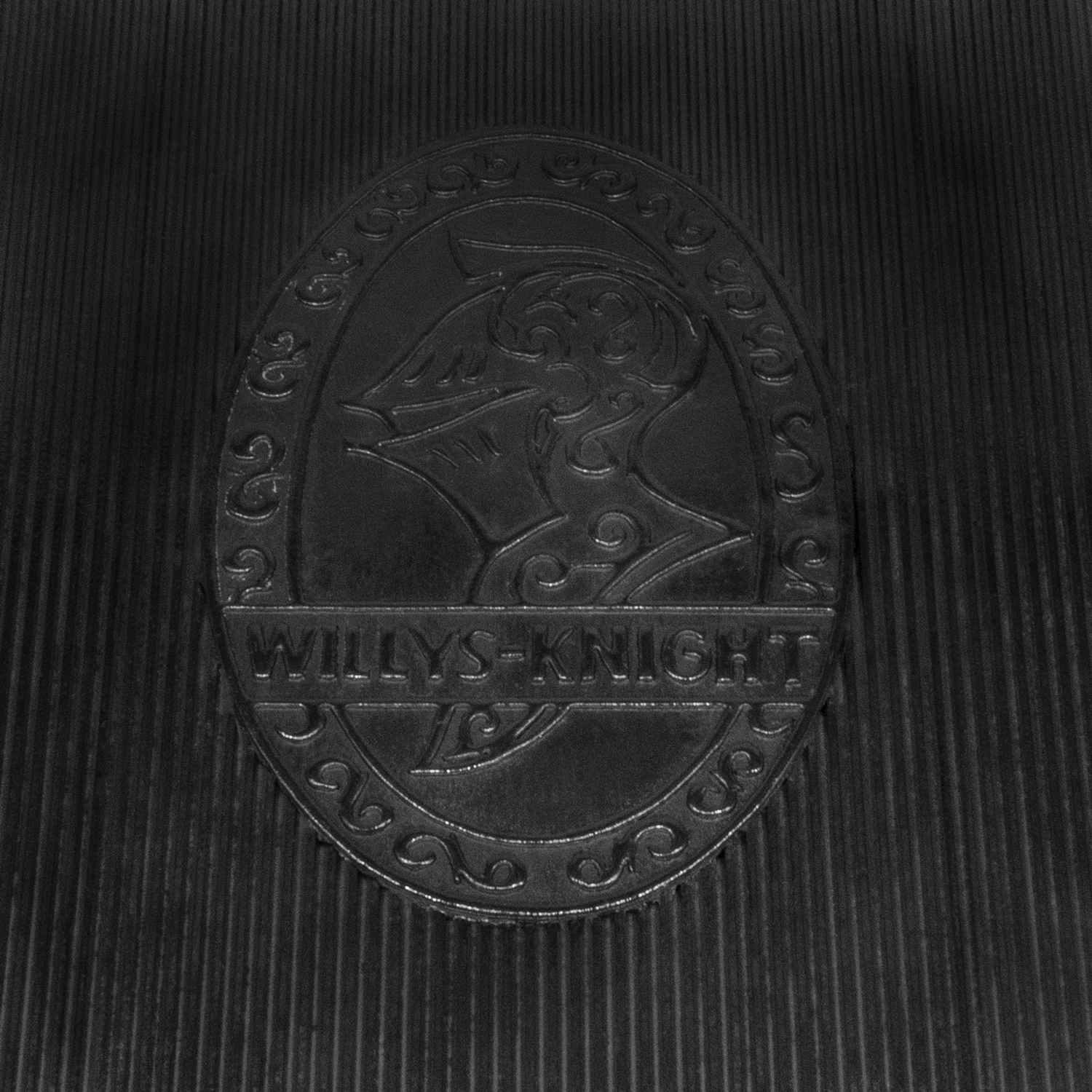 1916 Willys Knight Accessory Floor Mat - 12"X17"-AC 51Accessory Floor Mat - made of high quality black rubber with molded original emblem. Also designed to be sewn into new carpets. 12"X17", Each
Why Choose Metro?
For over 100 years, Metro Moulded Parts has been the pinnacle of quality in classic car restoration parts. Our commitment to precision and authenticity in every component ensures a perfect fit and an OEM-level appearance.
- Expert Craftsmanship & Quality: Each part is a testament to our dedication to reliability and perfection, crafted from original designs and thoroughly tested.
- Advanced Technology: We use cutting-edge techniques to create flawless, long-lasting parts that surpass others in performance.
- SuperSoft Sponge – The Ultimate Door Seal: Not only are our door seals 30% softer than competitors', but they're also guaranteed to never leak. They effectively reduce wind and road noise, enhancing your classic car's comfort and driving experience.
- Proudly American: Our parts are a product of American craftsmanship, made in the USA with a spirit of excellence and heritage.
- Unrivaled Warranty: We back our products with a 30-year industry-leading warranty, a testament to our confidence in their quality.
Join us in preserving the legacy of classic cars with parts that are crafted for perfection, not just made.