

Image of 1922 Willys Knight Model 27, Note: These illustrations use artistic license and may differ from actual historical models.
Performance Metrics
Fundamental Metrics
Emotional Appeal
MMP Rating
| Engine Specifications | |
|---|---|
| Engine Options: | Inline 4-cylinder engine |
| Displacement Range: | 3.0L |
| Horsepower Range: | Estimated 20-30 HP |
| Torque: | Not available |
| Compression Ratio: | Not available |
| Ignition System: | Battery and coil |
| Cooling System: | Water-cooled |
| Performance Specifications | |
| 0-60 Time: | Not available |
| 1/4 Mile Time: | Not available |
| Top Speed: | 45 mph |
| Transmission and Drive | |
| Drive Type: | Rear-wheel drive |
| Transmission Type: | 3-speed manual |
| Fuel and Efficiency | |
| Fuel System Type: | Carburetor |
| MPG: | Not available |
| Dimensions and Brakes | |
| Brakes: | Mechanical drum brakes |
| Wheelbase: | 112 inches |
| Weight: | Estimated 2500 lbs |
Note: Specifications for classic cars are given to the best of our ability, considering the limited and variant data available.
1922 Willys-Knight Model 27: A Different Kind of Luxury Car
The 1922 Willys-Knight Model 27 pursued refinement with an engine that had no conventional poppet valves. Built by Willys-Overland in the United States, it used a Knight sleeve-valve powerplant, a distinctive design intended to run quietly and smoothly. That unusual engineering gave the Model 27 a character all its own in an era when most American cars relied on more familiar valve arrangements.
Willys-Overland was already a major name in the industry, best known for practical, comparatively affordable automobiles. The Knight line sat higher in the company’s range and offered a more luxurious alternative. Its sleeve-valve engine was licensed from the Knight system, developed by Charles Yale Knight, and became a defining feature of Willys-Knight cars.
One intriguing detail is that the engine’s valves were sleeves that moved up and down around the pistons rather than conventional valves that opened and closed against their seats. The arrangement promised quieter operation, but it also made the engine more specialized to maintain. That contrast between advanced engineering and hands-on upkeep is central to the Model 27’s appeal today.
Classic Coachwork and Sleeve-Valve Engineering
The Model 27 wore the upright, substantial proportions typical of a quality American car of the early 1920s. Its tall radiator, long hood, separate fenders, running boards, and exposed lamps gave it a formal, purposeful stance. Brass-era ornament had largely given way to nickel and other bright finishes by this period, while the open body styles emphasized the car’s length and the craftsmanship of its coachwork.
Inside, the experience depended on the body style and trim level, but owners could expect a practical, well-appointed cabin rather than modern conveniences. Period cars commonly featured leather upholstery, wood trim or a wood-framed interior, a large steering wheel, and simple, readable instruments. Materials and finish varied, so a surviving car’s details may differ from another Model 27, especially if it has been restored or re-trimmed.
The Model 27’s standout technology was its Knight sleeve-valve engine. The sleeves provided the intake and exhaust openings and moved within the cylinder, helping the engine run with less mechanical clatter than many contemporary designs. It was paired with a conventional manual transmission and rear-wheel drive. Exact specifications can vary among period references and surviving cars, but the Model 27 is generally associated with a four-cylinder engine of roughly 245 cubic inches and approximately 40 horsepower.
Factory paint combinations were not necessarily identical across every body and order, and surviving documentation does not establish a single definitive color palette for all Model 27s. Dark shades such as black, deep blue, and maroon were common choices for cars of the period, often paired with contrasting trim or upholstery. Body offerings could include open touring and roadster configurations as well as closed cars, such as sedans or coupes, depending on the year and catalog. The touring car is among the most recognizable forms of the era, with its open cabin and folding top.
Why the Model 27 Stood Apart
The Model 27’s historical significance lies less in a single styling breakthrough than in its alternative approach to engine design. Sleeve-valve engines were promoted for quietness and smooth running, qualities that suited a car positioned as a more refined choice. In a market increasingly shaped by mass production and standardized engineering, Willys-Knight offered something technically distinctive.
That distinction also came with trade-offs. Sleeve-valve engines required careful lubrication and knowledge of their particular construction. They could be quiet and pleasant when properly maintained, but they were less straightforward for mechanics accustomed to conventional valve gear. As automotive engineering moved toward more economical, easier-to-service poppet-valve engines, the sleeve-valve layout gradually lost ground.
The Model 27 therefore represents an important branch in automotive history: a credible, commercially produced alternative that demonstrated how manufacturers experimented with engine architecture before the industry settled on the designs that would dominate later decades. Its influence is best understood as part of that broader engineering story, rather than as the direct origin of a modern technology.
Road Manners and Performance
Period factory figures for acceleration and top speed are difficult to pin down for an individual Model 27, and a verified 0-to-60-mph time is not generally available. Based on its approximate power, weight, gearing, and the performance of comparable cars, a sound example might reach roughly 50 to 55 mph under favorable conditions. Acceleration to 60 mph would be slow, and some cars may not comfortably reach that speed at all. A precise 0-to-60 figure should be treated as an estimate, not a factory specification.
On the road, the Model 27 was built for steady touring rather than quick launches or hard cornering. Its substantial chassis and period suspension could smooth ordinary road imperfections, but large bumps would still be felt through the frame and seat. Narrow tires, a high center of gravity, and comparatively modest brakes call for measured speeds, especially on winding roads or in wet conditions.
The engine’s subdued mechanical note is one of its signature pleasures. A well-adjusted sleeve-valve unit can sound smoother and less tappety than a conventional engine of the same period. Behind the wheel, the driver works a manual gearbox, monitors the instruments, and plans ahead. Steering and braking demand more effort and anticipation than a modern car, while the open-body versions bring the sound of the engine and the road directly into the cabin.
Living With a Willys-Knight
Today, a Model 27 is most at home in touring events, vintage-car shows, and private collections. It is not generally used as a daily driver, and it was not designed as a racing car. Its appeal is the chance to experience early-1920s motoring and an engine design that feels notably different from the norm.
Maintenance is manageable for an experienced vintage-car owner, but the sleeve-valve engine makes specialist knowledge valuable. Correct lubrication, careful adjustment, and access to someone familiar with Knight engines can make a major difference. Routine work on chassis components may be familiar to a prewar-car mechanic, but internal engine repairs are not an ideal first project for an owner accustomed only to modern vehicles.
Reliability depends heavily on condition and maintenance history. A sound, properly restored car can be enjoyable on appropriate vintage routes, while a neglected engine or poorly completed restoration can become expensive. Before buying, inspect the engine’s condition, lubrication system, cooling system, transmission, brakes, and the availability of model-specific parts and expertise.
Notable Details and Common Complaints
The Model 27’s most memorable piece of trivia is built into its engine: its “valves” were moving sleeves, not the familiar poppet valves found in most cars. That feature gave Willys-Knight its identity and helped the marque promote quiet operation. The design was unusual, but it was not unique to Willys-Overland; several manufacturers explored sleeve-valve engines during the period.
There is no widely recognized speed, endurance, or sales record associated specifically with the 1922 Model 27, and claims of celebrity ownership should be checked against reliable documentation. The car’s stronger historical connection is to the broader popularity of sleeve-valve engineering and to Willys-Overland’s effort to offer a more refined companion to its mainstream models.
Common criticisms include the engine’s specialized maintenance needs, the scarcity of knowledgeable repair shops, and the modest performance by modern standards. Parts availability can also be a challenge, particularly for components unique to the sleeve-valve engine. These concerns are balanced by the car’s smooth-running character and its rarity as an example of a once-serious alternative to conventional engine design.
Collector Value and Availability
Exact production totals for the Model 27 are not consistently documented in readily available sources, so any figure should be treated as an estimate. A reasonable working guess is that production was in the low thousands rather than tens of thousands, with surviving examples far fewer. The exact number built and the number still on the road remain uncertain.
For a collector, condition and completeness matter more than a single headline price. As a broad present-day estimate, a project car might fall around $10,000 to $20,000, while a presentable driver or older restoration could be roughly $20,000 to $35,000. A high-quality, well-documented restoration may bring approximately $35,000 to $50,000 or more, depending on body style, provenance, and the state of the engine. These are general guide ranges, not a formal appraisal, and specialist auction results can vary considerably.
Model 27s appear less often than mainstream cars of the same age, and finding the right example may take patience. Values are likely to be supported by the car’s rarity and distinctive engineering, but they also depend on a relatively specialized collector market. Over time, top-quality examples may appreciate, while ordinary cars are more likely to track broader prewar-car demand. Restoration costs can exceed the value of a finished car, so buying the best complete example an owner can afford is often the sensible approach.
A Distinctive Chapter in Willys-Overland History
The 1922 Willys-Knight Model 27 combines formal early-automobile styling with one of the era’s most unusual engine designs. Its sleeve-valve motor offered quietness and smoothness, while asking owners to accept specialized maintenance and performance suited to unhurried touring.
More than a rare old car, the Model 27 is a reminder that automotive history was shaped by experimentation as much as by the technologies that ultimately prevailed. Hear one running smoothly and its appeal is immediate: this is a Willys-Overland built to take a different road.
1922 Willys Knight Model 27 Catalog of Parts
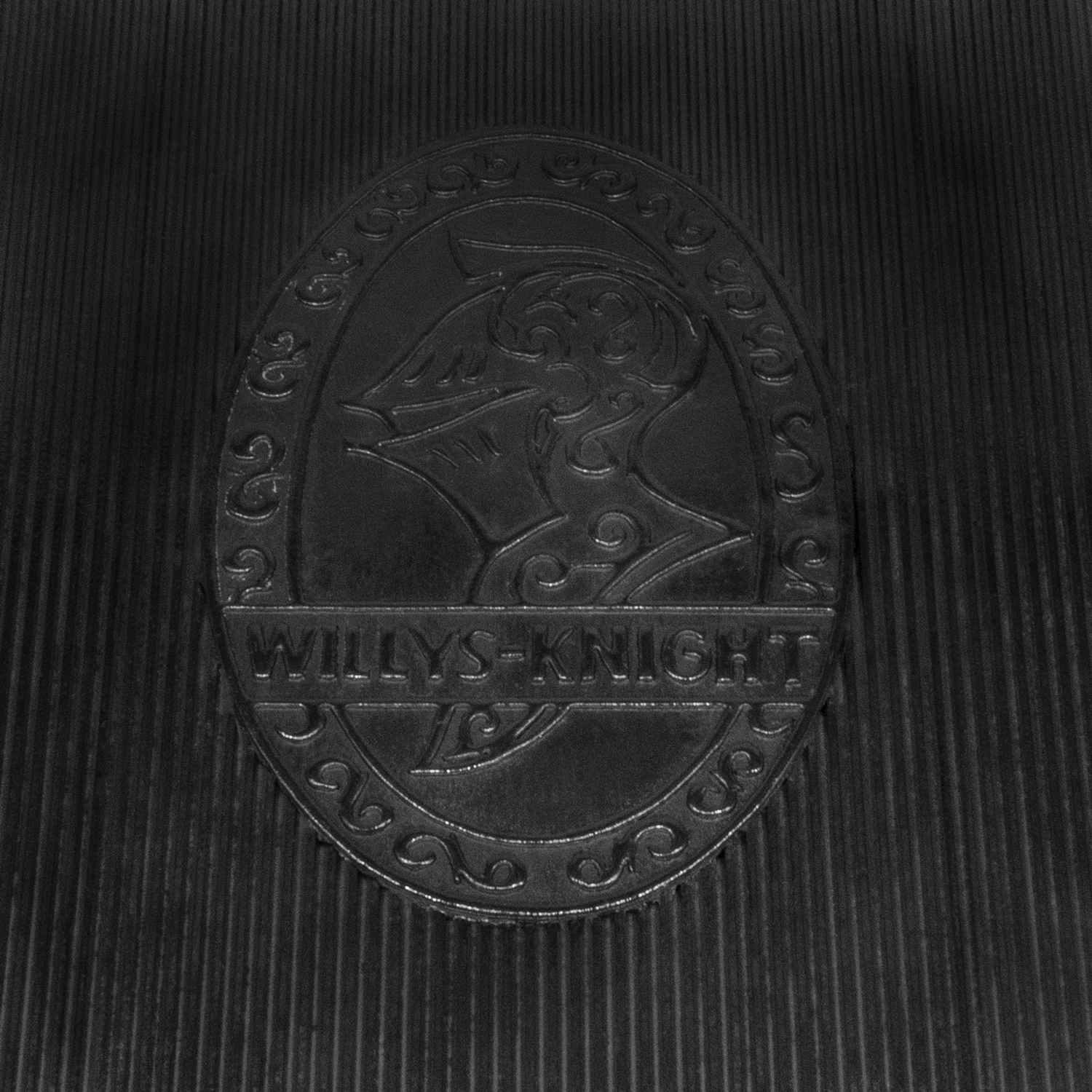 1922 Willys Knight Model 27 Accessory Floor Mat - 12"X17"-AC 51Accessory Floor Mat - made of high quality black rubber with molded original emblem. Also designed to be sewn into new carpets. 12"X17", Each
Why Choose Metro?
For over 100 years, Metro Moulded Parts has been the pinnacle of quality in classic car restoration parts. Our commitment to precision and authenticity in every component ensures a perfect fit and an OEM-level appearance.
- Expert Craftsmanship & Quality: Each part is a testament to our dedication to reliability and perfection, crafted from original designs and thoroughly tested.
- Advanced Technology: We use cutting-edge techniques to create flawless, long-lasting parts that surpass others in performance.
- SuperSoft Sponge – The Ultimate Door Seal: Not only are our door seals 30% softer than competitors', but they're also guaranteed to never leak. They effectively reduce wind and road noise, enhancing your classic car's comfort and driving experience.
- Proudly American: Our parts are a product of American craftsmanship, made in the USA with a spirit of excellence and heritage.
- Unrivaled Warranty: We back our products with a 30-year industry-leading warranty, a testament to our confidence in their quality.
Join us in preserving the legacy of classic cars with parts that are crafted for perfection, not just made.