

Image of 1924 Willys Knight Model 64, Note: These illustrations use artistic license and may differ from actual historical models.
Performance Metrics
Fundamental Metrics
Emotional Appeal
MMP Rating
| Engine Specifications | |
|---|---|
| Engine Options: | Inline 4-cylinder |
| Displacement Range: | 3.3L |
| Horsepower Range: | Estimated 50-60 HP |
| Torque: | Not available |
| Compression Ratio: | Not available |
| Ignition System: | Battery and coil |
| Cooling System: | Water-cooled |
| Performance Specifications | |
| 0-60 Time: | Not available |
| 1/4 Mile Time: | Not available |
| Top Speed: | 50-60 mph |
| Transmission and Drive | |
| Drive Type: | Rear-wheel drive |
| Transmission Type: | 3-speed manual |
| Fuel and Efficiency | |
| Fuel System Type: | Carburetor |
| MPG: | Not available |
| Dimensions and Brakes | |
| Brakes: | Mechanical drum brakes |
| Wheelbase: | 112 inches |
| Weight: | Estimated 2,800 lbs |
Note: Specifications for classic cars are given to the best of our ability, considering the limited and variant data available.
1924 Willys-Knight Model 64: A Quietly Different American Car
The 1924 Willys-Knight Model 64 offered motorists something unusual for its day: a four-cylinder engine designed to run without the familiar clatter of conventional poppet valves. Built by Willys-Overland in Toledo, Ohio, the Model 64 combined substantial early-1920s styling with the distinctive Knight sleeve-valve engine. It was not a mass-market Ford, nor a hand-built luxury car. Instead, it occupied a middle ground for buyers who wanted more refinement than a basic touring car could provide.
The car belongs to an important period in American motoring, when manufacturers were experimenting with quieter engines, more capable chassis, and increasingly varied body styles. One intriguing detail is that the Model 64’s defining feature was also its greatest engineering trade-off: its sleeve-valve engine could run smoothly and quietly, but it asked for more careful lubrication and maintenance than a conventional engine.
Model 64 Specs and Origins
Willys-Overland was one of America’s major automobile manufacturers, best known for its practical, relatively affordable cars. The Willys-Knight line gave the company a more upscale offering. Its engines used technology patented and developed by American engineer Charles Yale Knight. Rather than opening and closing poppet valves, sliding sleeves inside the cylinders controlled the flow of fuel-air mixture and exhaust.
The 1924 Model 64 is generally described as having a four-cylinder Knight engine of roughly 3.3 liters, or about 200 cubic inches, with power commonly quoted in the neighborhood of 60 horsepower. Exact specifications can vary among surviving references and by model-year configuration. It used a conventional front-engine, rear-wheel-drive layout and a manual transmission, typically with three forward speeds. The Model 64’s long-running production period and changing body offerings mean that individual cars may not match every published specification exactly.
Exterior Styling and Body Choices
The Model 64 had the upright, formal proportions associated with a substantial American car of the 1920s. Its tall radiator, long hood, separate fenders, running boards, and large spoked wheels gave it a confident road presence. Headlamps mounted beside the radiator and a broad windshield completed the unmistakable pre-streamlined look. The design was handsome rather than aerodynamic, with the engine compartment and passenger body clearly defined.
Willys-Knight buyers could choose among open and enclosed body styles, with touring cars, roadsters, coupes, and sedans appearing in the Model 64 range or in closely related catalog offerings. Availability could vary by year and production configuration. Open touring bodies were especially characteristic of the period: they offered room for several passengers and made the car well suited to warm-weather travel. Enclosed bodies brought greater comfort and weather protection, but typically cost more.
Paint choices depended on the body style, production year, and factory or dealer finishing. Dark, dignified shades such as black, deep blue, and maroon were common choices across cars of this class. Specific color combinations for an individual Model 64 should be verified against period documentation or surviving original paint, rather than assumed from a general catalog description.
Cabin Materials and Comfort
Inside, the Model 64 reflected the era’s emphasis on durable, straightforward craftsmanship. Open cars were commonly trimmed in leather, while closed-body versions could use cloth or mohair upholstery. Painted or wood-finished interior surfaces, a large steering wheel, a simple instrument panel, and exposed controls gave the cabin a functional character. The materials and trim varied with body style and equipment, so not every Model 64 had the same level of finish.
Comfort was generous by early-1920s standards, especially in a sedan, but it was not modern comfort. The seats were upright, the cabin had limited insulation, and passengers in an open touring car were exposed to wind, dust, and weather. Owners could add practical equipment such as a windshield, top, side curtains, or other body-specific fittings, depending on the car’s configuration.
Sleeve-Valve Engineering and Historical Impact
The Knight engine set the Willys-Knight apart from many contemporaries. Its sleeves moved up and down around the pistons, with ports in the sleeves lining up to admit the mixture and release exhaust. The arrangement eliminated the usual valve gear and its associated tapping sounds. A well-maintained engine could therefore feel unusually smooth and quiet for a four-cylinder car of the period.
This was a genuine alternative to the conventional poppet-valve engine, not merely a styling feature. Knight engines were used by several manufacturers around the world, and the Willys-Knight line helped make the technology familiar to American buyers. The system also had drawbacks. It depended on effective lubrication, could consume more oil than owners expected, and could be costly to rebuild if the sleeves and cylinders were worn. As conventional engines improved in refinement and durability, sleeve-valve designs lost their advantage.
The Model 64’s significance lies less in a lasting change to mainstream engine design than in its role as a well-known production car built around a different mechanical idea. It shows how competitive automakers were willing to experiment before modern engine layouts became dominant.
Performance, Speed, and Road Manners
There is no dependable, widely accepted factory 0-to-60-mph figure for the 1924 Model 64. Using its approximate power, weight, gearing, and period road performance as a guide, a sound example would likely take well over 20 seconds to reach 60 mph, and could take considerably longer depending on body style, mechanical condition, passengers, and road surface. A realistic estimated top speed is roughly 50 to 60 mph, with sustained cruising generally more comfortable below that range.
Those figures are estimates, not guaranteed test results. A century-old car’s performance depends heavily on engine condition, sleeve wear, ignition setup, carburetion, gearing, tire choice, and how carefully it has been restored. Modern traffic also changes the experience: the Model 64 was designed for roads and speeds very different from today’s highways.
On the road, the car’s solid axles and leaf springs provide the straightforward ride typical of its era. It can absorb ordinary bumps, but sharp impacts and rough roads are communicated through the chassis. Steering is slower and heavier than in a modern car, and narrow period-style tires offer less grip and precision than contemporary tires. On a winding road, the Model 64 rewards a measured pace and anticipation rather than quick inputs.
The engine’s character is a major part of the appeal. Instead of the familiar tick and clatter of a valve train, a healthy Knight engine is notably quiet and smooth for its age. The driver works a manual gearbox, manages the tall steering wheel, and plans braking well ahead. It is a hands-on, mechanical driving experience, not a vintage car that disappears beneath the driver.
Ownership, Maintenance, and Reliability
In its own time, the Model 64 could serve as personal transportation, a family touring car, or a comfortable way to travel between towns. Today, most examples are used for club events, local touring, historic displays, and collection. Regular modern commuting is possible only for a particularly well-sorted car and an owner comfortable with its slower pace and period safety equipment.
Routine upkeep is familiar in broad terms: check fluids, ignition, fuel delivery, cooling, tires, brakes, and chassis lubrication. The sleeve-valve engine, however, makes specialist knowledge valuable. Owners need to understand its lubrication requirements and monitor oil use. Wear in the sleeves or related components can turn a simple repair into a complex and expensive engine job. Parts availability is more limited than for popular Ford models, so joining a Willys-Knight or early-car club can be a practical advantage.
For an average owner, many basic tasks are approachable, but a major engine overhaul is not a casual weekend project. Reliability depends less on the car’s age alone than on the quality of its restoration and the care it has received since. A pre-purchase inspection by someone familiar with sleeve-valve engines is especially worthwhile.
Willys-Knight Facts and Common Criticisms
The sleeve-valve engine is the Model 64’s standout trivia point: it was engineered to avoid the mechanical valve noise many drivers accepted as normal. That quietness helped define the Willys-Knight identity. The trade-off was oil consumption and maintenance complexity, which are still among the most common criticisms owners encounter.
No widely recognized speed, endurance, or sales record is specifically associated with the 1924 Model 64, and there is no famous celebrity ownership that defines the model’s story. Its historical interest is more mechanical than headline-driven. It represents a real, commercially produced alternative in an era when engine design was still evolving.
Other criticisms are typical of cars from the period: modest acceleration by modern standards, limited braking performance, weather exposure in open models, and less predictable handling than a contemporary vehicle. Those are not defects unique to the Model 64, but they matter when planning to drive one today.
Collector Values and Rarity
Model-specific production totals are not consistently documented, so a precise production figure should be treated cautiously. A reasonable broad estimate is that several thousand Model 64 cars may have been built across the model’s production run, rather than just a few hundred. That is an informed estimate, not a confirmed factory total. Surviving cars are much rarer, especially complete, running examples with sound sleeve-valve engines and well-preserved bodies.
As a broad 2026 collector-market estimate, a project or incomplete car might fall around $8,000 to $20,000. A usable, presentable example could bring roughly $20,000 to $40,000, while a high-quality restoration may reach $40,000 to $70,000 or more. Body style, originality, provenance, restoration quality, and the condition of the engine can move the price substantially. These are guide ranges, not formal appraisals, and the market for a specialized prewar car can be thin.
Values tend to be selective rather than uniformly rising. Exceptional, correctly restored cars can attract committed collectors, but ordinary examples may be difficult to sell quickly, and restoration costs can exceed the car’s eventual market value. For buyers, condition and documentation usually matter more than a promise of future appreciation.
Why the 1924 Model 64 Still Matters
The 1924 Willys-Knight Model 64 brought together formal American styling, practical touring-car proportions, and an unusual engine designed for quiet operation. Its sleeve-valve technology made it stand out, even as the system’s appetite for careful maintenance limited its long-term appeal. Today, it is best understood as a distinctive piece of automotive experimentation rather than a fast or effortless classic.
For collectors and enthusiasts, the Model 64 offers a rare chance to experience an alternative path in engine history. Its quiet mechanical character, imposing period presence, and demanding engineering make it memorable: a car that did not simply follow the rules of its era, but tried to rewrite them.
1924 Willys Knight Model 64 Catalog of Parts
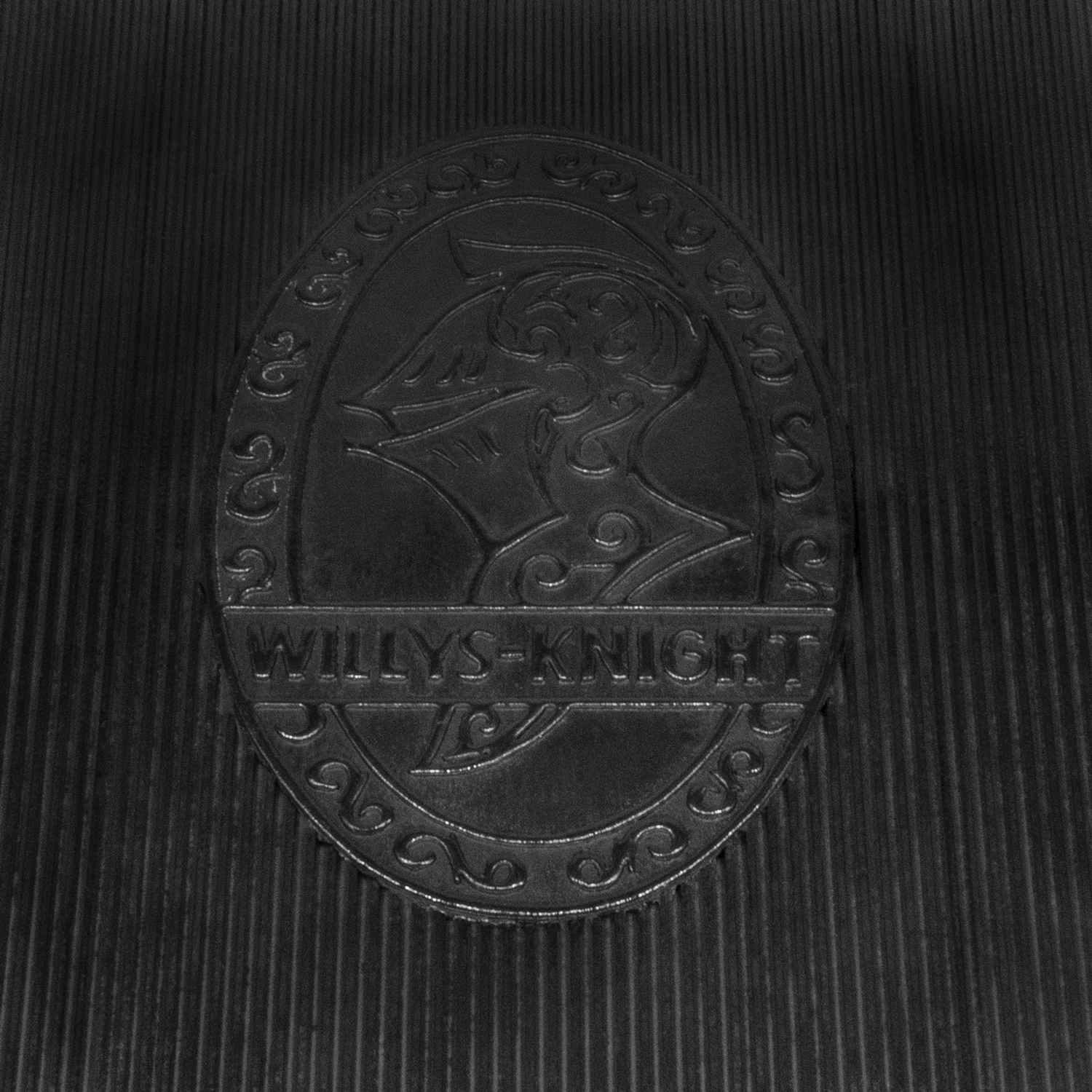 1924 Willys Knight Model 64 Accessory Floor Mat - 12"X17"-AC 51Accessory Floor Mat - made of high quality black rubber with molded original emblem. Also designed to be sewn into new carpets. 12"X17", Each
Why Choose Metro?
For over 100 years, Metro Moulded Parts has been the pinnacle of quality in classic car restoration parts. Our commitment to precision and authenticity in every component ensures a perfect fit and an OEM-level appearance.
- Expert Craftsmanship & Quality: Each part is a testament to our dedication to reliability and perfection, crafted from original designs and thoroughly tested.
- Advanced Technology: We use cutting-edge techniques to create flawless, long-lasting parts that surpass others in performance.
- SuperSoft Sponge – The Ultimate Door Seal: Not only are our door seals 30% softer than competitors', but they're also guaranteed to never leak. They effectively reduce wind and road noise, enhancing your classic car's comfort and driving experience.
- Proudly American: Our parts are a product of American craftsmanship, made in the USA with a spirit of excellence and heritage.
- Unrivaled Warranty: We back our products with a 30-year industry-leading warranty, a testament to our confidence in their quality.
Join us in preserving the legacy of classic cars with parts that are crafted for perfection, not just made.